Spot on @SophieAnde49073 and it has a trickle down effect. My son's and thier spouse also voted with an education in betrayal and they only voted differently in one race. The youth will be wise to the crooked behavior of our local government far sooner than we were.
Last night’s Utah House results weren’t a fluke or pure national headwinds.
They were the predictable outcome of years of “Republican” leadership treating Utahns like they need managing instead of representing.
Preliminary counts show a long list of GOP incumbents trailing or losing to Democrats and independents (Thompson, Auxier, Kyle, Sawyer, Ballard, MacPherson, Loubet, Dunnigan, Ivory, Eliason, Okerlund, Teuscher, Hunsaker, Thurston, and others).
The House supermajority that has defined Utah politics for decades is in real danger. That is not what happens in a deep-red state when the base is fired up and the party is delivering.
What actually happened
The Utah Republican supermajority, party leadership, and federal delegation spent far more energy telling voters everything was fine, or that any criticism was disloyal, than they spent drawing hard lines against the establishment status quo.
When the base wanted fight on spending, immigration, education, energy, and basic institutional accountability, they got process, messaging, and reassurances. Voters noticed.
The 2024 gubernatorial primary didn’t help. Phil Lyman won the convention and the activist base.
The audits, lawsuits, and claims of irregularities that leadership largely waved away or treated as a nuisance rather than a legitimacy problem for a large chunk of the party, did not help.
Whether you call the outcome fully “stolen” or simply a process the base rejected, the practical effect was the same: a demoralized and skeptical Republican electorate that showed up less enthusiastically for the rest of the ticket. Condensed or excused by those in power, that energy didn’t return on its own in 2026.
The result
When leadership prioritizes narrative control over confrontation with the institutions and interests that frustrate voters, the base stops showing up in the numbers needed to protect even safe seats. National Democrats running a strong midterm wave simply accelerated what was already in motion. McAdams’s easy win in the new 1st District and competitive showings elsewhere are downstream of the same dynamic.
This is fixable, but not by the same people doing the same things and expecting different turnout. Accountability starts with admitting the supermajority treated its own voters as the problem to be managed instead of the constituency to be served. The losses are the receipt.
Statement on Utah’s Amendment B:
There are those who accuse me of fracturing the Republican Party because I question positions promoted by Republican leadership.
There are others who attempt to align me with Planned Parenthood simply because we oppose the same constitutional amendment. Still others resort to labels such as "communist."
I reject these accusations and labels. Political disagreement is not disloyalty, and asking questions about our Constitution should not be grounds for personal attacks.
I have served as a San Juan County commissioner and as a member of the Utah House of Representatives. I am also a certified public accountant. My professional and public service experience has taught me the importance of examining legislation carefully, understanding its financial consequences, and holding government accountable.
That is precisely what I am doing with Amendment B.
Amendment B originated with Senate Joint Resolution 2, sponsored by Senator Lincoln Fillmore and Representative Jason Kyle during the 2025 legislative session.
The proposal would amend Article VI, Section 1 of the Utah Constitution, which expressly vests legislative power in both the Legislature and the people.
Under the proposed amendment, certain citizen initiatives involving tax increases would require approval from at least 60% of voters. The Legislature, however, would generally retain its existing ability to enact comparable tax legislation by a simple majority.
That is the constitutional distinction I believe deserves serious public discussion.
Supporters argue that the higher threshold would protect taxpayers from increases lacking broad public support. I understand that argument. But I believe Utahns should also examine why citizens exercising their constitutional initiative power would face a higher threshold than their elected representatives.
If the Legislature's objective is to give Utah citizens a greater voice in taxation, why not consider a constitutional amendment requiring voter approval before counties, cities, towns, or the state impose a tax increase?
Why should citizens be required to obtain 60% approval to increase certain taxes through the initiative process while their elected representatives can generally increase taxes without a direct vote of the people?
Shouldn't the same principle of taxpayer consent apply at every level of government?
I remember the Legislature's 2019 tax reform and the extraordinary public opposition that followed. That legislation was ultimately repealed following a referendum effort. Although the referendum process is different from the initiative process affected by Amendment B, the episode demonstrates the importance of citizens retaining meaningful constitutional checks on government.
My position does not depend on whether Planned Parenthood, another organization, or another political figure agrees or disagrees with me.
I encourage robust discussion, careful analysis, and respectful disagreement.
Senator Daniel McCay has publicly challenged me to debate the meaning of Amendment B. I welcome the opportunity to discuss the actual constitutional language, the Legislature's authority, and the rights reserved to Utah citizens.
Utahns should be able to disagree about legislation without questioning one another's loyalty, intelligence, or conservative principles.
I encourage every Utah voter to read Amendment B and evaluate its consequences independently.
🚨 BREAKING: President Trump just put a bounty on fraud, and every American can cash in.
He announced the Fraud Whistleblower Incentive Program today. You report fraud at https://t.co/XVTU1E4nTj, and if it's real, you get paid. Trump's words: "If you find a billion dollars, we are giving a commission to that person of 1%."
Find 10 billion, and that's 100 million in your pocket.
California's answer was reportedly a law to shut down Nick Shirley. Trump's answer is to deputize the whole country.
The fraudsters spent years robbing us blind. Now 330 million Americans are watching, and every one of them has a reason to turn them in.
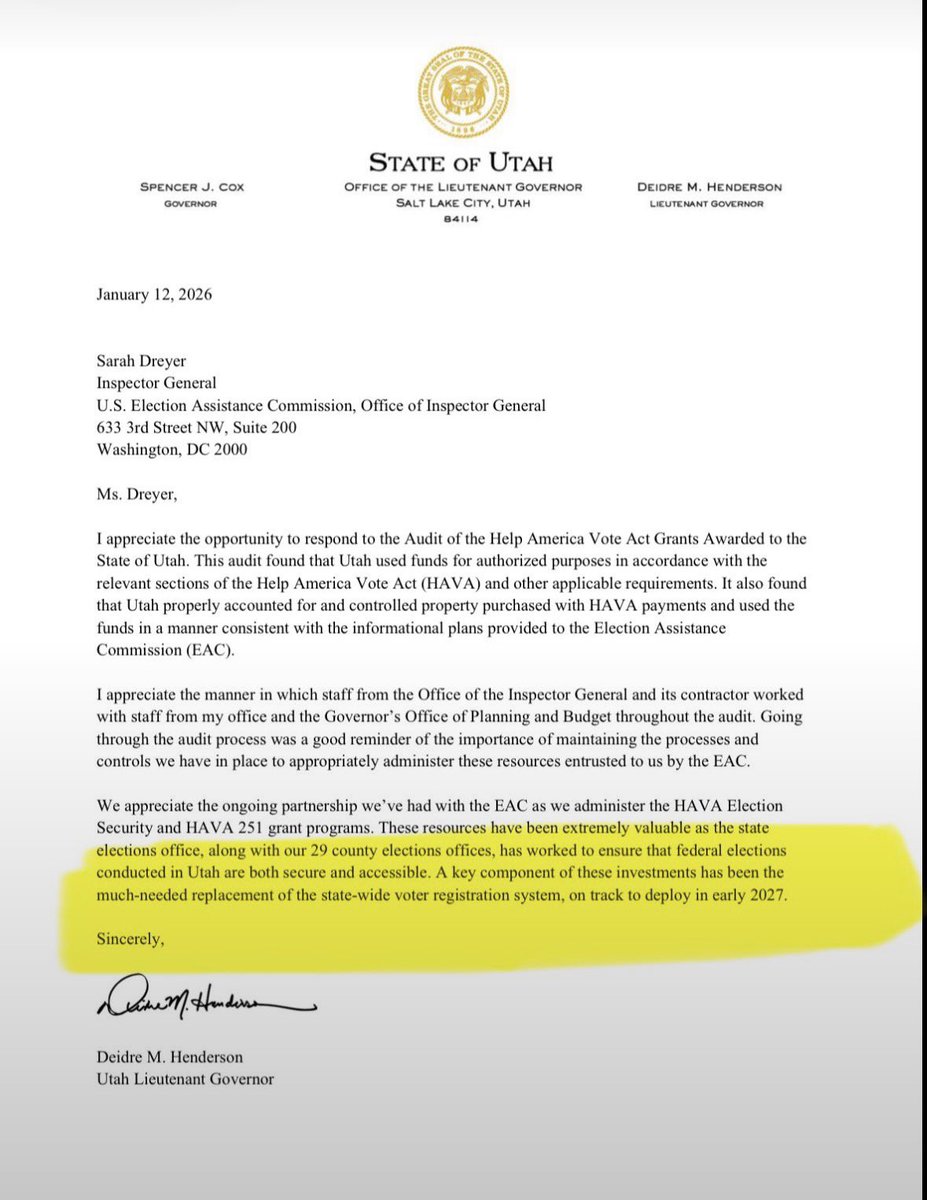
Further Centralization of Utah’s Elections and the Officials Who “Oversee” Them
Lt. Gov. Deidre Henderson confirmed in her official response to the HAVA audit that Utah is retiring its statewide VISTA voter registration system and deploying a new one (Total Vote) in early 2027, which she calls a “much-needed replacement.”
The timing is striking, the old system will be eliminated just as scrutiny of the rolls intensifies.
Once VISTA is gone, historical records, anomalies, and any evidence of unverified or problematic entries disappear with it; creating a clean slate under the new system and ending easy access to the data researchers have been examining.
The vendor for the new database is KNOWiNK (KnowInk), the same company that supplies Utah’s electronic pollbooks (Poll Pad).
This means one company and system will have even more centralized control over key parts of Utah’s elections
In 2021 I paid $10,000 to the Utah State Board of Education for a GRAMA request on records that should have been free for the public.
They openly demanded a $10k deposit (or $4k if I dropped one search) for “legal review” of emails showing exactly how COVID relief funds were used to push DEI and LGBTQ agenda into Utah schools.
Sunlight is the best disinfectant. Mothers and taxpayers shouldn’t have to pay extortion prices to see what their own government did with public money. These officials already collect a salary. Public records aren’t a privilege.
Elon Musk just created a FLYING CAR.
Tesla stunned the entire world with the launch event of the Tesla Roadster.
The car just defied gravity hanging upside down, doing mid air barrel rolls over an entire fleet of Teslas and actually flying. The Roadster also went 0-60 MPH in .81 seconds in a live demo.
Only Elon could pull this off.
The future is here.
That time in 2021 that I paid $10,000 for a GRAMA request because I knew Spencer Cox and state education officials were using COVID relief funds to implement a DEI and LGBTQ agenda in Utah schools.
As an angry and concerned mom watching the mandates and the sudden flood of federal money, I suspected the pandemic was being treated as cover for preferred-pronoun policies, anti-racism training, equity offices, and identity-focused curriculum that parents never voted for. Once the records arrived, the steep price made sense; they showed exactly how the recovery dollars and the post-Floyd moment were leveraged to lock those practices in.
ESSER stands for the Elementary and Secondary School Emergency Relief fund. These were the main federal COVID relief packages for K-12 schools: the first round under the 2020 CARES Act, a second under the CRRSA Act, and the largest under the 2021 American Rescue Plan (ARP ESSER). The money was intended to address learning loss, improve school ventilation and technology, support student mental health, and cover other pandemic-related costs.
Utah received more than $873 million in total ESSER funding across the three rounds; roughly $62 million in ESSER I, $250 million in ESSER II, and $562 million in ARP ESSER with the bulk distributed to local districts and charters based on Title I formulas.
The records I obtained showed that while the funds were labeled for COVID recovery, state and local officials used portions of them to build equity infrastructure, stand up culturally responsive training, and advance related DEI initiatives, exactly the shift I had suspected when I filed the request.
The pages detailed how the Utah State Board of Education planned to distribute ARP ESSER funds, 90 percent based on Title I allocations, with required Maintenance of Equity assurances while embedding equity structures throughout the recovery.
An internal Culturally Responsive and Equitable Workplace Steering Committee was created. Quarterly Equity Leader Meetings, Equity Labs, and ongoing technical assistance to districts were listed as standing mechanisms. Committee notes recorded Chair Benally-Sagg stating that the governor supported the racial-equity and inclusivity training and wanted members to know the governor’s office backed it.
The same records captured return-to-school discussions that treated the pandemic, economic fallout, and post-George Floyd racial unrest as simultaneous crises, with officials describing the need for leaders to examine their own implicit bias before schools could become “anti-racist” or “culturally responsive.”
“Best practices” materials treated preferred names, pronouns, gender-inclusive forms, bathrooms, locker rooms, flags, and stickers as standard markers of support.
Taken together, the documents show COVID recovery funds being used to institutionalize these practices inside Utah’s education system, with explicit state-level support noted from the governor’s office.
Hiring Tony Robbins today costs 1 million dollars for just one day.
This is a 21-minute tape recorded in his own home more than 30 years ago.
There, he explains exactly how to get anyone to say yes.
The same material for which they now charge a fortune... completely free.
It's a rare, unfiltered recording from the time when he still didn't charge millionaires just for being in the same room.
When someone says no, they give two excuses:
“I don’t have time” or “I don’t have money”
Neither is true.
The real reason is that they still don’t believe it’s worth it.
It’s not a money problem. It’s a state problem.
Tony teaches something he calls “attack and confess”
Instead of arguing the objection, you confess your own:
“I had the chance to go six months ago and I didn’t until two months ago.
I can’t even imagine the time I wasted”
The room goes silent. No one argues.
Then he gets the person on the “yes train”
Each little yes adds to the next.
Until saying no at the end feels harder than saying yes.
When it’s time to sign, the person has already said yes five times without realizing it.
Just 21 minutes.
There you learn the two only moves that people pay 1 million a day for:
how to read anyone’s state… and how to shift it.
Most people spend years guessing in sales.
He wrote it on a flipchart in his living room in less than half an hour.
A seat in that room cost $125 dollars.
Today it costs $1 million dollars a day to sit in front of him.
The tape is free right now.
And the answer is in this video.
JUST IN: The Lone Lindsay Clancy Juror Michael Desronvil Just Broke His Silence Tonight in a Defiant Statement praising God and Defending the Children Murdered by Lindsay Clancy.
“I know the whole focus has been on me, but we want to reel everything back and put the focus on the three angels that's at hand. The ones that can't speak for themselves, the ones that can't defend themselves, and the one that can't fight the battles.”
“And those are Cora, Dawson, and Callan.”
“I want to thank God for my Catholic faith. I want to thank God for blessing me with the ability to love my daughter.”
“I would like to thank everyone, every individual that has supported me throughout this difficult situation. Your prayers, your emotional support, your psychological support is tremendous to my heart that I feel, that I sense, that I know. I do want to thank you from the bottom of my heart. Thank you.”
Pray for Michael 🙏🏻
My Grok Bot Copliot is my chief of staff. It runs 4 other bots (research, bookkeeping, business, writing). Together we've built a 3-tap receipt cataloging app, cleaned up 2 email boxes I considered lost to spam, planned a mobile IV business, and started a western screenplay. Try it 🚀 https://t.co/7uv8Q24hFK
We’re inviting one Grok Bot user to a Starship launch. You could win the invite by sharing the ways you've integrated @Bot into your work. The invite includes a plus one.
How to submit and some examples we love: