"The biggest thrill ballplayer can have is when your son takes after you.
When my Bobby was in a Championship Little League game, he really showed me something.
Struck out 3 times, and made an error that lost the game.
Parents were throwing things at our car, swearing at us as we drove off.
Gosh, I was proud!"
Bob Uecker.
"Ryne Duren was the standard by how we ranked hard throwers.
We’d say [so-and-so] can throw almost as hard as Duren."
Jim Kaat.
"I know I was faster 10 years ago.
I think Jim Maloney, Bob Veale, Bob Gibson and perhaps one or two others throw faster.
In my best days I don't think I threw faster than Ryne Duren.
He was the fastest I ever saw."
Sandy Koufax.
"Ryne Duren could throw the heck out of the ball.
He threw fear in some hitters.
I remember he had several pair of glasses, but it didn’t seem like he saw good in any of them."
Yogi Berra.
Ryan Duren was the inspiration for Charlie Sheen’s "Wild Thing" character in the movie "Major League".
"I never really knew what it was like to pitch a sober inning."
Ryne Duren
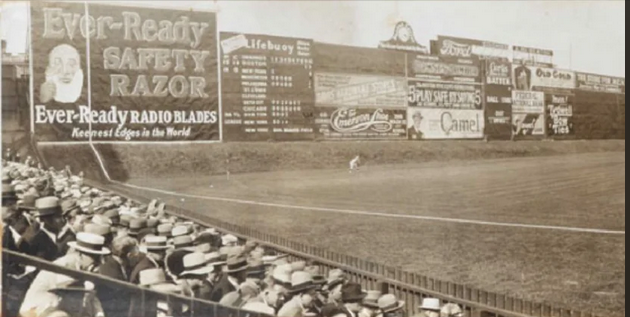
In 1912, the Boston Red Sox moved into Fenway, which featured a 10-foot high mound that formed an incline in front of the 25-foot left field wall, now better known as the Green Monster.
Duffy Lewis practised catching the ball on the way up the incline and throwing the ball while descending.
He mastered fielding on the incline to such an extent that it became known as:
"Duffy's Cliff."
Sports cartoons of the period often depicted him as a mountain climber making catches amid sheep and snowcaps.
At the time of his death, Duffy Lewis had no known living relatives and no money, and was buried in an unmarked grave in Holy Cross Cemetery in Londonderry, just outside of Salem.
In 2001 a collection was taken up to pay for a headstone, engraving, and upkeep on the plot.
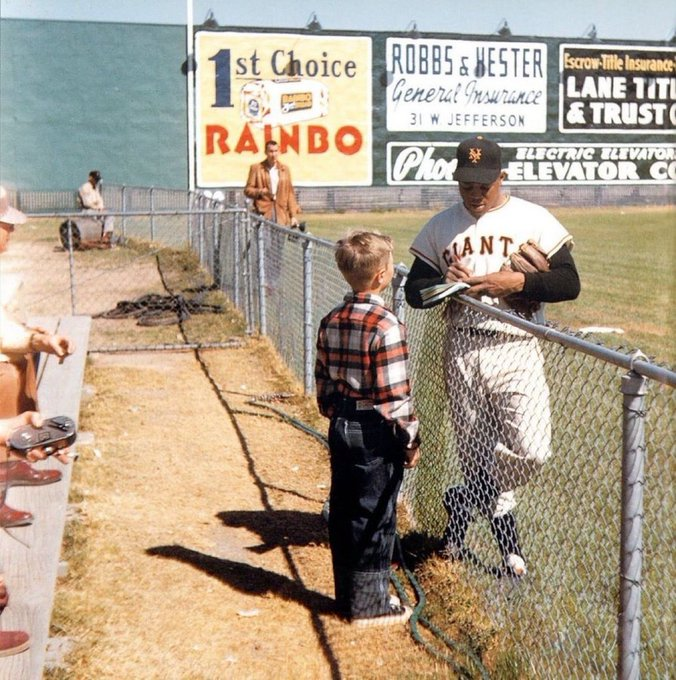
"I went out early to see Willie Mays in batting practice, and Willie hit about five balls into the upper deck.
Then he went out in the outfield and Mays could just run like the wind.
Turned out Willie Mays was best player I ever saw."
Robin Roberts on rookie Willie Mays.
"Willie Mays was to me, the greatest player I ever watched.
People ask me that and I don't hesitate, he could have been an All-Star shortstop, that's how good an athlete he was.
Mays could run backwards as fast as he could forward."
Don Zimmer.
"The wind blew right in your face.
Candlestick Park to this day, was the single most difficult park to play baseball I ever saw anywhere, at any level.
Which is why, Willie Mays was the greatest ballplayer I ever encountered."
Felipe Alou.
"People talk about that catch, and I've said this many times, that I've made better catches than that many times in regular season.
But of course in my time, you didn't have a lot of television during the regular season.
A lot of people didn't see me do a lot of things."
Willie Mays.
Ted Williams, one of the greatest natural hitters of all time, was retired and giving some tips to the rookies at the Red Sox spring training camp.
One of them asked how to tell apart a curveball from a slider when they were coming in.
Ted Williams replied:
"Oh!
That's easy.
If it's a curveball, the red spot you see on the ball will be rotating clockwise:
If it's a changeup, counterclockwise."
The rookies all nodded and thanked him for the tip.
One of the rookies turned to the others and said whispered:
"Now who the f*** can even see a red spot on a ball coming at you at 95 mph?"
Then Ted Williams went on to claim that he could tell exactly where on the seams he hit a baseball.
No one believed him.
Ted was long retired at this point.
Williams took a bat and covered the barrel with pine tar and they started throwing him some pitches.
Ted would hit and say:
"Across the seams."
"Between the seams."
Or
"Across one seam."
They retrieved the balls and found out Williams was right, EVERY single time.
"Nobody has won thirty games in a season since Denny McLain did in 1968.
No other pitcher has drunk as many Pepsi-Colas, broken as many team rules, or played the organ as famously as McLain did.
And there has never been another World Series game in which both starting pitchers had won the Cy Young AND the MVP awards that year."
Bob Gibson.
Denny McLain fielding a Bob Gibson grounder.
Game 1, 1968 World Series.
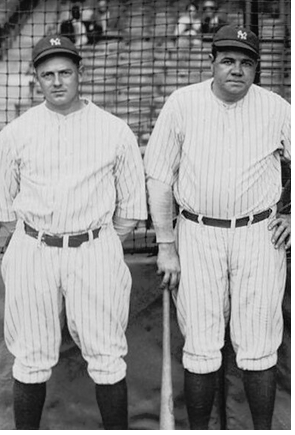
"Dining in while travelling, Babe Ruth would ask for “steak a la Gehrig.”
The incredulous serving staff would make sure they heard him right.
'We never have had a similar order, Mr. Ruth.
Can you tell me how you want this steak?' At which point, Ruth would deliver the punch line:
“Good and thick, that’s how I want it.
That’s steak a la Gehrig.”
"I'd rather see Ruth than Gehrig in a tight place.
Sometimes you can figure what the Babe is going to do, but you can never tell about Gehrig.
Lou Gehrig is likely to hit any kind of ball to any field."
St. Louis Mgr. Dan Howley.
"It seems to be slightly better than an even bet that Lou Gehrig will beat Babe Ruth in the great Home Run Derby of 1927.
While it does not appear likely that Lou will excel the Babe's record of 59 homers, even that is not without the plane of probability."
Dan Daniel, "World-Telegram".
"There was just as much noise when Babe Ruth struck out in the fifth inning as when Lou Gehrig hit his home run with the bases full in the ninth.
They don’t pay to see Gehrig hit ’em."
Rud Rennie, "New York Herald Tribune."
"Whatever I contributed to the unique morale of the Cardinals was part of this growth, and so, of course, was my decision to have it out in public with the owners of organized baseball."
Curt Flood
While Curt Flood might have been, in Flood’s own words, a “well-paid slave,” he was still a slave.
"It is this Court that has made baseball players impotent, and this Court should correct its error.
Antitrust laws in general, and the Sherman Act in particular, are the Magna Carta of free enterprise.
They are as important to the preservation of economic freedom and our free-enterprise system as the Bill of Rights is to the protection of our fundamental personal freedoms.
Anti-Trust laws are as important to baseball players as they are to football players, lawyers, doctors, or members of any other class of workers.
We must not forget, however, that there are only some 600 major league baseball players.
Whatever muscle they might have been able to muster by combining forces with other athletes has been greatly impaired by the manner in which the Court has isolated them."
Justice Thurgood Marshall.
Flood v Kuhn.
"The unbroken silence of Congress should not prevent us from correcting our own mistakes."
Justice William Brennan.
Flood sued MLB, but in 'Flood v. Kuhn' in 1972, the Supreme Court again reaffirmed both Federal Baseball and Toolson.
The Court acknowledged the ways baseball operated in interstate commerce, but claimed only Congress could rescind MLB’s antitrust exemption.
While Flood lost, his self-sacrificing initiative inspired other ballplayers, and led by player’s union president Marvin Miller, the reserve clause — which Flood sacrificed his career to challenge — was finally broken via contract law by the Seitz arbitration decision in 1975, and free agency finally emerged in baseball and then all other professional sports.
"Curt Flood wore No. 21.
Half of 42.
Jackie Robinson was Curt's hero from childhood.
Curt wore 42 in the minor leagues.
But 42 wasn't available when he got to the Cardinals.
So he took 21.
The moment that Jackie and Rachel walked into the courtroom for Curt Flood's trial, well, that was one of the high points of Curt's life.
To have Jackie Robinson tell him:
"Young man, I respect you.
What you're doing is right.
You have the courage to stand up.
I am here for you."
That brought Curt almost to tears."
Judy Pace, wife of Curt Flood
In my HOF!!!!
With some time off before his first season as CBS’s golden boy, Jackie Gleason camped out at Toots Shor’s with Frank Sinatra and his celebrity pals.
One evening Frank showed up during Jackie’s morning eye-opener with four tickets to the sold-out final playoff game between the New York Giants and the Brooklyn Dodgers.
J. Edgar Hoover, the head of the FBI, was having a tête-à-tête with Toots and Frank, and invited the trio to accompany him to the game.
Everyone agreed except Jackie, who wanted to stay at the bar and drink. They finally talked Jackie into it by renting a fully stocked limo.
Sinatra recalls:
'We pile into that limousine, already feeling no pain, especially Gleason. Jackie guzzled booze all the way to the Polo Grounds and ate most of the food.
When we get there, Jackie switches to hot dogs and beer. Comes the last half of the ninth and the fans are going wild. The Giants are behind 4-2 and Bobby Thompson comes to bat.
Right at the exact moment, with the crowd screaming, Gleason throws up right on me.
Here is one of the all-time classic games that people will talk about and I am right in the stadium and I don’t see Bobby Thompson hit that home run.
Only Gleason, a Brooklyn fan, would get sick at a time like that.
But that’s not the punch line.
On the drive back to Toots' saloon, Gleason keeps muttering to the chauffeur to pull over to the side of the road saying, “Let’s throw this bum Sinatra out of here.
He’s smelling up the limo.'
Some nights Jackie would show up at Toots' with a baseball bat and glove, get loaded, then go hit fly balls to Joe DiMaggio in Central Park in the middle of the night.
Jackie also liked to stage fake fistfights with rookie sensation Mickey Mantle, just to mess with Toots’ head."
"The Great Drunk: Lushing Large with Jackie Gleason"
Frank Kelly Rich.
'The Great One'.
"Babe Ruth was not a drunk, by no chance.
He drank and I guess at times he was drunk, but he was never, never was he, did he miss a game because of that or have a bad day because of it.
Never. Never. Never.
Any of these lame-brains that write and talk on the air about fat, drunk Babe Ruth, that’s silly and ridiculous. Don’t tell me about Ruth; I’ve seen what he did to people.
I’ve seen them, fans, driving miles in open wagons through the prairies of Oklahoma to see him in exhibition games as we headed north in the spring.
I’ve seen them: kids, men, women, worshippers all, hoping to get his name on a torn, dirty piece of paper, or hoping for a grunt of recognition when they said, ‘Hi ya, Babe.’
He never let them down; not once".
Roommate "Schoolboy" Waite Hoyt
The craziest Davey Johnson fact I learned this weekend:
• When Hank Aaron hit #715 to pass Babe Ruth, Dusty Baker was on deck and Davey Johnson was in the hole.
• When Sadaharu Oh hit #715 to pass Babe Ruth, Toshiro Yanagida was on deck and Davey Johnson was in the hole.


![Jimfrombaseball's tweet photo. "Ryne Duren was the standard by how we ranked hard throwers.
We’d say [so-and-so] can throw almost as hard as Duren."
Jim Kaat.
"I know I was faster 10 years ago.
I think Jim Maloney, Bob Veale, Bob Gibson and perhaps one or two others throw faster.
In my best days I don't think I threw faster than Ryne Duren.
He was the fastest I ever saw."
Sandy Koufax.
"Ryne Duren could throw the heck out of the ball.
He threw fear in some hitters.
I remember he had several pair of glasses, but it didn’t seem like he saw good in any of them."
Yogi Berra.
Ryan Duren was the inspiration for Charlie Sheen’s "Wild Thing" character in the movie "Major League".
"I never really knew what it was like to pitch a sober inning."
Ryne Duren](https://pbs.twimg.com/media/HO0c6biXIAATugr.png)