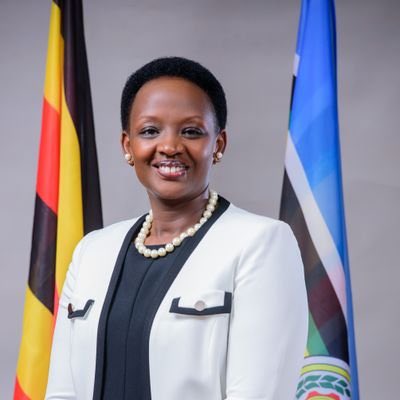
The PS for health showed dissatisfaction, saying that as a country, we feel we are victims of transparency because the more they communicate about Ebola, the more they are blocked from traveling.
This was already shared by @wekesa_amos and recently by @JKKAZOORA1. I think sometimes we just need to know when and how to keep information private that might hurt us with time.
It's so unfair for the tourism sector and our citizens who had plans to travel out of the country! We’ve learnt the hard way!
In 2024, President Museveni assented to nine key Rationalisation Bills that formally merged and streamlined several government agencies. The stated aim was to reduce public expenditure, eliminate duplication, and improve efficiency in service delivery.
However, more recently, the same government has approved proposals to increase the number of ministers both Cabinet and State Ministers on the basis of improving efficiency and strengthening oversight of government programmes.
Uganda remains unchanged in its geographical size of approximately 93,263 square miles (241,038 square kilometres), yet there appears to be a recurring cycle of restructuring government institutions under different justifications.
When compared globally, Uganda has a relatively high number of MPs despite having a much smaller population than countries such as Nigeria, Bangladesh, Pakistan, and Indonesia, many of which operate with fewer legislators relative to their population size.
Kati, if the goal is efficiency and reduced public expenditure, why are government structures repeatedly expanded after recent efforts to streamline them?
So why would I be requested to put on a mask for Ebola control? I thought Ebola is transmitted through fluids, not an airborne disease?!
@MinofHealthUG
Dr. Muganga was born in Seeta, Mukono District, Uganda. He enrolled at Makerere University in 1998 and graduated in 2002.
Following his studies, he relocated to Rwanda, where he acquired Rwandan citizenship. In 2009, he moved to Canada to pursue further education as a Rwandan citizen.
While residing in Canada, his Rwandan passport and national identity card expired in 2014. He chose not to renew these documents and instead returned them to the Rwandan authorities.
In 2019, he returned to Uganda as a Canadian citizen, having allowed his Rwandan passport to expire without seeking its renewal. Since then, he has permanently settled in Uganda, his country of birth.
This raises an important question: Does the surrender of his Rwandan passport and national identity card amount to a formal renunciation of Rwandan citizenship? If so, was that renunciation officially accepted and approved by the relevant Rwandan authorities?
If the renunciation was formally approved, then it could be argued that he no longer holds Rwandan citizenship. In that case, if required by law for eligibility to a ministerial position, he could similarly undertake the legal process of renouncing his Canadian citizenship and retain only Ugandan citizenship.
It's hard for me to explain to those outside #Uganda just how irritated the Ugandans are to be lumped in with DRC for the #Ebola epidemic. As of this writing, there have been hundreds of deaths and over 1000 cases in Congo, whereas Uganda has had only 9 cases -- three Congolese, four medical workers who treated them, one driver who drove them, and one other known contact. Only one person has died in Uganda, a Congolese.
So when WHO and Al Jazeera talks about the Ebola epidemic in "Congo and Uganda," it's like saying because there are wildfires in California, you should cancel a trip to the Grand Canyon because some Californians lit a campfire there. Yes, it is possible it *could* spread and you have to be vigilant, but these two situations are nowhere near the same magnitude.
As of this writing, the only Ugandan death has been the tourism industry.
@WeBantu99863@omujamaica @sk_bongomin93 I may not agree with you coz all their descendants never even at any point eat fish (I mean all of them) search and see so they have never been within the fisher men communities