Eventually, much of AI will converge towards intuition-guided symbolic world modeling, i.e. deep learning-guided program synthesis. It is inevitable. Symbolic modeling lets a system construct a compact, reusable, highly generalizable mental model of a problem space using minimal data.
New research from Carey faculty @TinglongDai and @TheHaiyang finds that waiving copays increases patients’ preference for medical AI, but they still seek reconfirmation from a doctor.
https://t.co/fwj8VuDiHE
The cardiac unit of the Düsseldorf University Hospital, where people recover from heart surgery, is currently measuring 38°C/ 100.4°F. As you can see, the building is only about 15 years old. And built without central air-conditioning.
Trust, reimbursement & AI
Or: the three stages of trust
What can physicians and other healthcare providers learn from AI creators — and what can AI creators learn from the provider experience?
There is a lot of debate about AI in healthcare and how it relates to physicians and other providers. Too much of it is physicians telling AI creators how it should be, and too little is about listening to how it can be.
It is interesting to look at this from a financial perspective. In this thread I assume the US third-party payer system as given, and I primarily use Medicare data, since commercial payers often follow Medicare and there is substantial documentation on the why and how.
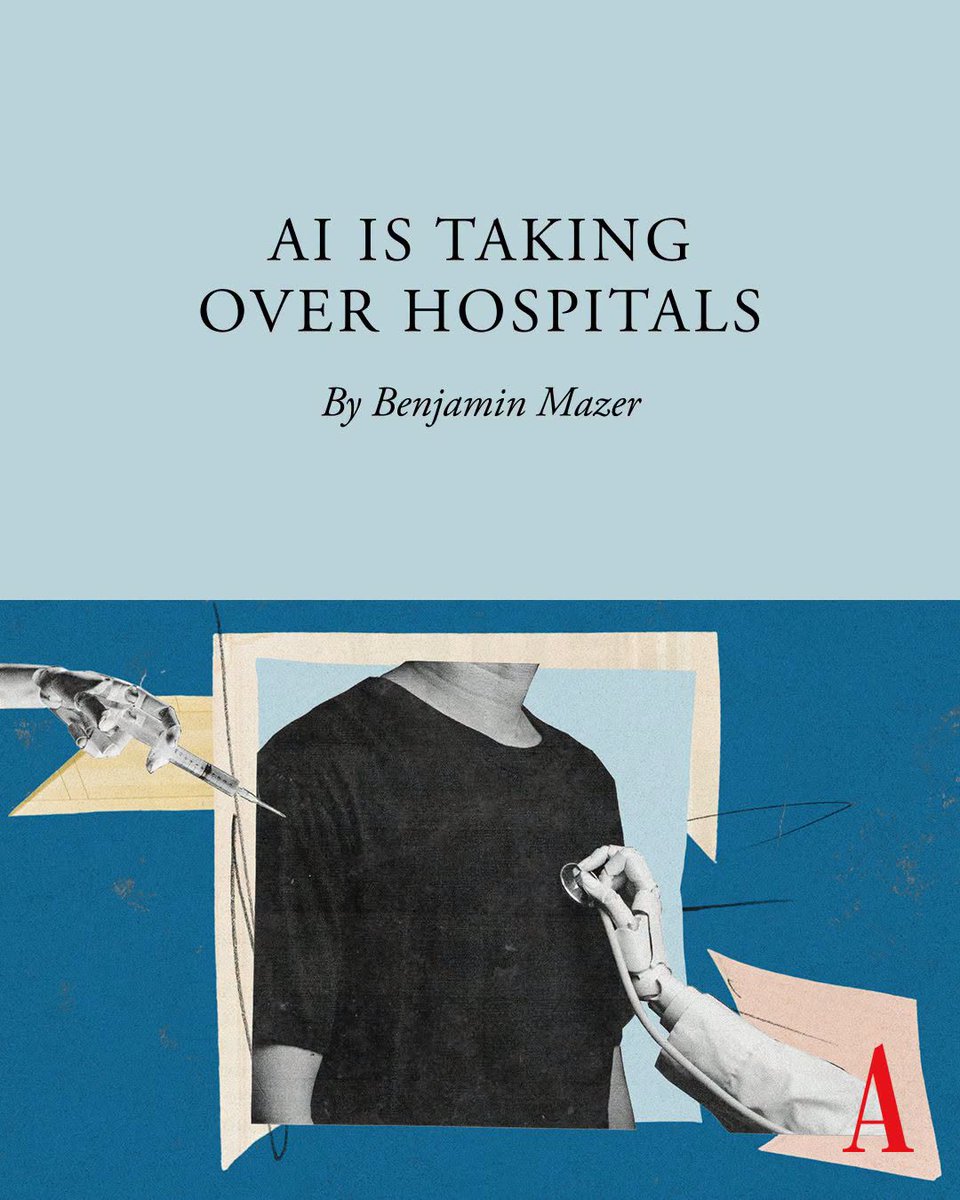
Health care is typically among the last fields to adopt a new technology; I still use a pager, and I send faxes on a regular basis. But now chatbots are everywhere in medicine.
My latest story.
https://t.co/5DysptslEi
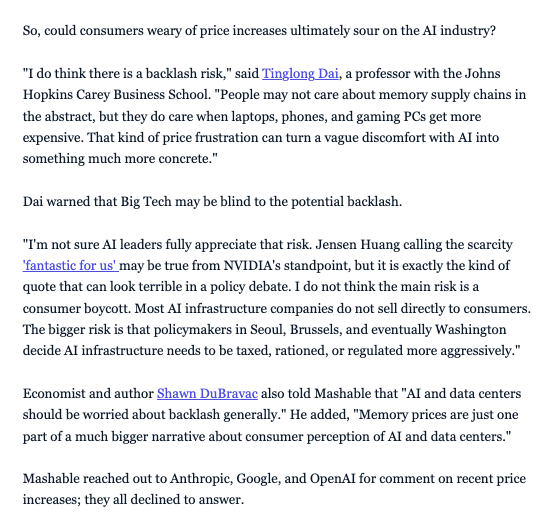
Thanks to the AI industry and RAMageddon, laptops, smartphones, gaming consoles, and other products are getting more expensive. Johns Hopkins professor @TinglongDai told me the AI industry should be worried about a backlash.
"I do think there is a backlash risk...I'm not sure AI leaders fully appreciate that risk. Jensen Huang calling the scarcity 'fantastic for us' may be true from NVIDIA's standpoint, but it is exactly the kind of quote that can look terrible in a policy debate." (1/3)
BE THE WHOLE PROBLEM
Address to Johns Hopkins MBA Class of 2026
May 18, 2026
Deans, faculty, staff, families, friends, and most importantly, the Johns Hopkins MBA Class of 2026, congratulations!
This is the third year in a row that Carey MBAs have invited me to do this. What an honor.
In 2024, I talked about death. In 2025, I talked about destruction. Despite these dark themes, you gave me a third chance.
So this year, I promised myself something sweet... Cheerful... Emotionally safe... Perfect for graduates and families who are celebrating...
I will talk about: DOOM.
Doom as in: We're All Doomed.
For those of you who took my artificial intelligence course, you have heard me say "we're doomed" in every class. Parents, yes, this is exactly how your children have been educated at Johns Hopkins.
❀ ❀ ❀
Let me begin with the story of an alien.
When you think of doom, what do you think of? Climate catastrophe. A.I. But the classic form of doom is alien invasion.
So let me ask: how many people in this room are worried about alien invasion? Raise your hands.
Just a couple of hands? Good. Very brave.
Now, how many people in this room have seen an alien in your lifetime? Raise your hands.
No one?
Well, I have. I was an alien for 14 years. Not metaphorically. Legally.
The American immigration and taxation system is so poetic and so imaginative. DHS and IRS looked at a person like me and declared: you must be an alien.
I was a non-resident alien for nine years and then a resident alien for five years. Apparently, over time, my species had adapted to local conditions.
I was proud to be one. Still am. An alien is someone who arrives to become a different person, with everything behind them and everything ahead.
If being an alien makes me mysterious, wait for it — I was illegal before I was an alien.
I was born in China in the 1980s, a millennial under the one-child policy. I had four siblings. I was the middle child. You see, my parents are true believers and practitioners of the Scaling Law. As far as the law of the land was concerned, however, I should not have existed.
I was an illegal child. Just as we debate illegal immigrants today, by some measure, I am an illegal person.
Before I had done anything wrong, before I had spoken my first words, I was already redundant. A rounding error in human form. I was the problem.
My parents went into huge debt so my family could exist. I feel two things at once. The money. And the love.
When I was born, the government saw an illegal being and an account receivable. My parents saw me.
When I came to America, the law saw an alien. Johns Hopkins saw a professor. And you saw someone worth listening to.
That is why the question of aliens is not really about outer space. It is about who gets to be fully human.
I have been thinking about what happened in Minneapolis. Watching the stories of Renée Nicole Good and Alex Pretti, I could not stop crying.
Renée Nicole Good. Alex Pretti. Good and Pretti. Those names say it all.
❀ ❀ ❀
Now let me tell you a bit about the beginning of my academic career.
In Spring 2013, I earned my PhD from Carnegie Mellon, and I received a faculty offer from Johns Hopkins. My wife was pregnant and we were expecting a baby in the summer.
Amid all the celebrations, I realized one thing that seemed unmistakable: my career was doomed before it even started.
All my papers were being rejected by top journals. The same journal rejected my job-market paper, the one that got me the job at Hopkins, twice.
And the rejections were not even subtle. They said: not only is this paper not good, it has no chance of getting better.
Within months, I experienced success and failure, so I feel qualified to compare them.
Success is sweet. Success makes every detour look like strategy. Success also makes people less funny; that is why Jerry Seinfeld feels less funny now than before.
Failure is rude. Failure is painful. And failure is personal.
Failure tells you what matters, who matters, and who celebrates you when there is nothing yet to celebrate.
Failure is discontinuity. Discontinuity is the precondition for poetry. Harold Bloom said the god of poets is not Apollo. Apollo is too steady, too continuous. The god of poets is Error, who lives at the back of a cave and only comes out in the dark of the moon.
I am not romantic about failure. Failure made me ridiculous.
I failed so much that during my first year at Carey, I bought a book by Scott Adams, with a title of "How to Fail at Almost Everything—and Still Win Big." I saw the first half of the book title and was like, "wow, this book is just for me."
You may not like Scott Adams' politics and I certainly don't. But the book has some good stuff. One trick the book taught me was affirmations. Pick a goal, phrase it as "I, xxx, will be a great astronaut." Then repeat it. Write it fifteen times a day. Say it out loud on the treadmill. The point wasn't magic. It was focus. His own version was "I, Scott Adams, will be a famous cartoonist." That worked out for him.
So I tried it.
There were days when I drove alone on I-95 and yelled, almost screamed, "I, Tinglong Dai, will become a great business school professor." Just like that, 15 times. I screamed without worrying about people driving next to me. This is Maryland. They've seen worse. The driver next to me was probably screaming too.
Sometimes it was raining. Very cinematic. Sometimes tears flowed nonstop, because I knew how ridiculous and how pathetic it sounded.
This was desperation in its rawest form.
This is what failure does. It strips away the audience. It leaves you alone in the car, in the rain, asking one question: do I still believe in a life that does not yet believe in me?
Years later, those rejected papers were accepted by the same journals after many, many revisions, tears, and smiles. And I have been appointed to edit the same journals.
People now look at my CV and assume I had an easy life publishing. But I failed more than anyone I knew, and I was, by any measure, the biggest failure I knew.
Failure is clarifying. It teaches us gratitude, if we let it.
Failure teaches us humility, if we survive it.
Failure teaches us love, if we are attentive to who is behind us.
My wonderful colleague Kathleen Sutcliffe, a pioneering scholar of management and organizations, writes that high-reliability organizations are first and foremost "preoccupied with failure." I love that phrase. Preoccupied with failure.
Failure forces us to change. It meets us in the corner we painted ourselves into. It finds us at the edge of the map. It speaks when the world we knew has ended, and asks: now what will you become?
Class of 2026, some of you came to Carey to change careers. Some of you came to change countries. All of you came to change the world.
But changing the world starts with changing yourself. Your Johns Hopkins MBA doesn't change yourself, but it makes you more interpretable to yourself.
❀ ❀ ❀
Now, let's go back to doom — and somehow, to a love story.
When I moved from Hong Kong in 2007, I walked around downtown Pittsburgh and was shocked. Everything felt messy and exposed. In Hong Kong, the streets felt orderly. In America, even the sidewalks seemed to be having an identity crisis.
The healthcare system was broken. The country was sleepwalking into a financial crisis. National debt was unsustainable. Infrastructure was crumbling. Do I even need to mention crime?
For a while, I genuinely suspected America was a scam. A conspiracy theory the rest of the world had quietly agreed to play along with.
And yet, over time, I began to understand. America's genius is not perfection. America's genius is a permanent sense of impending doom.
This country has been one step from complete collapse since 1776. We have been declaring "this is the end" roughly three times a week for two hundred and fifty years. We are very, very good at it.
Look out the window. See the harbor. See the fort across the water. Let's think about the War of 1812.
To be fair, one of America's first major moves in that war was a terrible decision: invading Canada.
But wars have a way of coming home. By 1814, the British had burned Washington and sailed for Baltimore. Their warships filled this harbor. They gave the fort an ultimatum: lower your flag by dusk, or be erased.
The flag stayed up. Through a night of fire, the defenders refused to lower it. At dawn, the flag was still there. Detained on a British ship in this harbor, Francis Scott Key watched the flag survive. The words he wrote that morning became our anthem. We still sing them, even though it is known to be hard to sing.
The harbor is still here. The fort is still here. America was one breath from gone. And then it wasn't.
Every administration, every crisis, every news cycle: the institutions buckle, the markets tremble, the center cannot hold. And then somehow, maddeningly, imperfectly, something moves.
A country recovers. An institution recovers. A career recovers. A person recovers.
America once called me alien. Then it let me become American. That contradiction is America.
And maybe that contradiction is also Carey: a young business school in America's oldest research university, still building, still self-advocating, still proving, still becoming.
A school that takes risks on people. I know this because it took one on me.
And maybe that contradiction is Johns Hopkins itself.
The largest donor in this university's history is Michael Bloomberg. Class of 1964, electrical engineering. C student in high school. Only listed extracurricular: math club. Hopkins said yes anyway. Almost by accident. Even ChatGPT wouldn't recommend admitting him.
In a recent Johns Hopkins Magazine essay, alongside one of my own, he said it himself:
"I was fortunate that Hopkins opened its doors to me. I was never a stellar student... I've always wondered how, after graduating, I got accepted to Harvard Business School, given my middling grades and lack of connections. Maybe the admissions office figured that since Hopkins' students believed in me, they would give me a shot, too."
One could argue Hopkins made a mistake. By his own admission, he was just "middling" at Hopkins. And yet he has given more than four billion dollars back to Hopkins, and counting. Without him, would Hopkins still be Hopkins as we know it?
You are a proud product of Johns Hopkins. And Johns Hopkins was a product of love, accident, stubbornness, and people making bets that looked irrational at the time.
In the 1810s, around the same time the U.S. almost ceased to exist, Johns Hopkins, the man, fell in love with his first cousin Elizabeth. Or so the story goes. Their Quaker family forbade the marriage. Neither of them ever married anyone else. He had no child to bear his name, and yet, Hopkins has become the most beloved and most trusted name in higher education. And his Hopkins family has grown bigger than anyone could have imagined.
A love that could not become a marriage became, in some mysterious way, a lovable institution.
A heartbreak became a gift. Without that love, without that unspent devotion, without that strange conversion of longing into legacy, do we even have Johns Hopkins?
Not every breakup should become a university. That would be too much pressure on modern love. But the deepest human energies do not disappear. If we are lucky, disciplined, and generous, they become something larger than ourselves.
And Hopkins Medicine, the jewel of this university, also came into being through people others were ready to underestimate.
By the 1890s, Hopkins was in trouble. The endowment had collapsed with the B&O Railroad. There was no money to open the medical school the will required. M. Carey Thomas, her lover Mary Elizabeth Garrett, and their circle of women raised the money. And raised the bar. Their conditions: women admitted on equal terms with men, and admission standards higher than any American medical school. The trustees did not know what hit them. They helped create not just a medical school, but a medical school worthy of Johns Hopkins.
M. Carey Thomas. If that name sounds familiar, it should. Same Carey family. Her father was one of the original trustees of Johns Hopkins. Six generations later, a Carey descendant gave us our business school.
Without them, the School of Medicine may never have opened in the form that made it famous.
If that is not the Hopkins story, I do not know what is.
❀ ❀ ❀
Here's the pattern:
Hopkins said yes to a mediocre student, and he became its greatest benefactor.
Hopkins said yes to women told they did not belong in medicine, and they built one of the world's greatest medical schools.
Hopkins said yes to a forbidden love, and that love became a university.
And Hopkins said yes to you, and to me — an illegal human being and an alien.
Hopkins saw the problem you and I were going to be, and said yes anyway.
So graduates, the world will tell you: don't be part of the problem.
I disagree.
Be the kind of problem that forces the world to become more alive.
DON'T BE PART OF THE PROBLEM. BE THE WHOLE PROBLEM.
Or as Taylor Swift put it:
"It's me, hi, I'm the problem, it's me...
I'll stare directly at the sun but never in the mirror."
The best institutions are not built by people who only know how to say yes to the obvious. They are built by people willing to see what others miss, protect what others dismiss, and widen doors they did not have to widen.
❀ ❀ ❀
Now, before I end, I want you to look around this room.
Look at your families, your partners, your children, your parents, your siblings, your friends, your classmates, your faculty and staff. The existence of each of us is a miracle. That we are all in the same room is impossible. Almost obscene.
Please give them a round of applause.
They're part of your miracle. They're part of your problem. They are the whole problem.
May you never confuse being impressive with being loved. May you never confuse being successful with being human.
May you be preoccupied with failure as much as you are preoccupied with success.
May you lower your expectations just enough to be grateful, and raise your ambition enough to keep moving.
❀ ❀ ❀
One last thing.
You are living in a love story.
The love that sees a child who was not supposed to exist. The love that welcomes an alien. The love that believes in a non-stellar student. The love that builds a university. The love that makes a country thrive on a permanent sense of impending doom.
Congratulations, Class of 2026.
As you start this journey, I want you to think about this story. In 1783, Benjamin Franklin watched a hot-air balloon take flight over Paris. It was a marvel. A miracle. But one skeptic in the crowd was not impressed. He asked Franklin: "What is the use of it?"
Franklin did not give an answer. He gave a problem worth solving. He asked back: "What is the use of a newborn baby?"
Class of 2026, you will face no shortage of skeptics. They will ask: what is the use of an MBA degree if A.I. can do this and do that?
Do not give them an answer. Give them a problem. Be a problem. Be a problem worth solving.
BE THE WHOLE PROBLEM.
Because every newborn baby, every new idea, every new institution, every new life begins as a problem the world does not yet know how to love.
Class of 2026: go be the problem the world will someday thank itself for having.
Go change the world!
A $1 billion private container terminal breaking ground at Sparrows Point is being cast by officials and supply chain experts as a long-term bet on whether the Port of Baltimore can expand its role in an increasingly competitive East Coast shipping network.
The project at the Port of Baltimore is expected to expand container capacity by roughly 70%, adding two new berths and modern crane systems designed to handle larger cargo vessels. It comes as the port works to regain momentum following the collapse of the Francis Scott Key Bridge collapse, which temporarily shut down the main shipping channel and disrupted supply chains across the region.
Tinglong Dai, a supply chain expert at Johns Hopkins University’s Carey Business School, said the expansion represents a structural shift rather than incremental growth. “This is an important moment, a milestone,” he said. “It’s not just an expansion to the port. It’s really developing the status of the Port of Baltimore.”
Read more: https://t.co/hEmz6PWx9v
🎥: Lloyd Fox and Natalie Jones, @baltimoresun
My advice to econ/finance PhD students in the age of AI:
Embrace the chaos. In Littlefinger's words, chaos is a ladder. Existing hierarchies will be disrupted, unlikely entrants will rise rapidly to the tops of fields thought to be impossible to disrupt