It’s an incredible feeling for a writer to see their name in print for the first time! Like a lot of journalists, I got laid off this year, and the media job market is pretty apocalyptic, so you’ve got to celebrate wins where you can. "Words by Timothy Beck Werth" in @GearPatrol
MotoSync+ is a mobile app required to set up and troubleshoot Motorola WiFi routers. It suddenly stopped working, and no one knows why. https://t.co/MJj0F76kKt
The reviews are finally out for the Trump Mobile phones, an American-made alternative to big tech.
Mashable tech editor, @beck_werth, joined Arizona's Morning News to give us all the details
Tech Tuesday is sponsored by @wgu School of Technology.
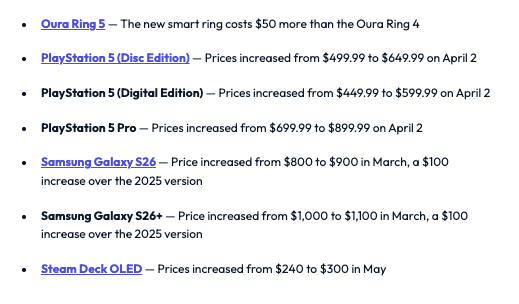
Meanwhile, with the Anthropic, OpenAI, and SpaceX IPOs, AI industry leaders are set for a massive payday. See all of the RAMageddon price increases so far @mashable, and brace for impact, because more are certainly coming.
https://t.co/HYdTQ60azH
Thanks to the AI industry and RAMageddon, laptops, smartphones, gaming consoles, and other products are getting more expensive. Johns Hopkins professor @TinglongDai told me the AI industry should be worried about a backlash.
"I do think there is a backlash risk...I'm not sure AI leaders fully appreciate that risk. Jensen Huang calling the scarcity 'fantastic for us' may be true from NVIDIA's standpoint, but it is exactly the kind of quote that can look terrible in a policy debate." (1/3)
The price of gaming consoles has increased 32.8% on average in 2026. Phones and laptops have increased 23.3% and 25.3%. And the supply chain experts I talked to said that not only will the crisis continue into 2027, but that it will get worse before it gets better. (2/3)
When OpenAI and Anthropic release a new frontier AI model, they report data on undesirable behaviors like hallucinations, sycophancy, and encouragement of delusions. Yet I scoured Google’s recent model cards and couldn’t find a single mention of hallucinations or these other behaviors.
I talked to a Google spokesperson and AI experts like @GaryMarcus, who told me: "Some candor about these things, as with nutrition labels, would certainly be a good thing." Read more in my latest for @mashable:
https://t.co/XL1y67iGIA
How often does Google Gemini 3.5 Flash hallucinate? Google won't say, so I did some digging. According to Google’s FACTS accuracy benchmark, Gemini 3 Pro scores 68.3%.
That’s really good for an AI model, but in any classroom, it would be a hard F. (1/2)
Mashable's pro-reader tested over a dozen e-readers to find the best one for your digital library. See how our favorite Kindles compared to readers from Kobo, Remarkable, and the iPad.
https://t.co/Ov5waNN79s
More people today are meeting their significant others on dating apps than ever before.
And although this is the new norm, Mashable tech editor @beck_werth joined AZMN to explain that many people aren't happy with it.
Tech Tuesday is sponsored by WGU School of Technology.
Apple’s famously secretive about new gear. Think you can crack the code on its 2026 roadmap?
Put your guesses to the test in our Big Guessing Game, where your accurate predictions could win you a new Apple Watch.
Enter to win!
https://t.co/XpMbq17AFj
A Tennessee grandma arrested for a crime in Fargo, North Dakota, a place she's never been. Why was she arrested for 50 days even though she's innocent?
@mashable's @beck_werth says many police departments are using AI facial recognition software and it has led to false arrests.
Open-source developers and bug bounty programs are seeing a deluge of AI-discovered bugs, and the worst is yet to come. As a result, some bug bounty programs are shutting down, while the Zero Day Initiative told @mashable it's seen a 490% increase this month compared to April 2025 — and the month isn't even over yet.
But not only is the volume of bugs growing in 2026, but the reported bugs are more severe in nature. (1/3)
Previously, devs were seeing a deluge of low-quality bugs and AI slop. But in 2026, experts say the bugs being submitted are more serious in nature, a stark reversal. The end result? Bug bounty programs closing, overloaded developers, and a less secure internet for end users.