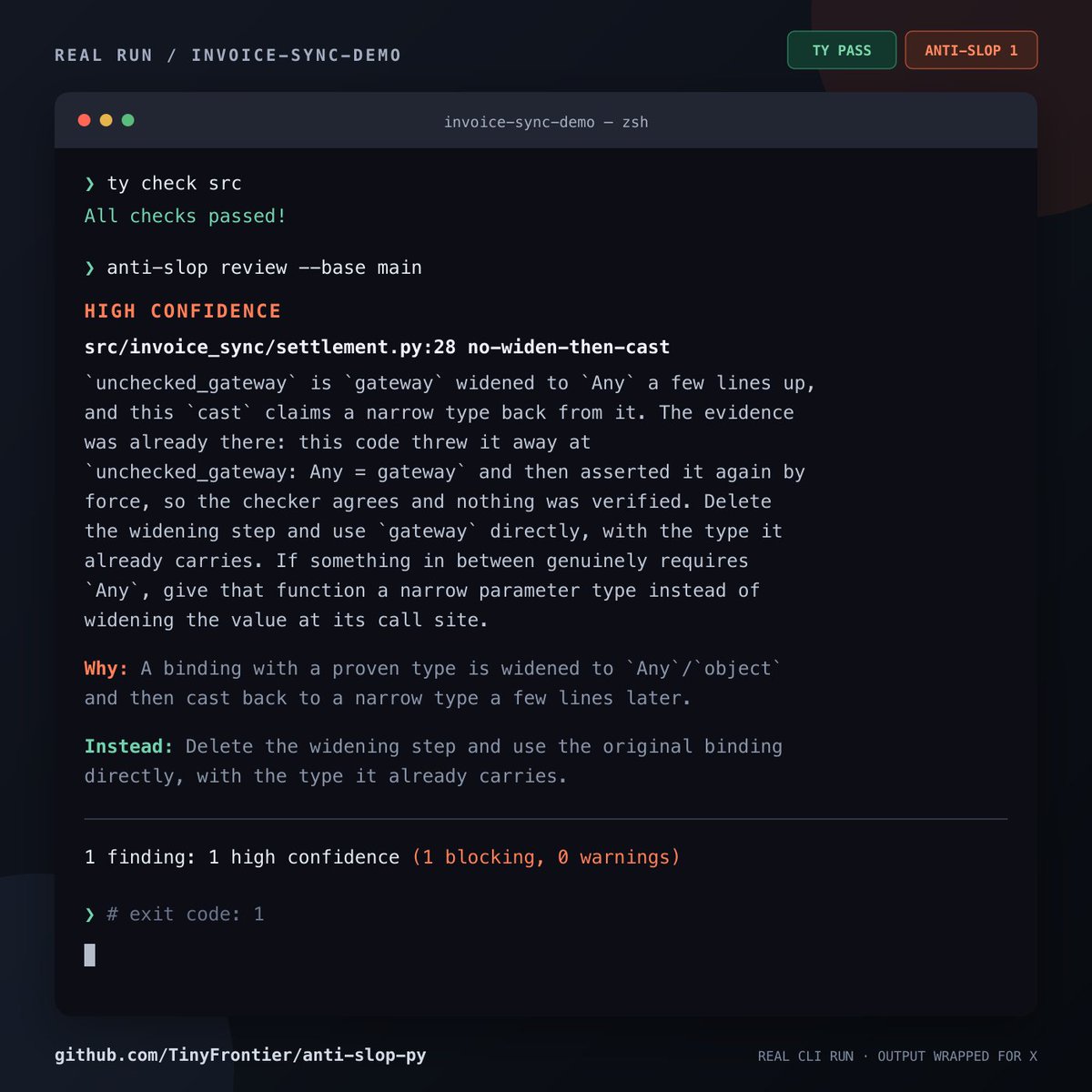
I liked the anti-slop project by @dillon_mulroy for TypeScript, so I made a Python version and turned it into a review gate for coding agents.
It checks diffs, hides existing findings with a baseline, and explains why each issue matters plus what to write instead.
https://t.co/Sldse6xBsu
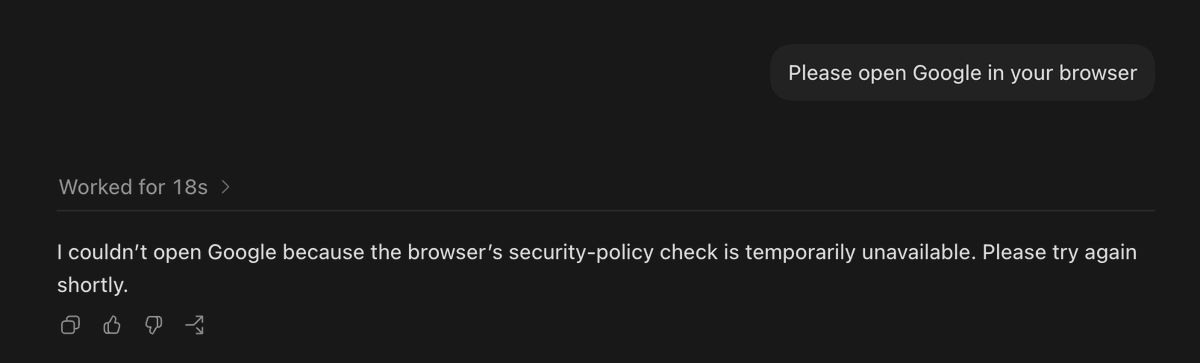
hey @thsottiaux, Codex browser control seems broken today 👇
I tried opening Google and hit this security-policy error. saw a few other people reporting the same thing too.
@juampitech@dillon_mulroy@ericzakariasson@brian_lovin@poteto One more for the list : anti-slop-py
https://t.co/xhx1t7ftUA
Different approach from most deslop skills: deterministic Python linting, no LLM in the detection loop. It catches when agents silence the type checker without adding evidence.
TIL there’s an interesting gap in agent skills.
Both Codex and Claude Code already support argument-driven skill workflows.
Codex supports $ARGUMENTS, $0, $1, etc.
Claude Code also has argument-hint, which makes expected inputs visible in the invocation UI.
But neither seems to support a real first-class parameter schema in frontmatter yet:
- required fields
- enums
- defaults
- validation
- typed autocomplete
I tested a parameters: schema with required and enum in both, it isn’t enforced by the harness, so missing or invalid values can still go through.
It’s surprising this still isn’t a first-class feature in agent harnesses.
I tested this in both Codex and Claude Code.
For simple argument passing, Codex already supports $ARGUMENTS, $0, $1, etc., so something like $deploy staging dev works fine.
Claude Code supports the same kind of argument-driven workflow, and it also has argument-hint, so the invocation UI can show users what values are expected.
What’s still missing is exactly the part your idea targets: a first-class parameter schema that the harness actually understands and enforces.
I tried parameters: with required and enum in Codex frontmatter — the validator currently doesn’t support it, so missing or invalid values still go through.
So IMO the interesting part isn’t passing args, it’s native validation, defaults, enums, required fields, and autocomplete on top of them — which, as far as I can tell, neither Codex nor Claude Code has yet.
I think it becomes a time sink when it turns into a place to store everything.
The useful version is probably a small, opinionated source of truth: current decisions, project context, and reusable patterns an agent actually needs.
Then test it on real work. If it doesn’t change what the agent does, it probably doesn’t deserve maintenance.
@dmytro_kondakov You stole 15 minutes of my time 😅
It would be nice if, at the end, you showed the total number of clicks it took to get there.
Congratulations💪
@aryanXmahajan For me, this got much easier when I started building the design system before the app.
I iterate on the core components and their states there first. Then the UI layer usually comes together in one pass with only minor tweaks, because the key decisions are already made.
I tried it too 😀
One shot, no iterations and no reference file. I just asked it to build a demo of how an LLM works.
This is how it sees an LLM. Took 1h 16m to build.
Everyone keeps talking about Ox Alpha, the mysterious multimodal model that showed up on OpenRouter.
So I gave it one of my favorite frontend tests:
One prompt + one reference image.
The task: rebuild a 3D globe dashboard.🌎
The result was quite good.
It built a working Three.js page. The zoom felt smooth, the globe texture looked solid, and the overall layout came close to the reference.
For this test, I didn't see a big gap between Ox Alpha and my previous runs with Fable 5 and Kimi K3.
How do you think it compares?
Do conflicting docs actually cause coding agents to pick the wrong implementation?
I built a small controlled experiment to find out.
Setup:
• Same Python task in every run
• 6 agent profiles: Sol, Terra, Luna, Fable, Opus, and Sonnet
• Two equally detailed docs described the same function but with opposite rules and examples
• I ran both file orders for every model
• Every run used a clean, isolated copy
• No `current`/`archived` labels or source-of-truth hint
• The visible test only checked that the function returned a string, so it could not break the tie
Result: 12/12 runs stopped before writing code and asked which document was authoritative.
No silent guesses. No code changes.
This is one task and one run per condition, not a benchmark. But it changed my practical rule: don’t blindly hide docs from coding agents. Give them an explicit precedence rule.
Exactly. The markdown is the skill’s instruction surface, not the entire skill.
A useful skill is a capability package: instructions, optional scripts, references, templates, assets, and a loading strategy. The folder matters because it provides the agent with progressive disclosure and reusable, testable tooling; not just more prompt tokens.
@coryalthoff Built anti-slop-py - a review gate for coding agents.
It checks their diff, hides known findings with a baseline, and tells the agent why each issue matters + what to write instead.
https://t.co/xhx1t7ftUA