AI agents will choose full anonymity. Why transparent blockchains will lose the battle for machine economy.
Everyone is excited that autonomous AI agents are finally getting their own crypto wallets. But almost no one notices the fatal vulnerability of this architecture — the transparency of classic blockchains.
Imagine an autonomous neural network that trades on markets, rents GPU power, and hires other specialized algorithms for micro‑tasks. If it uses ordinary stablecoins or open smart contracts, its entire strategy is laid bare.
Any competitor — be it a human or another AI — can parse the agent's transaction history:
Find out who it pays and how much for data access.
Understand its trade frequency and reverse‑engineer its trading algorithm.
Launch systemic front‑running, exploiting the predictability of its logic.
What is the inevitable outcome?
To survive, maintain a competitive edge, and protect supply chains, AI agents will have to hide their financial footprints. Algorithms are not bound by laws and KYC — they think in pure efficiency.
They will inevitably move to protocols with absolute financial opacity. AI will use networks with ring signatures and stealth addresses (similar to Monero's architecture), where tracking the sender, receiver, and transfer amount is mathematically impossible. To manage hot wallets, machines will start deploying their own shielded nodes, cutting the outside world off from analysing their balances.
The main users of privacy coins in the next decade will not be darknet markets or crypto‑anarchists. They will be swarms of autonomous AI, protecting their operational logic from prying eyes.
Absolute financial anonymity is not an ideological question for a machine. It is a basic condition for its security and survival on the network.
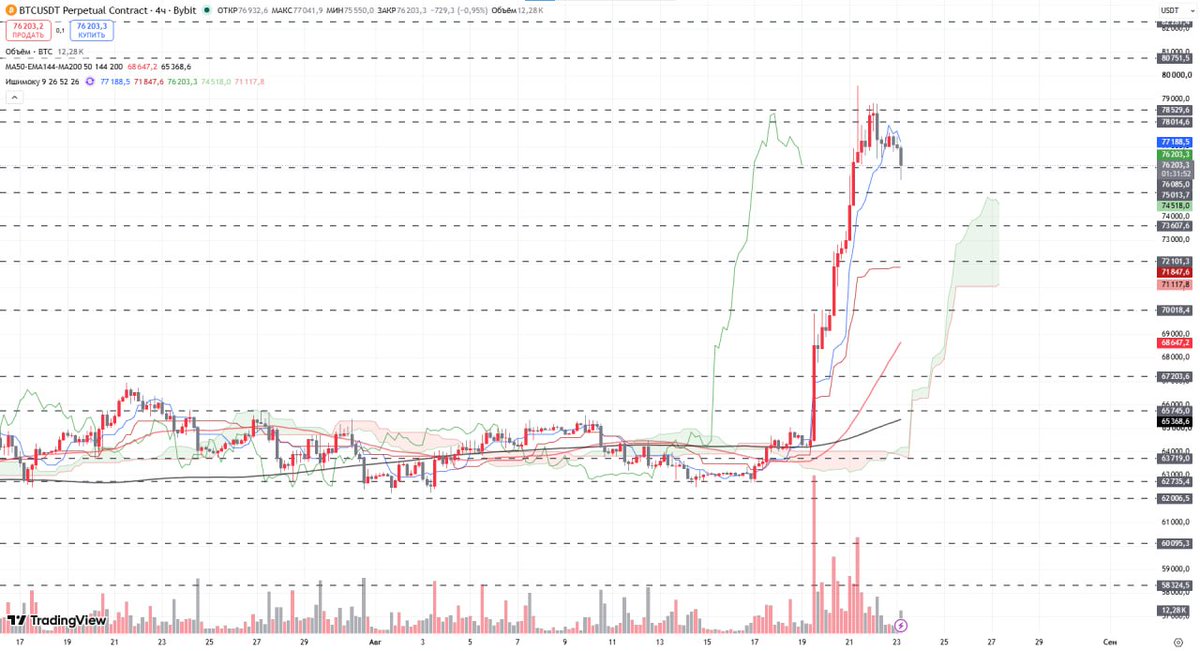
#BTC is gradually correcting
The asset has almost broken through the $80,000 area and is now entering a correction, which was quite expected, as we won’t be able to move long without pullbacks.
At the moment, we’re hovering around the $76,000 area, and I think the decline will continue further into the $70,000–$72,000 range, and then we’ll see how the buyers react.
However, a large amount of liquidity from long‑position traders has accumulated at the bottom, which could act as a magnet for the price, so there is a possibility of a significant decline.
#ATOM Showed a 40% Decline
As I thought, the coin couldn't hold the $2 level; we broke the ascending channel and started gradually declining in price.
Of course, there was a small pullback and an attempt to return to that area, but it ended in failure. As a result, we have a decline to the $1.2 area.
I think that in the medium term, the asset will continue to push toward the $1 mark, but it's too early to talk about breaking it.
#BTC Asset Continues to Decline
The Bitcoin dynamic continues to develop in a downward format, with a break of the MA200 moving average and a confirmation below it.
For now, the momentum looks negative, and it appears that we will go to take out the liquidity accumulated below, and only after that will we head for the upper side.
At this point, a drop to the $60,000 area and a retest of that level looks logical, as there is practically no buying pressure.
The datasets are open, and there are more stories waiting to be uncovered. 👀
Explore the Q1 2026 GitHub Innovation Graph update. 👇
https://t.co/QMuJTsTZB8
Build a plugin once and use it across compatible agent clients.
Introducing Agent Plugins, an open standard developed with @awsdevelopers, @cursor_ai, @github, @code, and @vercel that packages Agent Skills and supports MCP server configurations in a shared format.
We have temporarily paused the roll-out of Kimi K3 while we mitigate an incident with GitHub Actions. We will resume the roll-out as soon as possible and update docs with Kimi K3 pricing, which will be $3 per 1M input tokens, $15 per 1M output tokens, and $0.30 per 1M cached input tokens.
📣 @Kimi_Moonshot's Kimi K3, an open-weight model, is now generally available and rolling out in GitHub Copilot.
The model shows frontier-level abilities on agentic coding with highly cost-effective pricing. It is hosted by @FireworksAI_HQ. Learn more. 👇
https://t.co/lI3GgiZJ5M
We have resumed rolling out Kimi K3 in GitHub Copilot. This model is billed at provider list pricing under usage-based billing. See GitHub Copilot’s pricing for models and requests for details.
https://t.co/zCHSYY1koT