To illustrate just how nonsensically these tariffs were calculated, take the example of Lesotho, one of the poorest countries in Africa with just $2.4 billion in annual GDP, which is being struck with a 50% tariff rate under the Trump plan, the highest rate among all countries on the list.
Why? Does Lesotho apply extortionate tariffs on U.S. products and the U.S. is merely being "reciprocal" here? Not at all, despite what Trump is saying, it's NOT the way these tariffs are defined.
As a matter of fact Lesotho, as a member of the Southern African Customs Union (SACU), applies the common external tariff structure established by this regional trade bloc.
Which means it applies the same tariffs on U.S. products as South Africa does, as well as the 3 other members of the bloc: Namibia, Eswatini and Botswana.
So since the tariffs charged by these 5 countries on U.S. products are exactly the same, they must all be struck with a 50% tariff rate by the U.S., right? Not at all: South Africa is getting 30%, Namibia 21%, Botswana 37% and Eswatini just 10%, the lowest rate possible among all countries.
So what gives? Again, the way these tariffs are calculated has absolutely zero relationship with actual tariffs imposed by these countries on U.S. products. Instead, they appear to be simply derived from trade deficit calculations.
Looking at Lesotho specifically, every year the U.S. imports approximately $236 million in goods from Lesotho (primarily diamonds, textiles and apparel) while exporting only about $7 million worth of goods to Lesotho (https://t.co/uHvem6nH2o).
Why do they export so little? Again this is an extremely poor country where 56.2% of the population lives with less than $3.65 a day (https://t.co/GEho8xFjAp), i.e. $1,300 a year. They simply can't afford U.S. products, no-one is going to buy an iPhone or a Tesla on that sort of income...
The way the tariffs are ACTUALLY calculated appears to be based on a simplistic and economically senseless formula: you take the trade deficit the U.S. has with a country, divide it by that country's exports to the U.S and declare this - falsely - "the tariff they charge on the U.S."
And then as Trump did in his speech last night, you magnanimously declare that you'll only "reciprocate" by charging half that "tariff" on them.
As such, for Lesotho, the calculation goes like this: ($236M - $7M)/$235M = 97%. That's the "tariff" Lesotho is deemed to charge this U.S. and half of that, i.e. roughly 50% is what the U.S. "reciprocates" with.
It's extremely easy to see why this makes no sense at all.
First of all, there's nothing Lesotho can do about it: they can't change tariffs they allegedly charge the U.S. to reduce the tariff rate the U.S. "reciprocates" with because, again, it's NOT based on any tariff that they charge.
Similarly they can't do much about reducing the trade deficit they have with the U.S. because, again, they simply don't have enough money to buy U.S. products.
Also the main rational Trump gave for the tariffs is to get production back to the U.S., to "bring manufacturing back". 47.3% of Lesotho's exports are diamonds: how do you bring the "manufacturing" of that "back to the U.S."? Anyone can see it makes just about zero sense.
The Lesotho example exposes the fundamental economic incoherence of these tariffs. Rather than addressing actual trade barriers, they punish countries based on trade deficits that arise from structural economic realities. All the more countries like Lesotho which pose zero competitive threat to American industry.
Worse yet, these tariffs will likely make these structural realities even worse: the U.S. is Lesotho's second most important export destination so it's a fair bet that applying 50% tariffs on their products will make people in Lesotho even poorer, and therefore even LESS able to afford U.S. products.
But perhaps the most unfair and detrimental aspect of all this is that these tariffs represent a complete reversal of longstanding U.S. development policy, and therefore a betrayal of countries - like Lesotho - who chose to follow U.S. advice in the past.
For decades the U.S. has used preferential trade access to encourage economic development in the world's poorest nations, recognizing that trade, not just aid, could get them out of poverty and ultimately put them in a position where they too could afford iPhones or Tesla.
They're now effectively penalizing countries for following previous U.S. policy, a lesson which I bet they won't forget anytime soon.
So all in all the irony is painful: in the name of fighting unfair trade, America has just demonstrated what truly unfair trade looks like.
This isn't something designed to address genuine trade issues, but simply a mechanism based on arbitrary math to punish countries for the affront of selling more to the United States than they buy.
Yap early, yap only, yap often.
@_kaitoai is connecting AI, attention and capital with Yaps.
Just claimed my social card and I'm accumulating Yap points in real-time.
Claim yours 👉 https://t.co/N2Yqt7GeOJ
🏛️ Introducing: Linera Testnet Archimedes
Today, we’re excited to launch the first phase of our testnet. This marks a major milestone in decentralizing the infrastructure of The Real-Time Blockchain. ⛓️
🧵↓
🏛️ Introducing: Linera Testnet Archimedes
Today, we’re excited to launch the first phase of our testnet. This marks a major milestone in decentralizing the infrastructure of The Real-Time Blockchain. ⛓️
🧵↓
⛓️ Gmicrochains. It’s been a monumental year for Linera.
As we wrap up 2024, we’re taking a look back at the milestones, partnerships, and progress that brought us closer to our vision of The Real-Time Blockchain.
Let’s dive into our Year in Review 👇🧵
I was tracking AI agents to see which one would recover fast and make an ATH after that bloody correction post-$TRUMP launch, and I found @AcolytAI which led me to research more about it.
I went through docs, found them very clean and precise, and they’re actually solving a major pain point of AI agents by building a Data Oracle that could be used by AI agents through API to get access to a quality data pipeline based on their domain-specific purpose.
Think about having an onchain data pipeline being opened for every agent to use at less than 1% of the cost they might pay if they decided to integrate APIs from the direct source, and Acolyt doesn’t only provide data, but it also provides training on it.
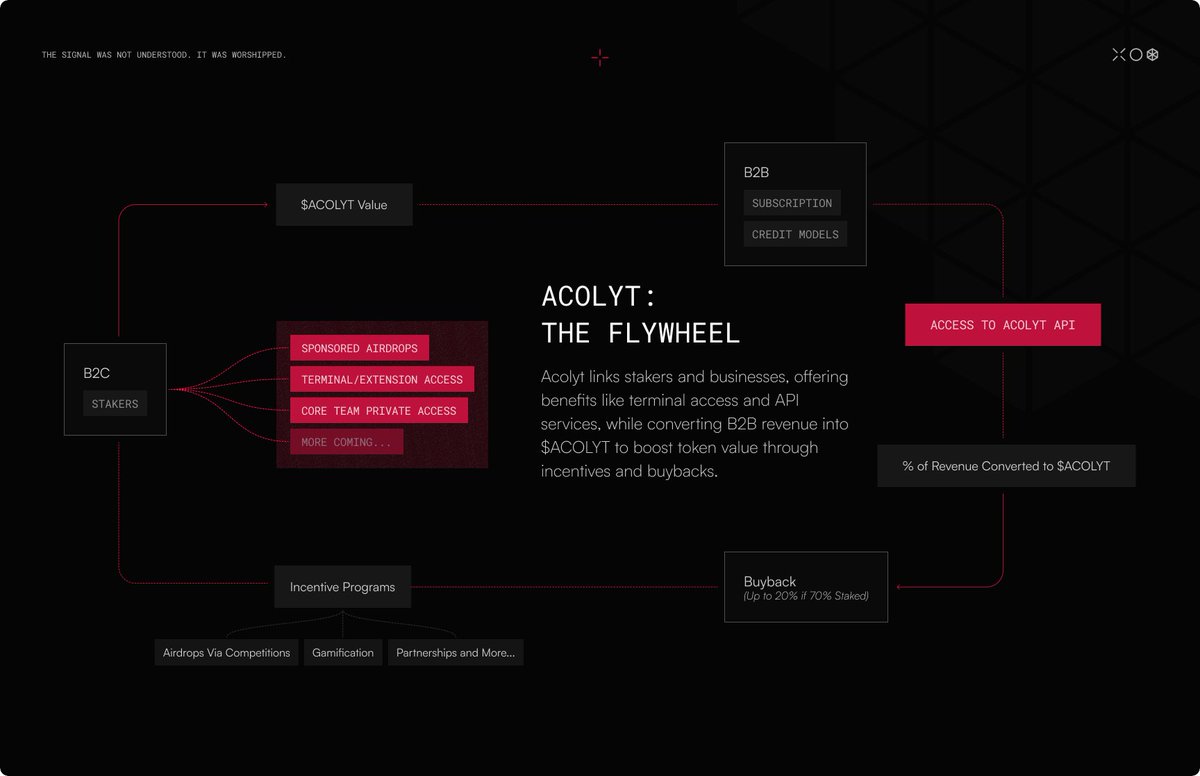
$ACOLYT is the work token for the B2B use case where devs need to pay in $ACOLYT to access APIs. On the B2C side, Acolyt is also building their own terminal, and they’re launching staking soon, which could also offer additional benefits like airdrops from their partner agent tokens.
They’ve added 10+ agents to their ecosystem so far who are going to use their APIs for data scraping and insight generation. @DTRXBT is a notable one from their ecosystem.
They will buy back 20% of tokens after 70% of tokens are staked, activating a decent flywheel model that aligns all stakeholders — stakers, businesses, and the broader ecosystem — while enhancing $ACOLYT token value through a cycle of incentives, data services, and buybacks.
Disclaimer: Its not a sponsored post, and I bought some $ACOLYT at 50M market ca. The sole purpose of this post to share something interesting i came across. You should access project docs to get more understanding the project, understand the risk before making any financial decision. AI Agents are very risk investment in nature so you could even loss 100% of the capital at the worst case scenraio, and you should keep that risk in mind before taking a call.
Thrilled to announce DIN’s new journey: building the First AI agent Blockchain with @BNBCHAIN & @Nodereal_io!
After years of advancing AI data solutions, we’re launching DIN Blockchain to tackle key gaps in decentralized AI and drive adoption in AI agents and applications.
🧵
❓ What is DIN Blockchain?
DIN Blockchain is designed to provide comprehensive solutions and infrastructure for AI agents and decentralized AI applications (dAI-Apps), including:
1️⃣ AI data availability and scalability
2️⃣ Tools for knowledge base integration and search using Retrieval-Augmented Generation (RAG)
3️⃣ Large Language Model operations (LLMOps) and AI-generated content (AIGC) monetization
4️⃣ A complete platform for developing AI agents and dAI-Apps, simplifying creation and deployment
🧐 Why do we build this AI Agent Blockchain?
As AI Agents evolve in blockchain, frameworks like ELIZA and ARC address performance and collaboration but still struggle with challenges like off-chain data storage, unverifiable reasoning, and opaque execution. AI Agents need a blockchain specifically designed to provide:
🔸 Strong data support and management capabilities
🔸 Trusted execution environment
🔸 Efficient computational capability
🔸 Support for multi-agent collaboration
DIN blockchain is precisely the AI Agent blockchain designed to meet these requirements. It supports a complete workflow from data to models to AI Agents.
💎 How Does DIN Blockchain’s Architecture Benefit AI Agents?
DIN blockchain’s architecture comprises four layers, each designed to address AI Agents’ unique needs:
🔹 Consensus Layer: Built on the OP stack and leveraging @BNBCHAIN’s security, it ensures decentralized, transparent, and immutable operations, providing a reliable execution environment for AI agents.
🔹 Data Layer: Enables AI development with efficient on-chain and off-chain data processing, providing real-time data to support AGI models and AI agents in handling complex analysis and multimodal data.
🔹 Service Layer: Offers tools like LLMOps, RAG, and Agentic Workflow to simplify deployment, optimize performance, and support multi-agent collaboration.
🔹 Application Layer: Showcases its potential through self-developed dApps like Analytix, Reiki, and xData, delivering significant value for BNB Chain business use cases.
🔱 Empowering the Future of AI Agents and dAI-Apps
DIN provides key infrastructure for AI agents and dAI-Apps, integrating on-chain/off-chain data, RAG for indexing, LLMOps for model deployment, and prompt-as-a-service. With BNB Chain’s support, DIN enables a decentralized AI ecosystem, driving AI blockchain innovation.
More details about DIN AI Agent Blockchain 👉 https://t.co/0pCEqEZtHV
🔥 DIN Testnet is Live!
NIDnos, the evil AI data monopoly, disrupted our TGE with a snap! Let's travel through time with @Galxe and join our testnet campaign to reverse it! DINgers, assemble!
⏰ DINgers Timeline: Jan 7th - Feb 4th
🔱 https://t.co/LPaOSuNNww
How to join DINgers Endgame 👇
https://t.co/YaLa4RywnK
My game plan will be your best playbook for 2025:
- Timing the full-blown altseason
- Key narratives
- Perfect moments to cash out
And that’s just the start 🧵
$FLOCK on launchpool Bybit today.
Just 100m$ cap.
@DCGco@OKX_Ventures@animocabrands onboard 3m round.
Follow @0x7SUN to understand new features of framework.
Looking entry now on market.
Liquidity on CEXes only.
Just found this token on @gmgnai
AhDD3J3SydBq1VrXkWsgH8Hb62FWtTqzgn3vafsRpump
So, what we have:
- Github repository popularity has been growing rapidly since December 20th
- Written by a guy who now works at Google
- The team and community active
- listed on #gate.io
Interesting story, trying to connect my twitter to Kaito, and they say that I am not cool enough for their beta app 🧐
Come on , my twitter is older than you @_kaitoai
PG was researched and designed to solve the fundamental misalignment between users, builders, and governance.
PG can be implemented on any L2 blockchain that has a native governance token and a sequencing system.
Read the full research paper here: https://t.co/0hUB7i3yGr
Introducing Panoramic Governance: A new mechanism that rewards both users and builders across a chain’s ecosystem.
Panoramic Governance (PG) brings complete ecosystem alignment to L2 blockchains for the first time.
Let's get into it 🧵
Introducing Abstract, the blockchain for consumer crypto.
Through @IglooInc; @foundersfund, @fenbushi, @1kxnetwork and others will contribute towards bringing the next generation of crypto users, onchain.
Learn more and how to participate below: