“It was the climax of seven weeks of market convolutions, the last bumpy ride of illusion on its way to the rainbow’s end. Like a giant storm, it’s violence and intensity stunned even those who thought they saw some such disturbance looming on the horizon” - John Brooks Oct 1929
"In the summer of 1929 the surface of Wall Street was a mixture of placidity and mania - stocks at record highs and still headed upward, the dissenters momentarily routed... The 1929 boom was, in fact, quite a narrow and selective one." - John Brooks
https://t.co/toPC1U5bQ8
Trump is now turning his attention to refiners and fuel producers, criticizing the slow pace of declines in retail gasoline prices following the sharp drop in crude oil. However, the refining sector's response remains constrained by historically low inventories of refined products, particularly in the middle distillate complex.
As the charts highlight, US gasoline crack spreads remain elevated despite the recent easing in crude prices. The biggest beneficiary of the reopening of Middle East export flows has so far been the distillate market, with gasoil and diesel cracks falling from their March peaks. This reflects the fact that much of the additional crude now reaching the market is medium-to-heavy Gulf crude, which yields a higher proportion of middle distillates such as diesel, gasoil and jet fuel.
While increased crude availability should eventually help ease refining margins and lower fuel prices, depleted product inventories accumulated during the Strait of Hormuz disruption continue to support cracks. The combination of peak summer demand for gasoline keeping prices at the pumps seasonally elevated, refiners – for now - remain incentivized to maximize diesel and jet fuel production, delaying a more pronounced decline in gasoline prices.
Well, here's some math. Starlink is a profitable business with about $11 billion of sales and $3 billion of free cash flow. It might be worth $75 billion at a frisky multiple of 25X free cash flow.
The balance----the space launch business and the AI/data centers in space fantasy----has $7 billion of sales and NEGATIVE -$17 billion of free cash flow. So why is it worth anything, unless you are pricing a dream peddled by sell-side hucksters?!
In short, after trading up to $2 trillion based on $75 billion of tangible Starlink value, where's the remaining $1.925 trillion of it?
This isn't just the classical mania of the crowds. This is sui generis--- mass insanity in a casino that has been giving a lobotomy by three decades of money-printing madness at the Fed and its fellow-traveling central banks around the planet.
#Gold has been trending lower since mid-April amid an energy-driven inflation scare. Following Friday's stronger-than-expected US jobs report and a broader deterioration in risk sentiment that also weighed on equities, bullion closed below its 200-day moving average for the first time since October 2023.
For now, a combination of resilient economic growth, elevated inflation expectations, higher bond yields, a stronger dollar, and growing speculation that the Federal Reserve may need to raise rates in 2026 has created a challenging environment for gold, overshadowing the longer-term supportive themes of central bank buying, fiscal concerns, and geopolitical uncertainty.
Attention now turns to the USD 4,100–4,075 support zone, which marks both the March correction low and the 38.2% retracement of the 2022–2026 rally. Resistance: 4,432 (200-DMA), 4,490 (recent high) and 4,635 (channel resistance).
President Trump is fond of saying "USA holds all the cards" in the Iran conflict. A review of the facts in evidence reveals that it's CHINA that holds all the cards.
China has been able to reduce its IMPORTS (that's IMPORTS, not consumption) by a massive 5.7mm bbl/day, without disrupting their economy. So far they have not publicly acknowledged drawing down any reserves in order to pull off this feat, and that probably means they have more reserves than we know about.
So China can CHOOSE to allow this crisis to continue for 6 more months without blowing oil prices out to $200+, simply by running their economy on reserves for that period, or they can force that price spike event at any time by resuming full-replacement rate imports to match their consumption and/or replenish the reserves they've already drawn down.
China has more leverage than anyone seems to understand.
NVIDIA IS BUYING ITS OWN CHIPS AND CALLING IT REVENUE
And your retirement account is secretly holding the bag.
This scheme is literally straight out of the Enron playbook...
In January 2026, a special purpose vehicle called Valor Compute Infrastructure was created with one purpose:
Buy Nvidia's chips so Nvidia could book the sale as revenue.
Valor raised $5.4 billion and purchased over 100,000 of Nvidia's GB200 GPUs.
But $1.9 billion of that money came FROM Nvidia itself.
Nvidia invested $1.9 billion into the shell company, then sold that same shell company $5.4 billion worth of its own chips and booked every dollar as revenue.
It's the Girl Scout whose dad bought all the cookies and then she wins the sales contest because Dad was the customer. Except this Girl Scout is a trillion-dollar company and the cookie sale is $5.4 billion.
But it gets MUCH worse:
The remaining $3.5 billion in financing came from Apollo Global Management. Apollo structured the debt, packaged it into securities, and then sold those securities to Athene.
And guess who Athene is? Apollo's OWN insurance subsidiary. The one that sells fixed annuities to American retirees as safe, conservative retirement products.
Follow the chain:
Nvidia funds a shell company with $1.9 billion. The shell company buys $5.4 billion in Nvidia chips. Apollo finances the remaining $3.5 billion. Apollo sells the debt to its own insurance arm. That insurance arm packages it into annuity products and sells them to retirees who think they're buying something safe.
The retirees have no idea that their retirement savings are now backed by 100,000 computer chips sitting in some data center that will be worth pennies on the dollar in three years.
Now look at what's happening inside Athene:
$74.2 billion in US reserves but $217 billion in assets have been shifted to a Bermuda-based captive insurer, outside normal US regulatory oversight.
$103 billion of that portfolio (roughly 35%) is classified as Level 3 assets. That means there is no observable market price.
These assets are valued by internal models, not by actual markets.
And sitting on top of all those unpriced assets? 16.6x leverage.
If you're getting flashbacks to 2008, you should be.
Back then it was mortgages bundled into securities that nobody understood, sold to investors who had no idea what they were holding, rated as safe by agencies that never looked under the hood.
Today it's GPU-backed securities. Computer chips bundled into structured credit instruments, routed through an offshore insurance subsidiary, and sold to you as a retirement product.
The collateral is 100,000 GPUs leased to a single customer through an xAI subsidiary. If xAI stops making lease payments for any reason - financial distress, a pivot in strategy, anything - the entire structure unravels.
And Nvidia releases new architectures every year, so each generation delivers dramatically more compute per watt. A 5 year lease on technology that's obsolete in 2 years creates a mismatch that should terrify every annuity holder in America.
Every single step in this chain is technically legal. The SPV is legal, the lease is legal, Nvidia's equity stake is legal, the securitization is legal, and the Bermuda transfer is legal.
But legality and legitimacy are not the same thing.
I've seen every trick Wall Street has ever pulled in my 45 years of doing this.
And what I'm looking at right now is a pipeline that takes AI infrastructure risk, launders it through 8 layers of financial engineering, and deposits it in the retirement accounts of Americans who never agreed to fund Elon Musk's data centers.
In 2008 it was mortgage-backed securities.
In 2026 it's GPU-backed securities.
Different asset. Same greed. With the same ending.
In real effective terms, Turkish Lira has risen more than 50% since its low in 2022, but Turkey's current account deficit - the single most important fundamental variable - has deteriorated massively since then. Turkish Lira is at least 20% overvalued...
https://t.co/ehfW0LXjTl
Elon is smart. He has a massively overvalued mega cap albatross he needs to get public before the music stops and he knows - as everyone does - that OpenAI may well blow up and pop the bubble. Hence he’s pushing out SpaceX first…
Oil futures lower due to more Trump market manipulation.
Next week is futures contract rollover (May 29th).
For the past two months, the final week has seen a large spike in oil as the front contract closes. Last month it hit $125 intra-day.
The uptrend remains intact.
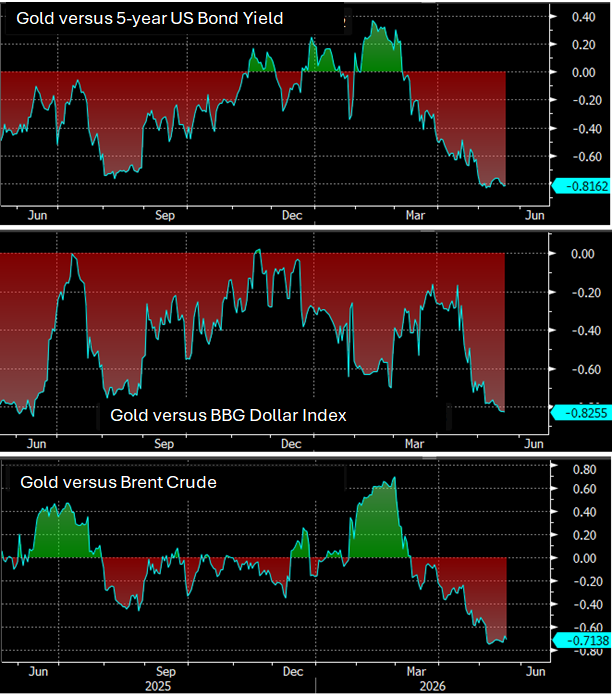
#Gold is currently showing very elevated inverse correlations with bond yields, the dollar and crude oil, underscoring the reaction function currently driving price action and what likely needs to change for bullion to attract a renewed bid. Rising yields increase the opportunity cost of holding non-yielding assets, a stronger dollar reduces gold’s appeal for non-US buyers, while higher crude prices are feeding inflation and rate-hike expectations rather than supporting gold through their traditional inflation-hedge channel.
The recent shift highlights how markets are currently focusing less on gold’s longer-term structural drivers - fiscal debt concerns, reserve diversification, de-dollarisation and central bank demand - and more on near-term macro headwinds. For gold to regain upside momentum, the market needs to see some easing in oil-driven inflation concerns, or renewed evidence that growth risks are beginning to outweigh inflation fears.
Charts from Bloomberg
Most fund managers still believe Hormuz disruption is temporary
There's no evidence beyond "this never happened before" and "because markets" to support this.
Even if the Strait opens, the insurance, operational & logistical risks will constrain shipping for most of 2027.
This is a psychological disorder @biancoresearch
#oil #Hormuz #energy #geopolitics #shipping #markets #inflation #macroeconomics #petrodollar #supplychains
The chart below shows that passive mutual funds and ETFs now make up almost 62% of all equity funds’ assets.
Has the adage "flows follow performance" now become "flows create performance"?
@fleckcap@adamtaggart@profplum99
Maybe it has nothing at all to do with "software being cooked" and everything to do with the fact that $MSFT is torching $200B a year into capex chasing a commoditized technology that will likely never generate a positive ROI















![Rory_Johnston's tweet photo. A brief [updated] history of presidential oil market jawbones through the Hormuz crisis. https://t.co/8FUFdfywtO](https://pbs.twimg.com/media/HIydSgOW4AAb59Q.jpg)