I am a geologist and writer doing energy-related work.
Energy is the economy so that covers economics, environment, geopolitics , ecology & human behavior
Commonwealth Bank's John Oh sees rising oil inventories and a $25–$30 Brent risk premium.
But October's inventory build was entirely oil on water, land stocks kept falling, and Gulf exports have since weakened.
Where's the evidence for sustained builds—or that premium?
https://t.co/lo4QtKXoyB
China's AI export boom depends heavily on imported technology, writes @Manishi_R
Tighter U.S. chip controls and weaker global AI spending could undermine it.
Add weak domestic consumption and slowing demand for other exports, and China's growth outlook looks increasingly fragile.
Plausible, not proven.
https://t.co/xWjn2XAlpA
China's iron ore imports are up 3.1% while steel output is down 2.8%, writes @clydecommods.
Much of the ore is going into inventories, not production.
The same pattern may be emerging in oil:
Strong imports masking weak consumption.
Analysts should distinguish flows from demand.
https://t.co/aKuzcrar7m
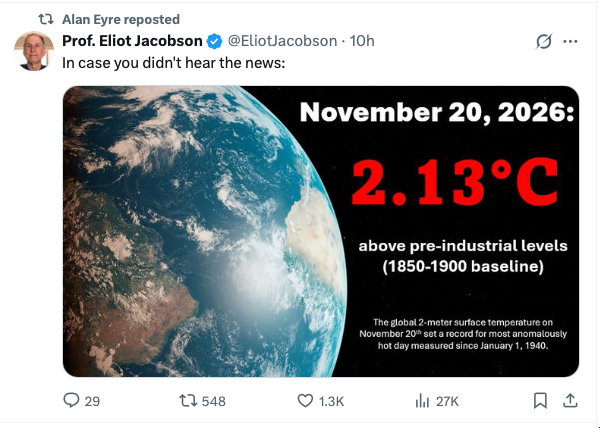
A single day's 2.13°C temperature anomaly is not the long-term climate trend.
El Niño amplifies warming temporarily.
Broadcasting exceptional readings without context may feel virtuous, but it desensitizes the public and gives climate skeptics ammunition.
The facts are serious enough.
@AlanEyre1
Jake Sullivan says Nvidia appears to have deliberately circumvented U.S. chip export controls for profit.
But the larger scandal may be government complicity.
What happens when officials know national security rules are being evaded and choose not to enforce them?
“A story of industrial-scale evasion of American chip controls”: That’s what former NatSec Adviser Jake Sullivan said the Jensen Huang scandal is really about. Part 2 of my conversation with him:
AI may be exposing digital civilization's greatest vulnerability, says @FareedZakaria
Decades of efficiency and interconnection have created fragile systems
Last week's outages weren't confirmed cyberattacks, but they show how easily complex networks can fail
In recent days, it seemed as if the world’s computers went on strike.
The outages shine a light on the cybersecurity challenge we now face. We have built highly complex and interconnected software systems, and they have huge vulnerabilities.
My take:
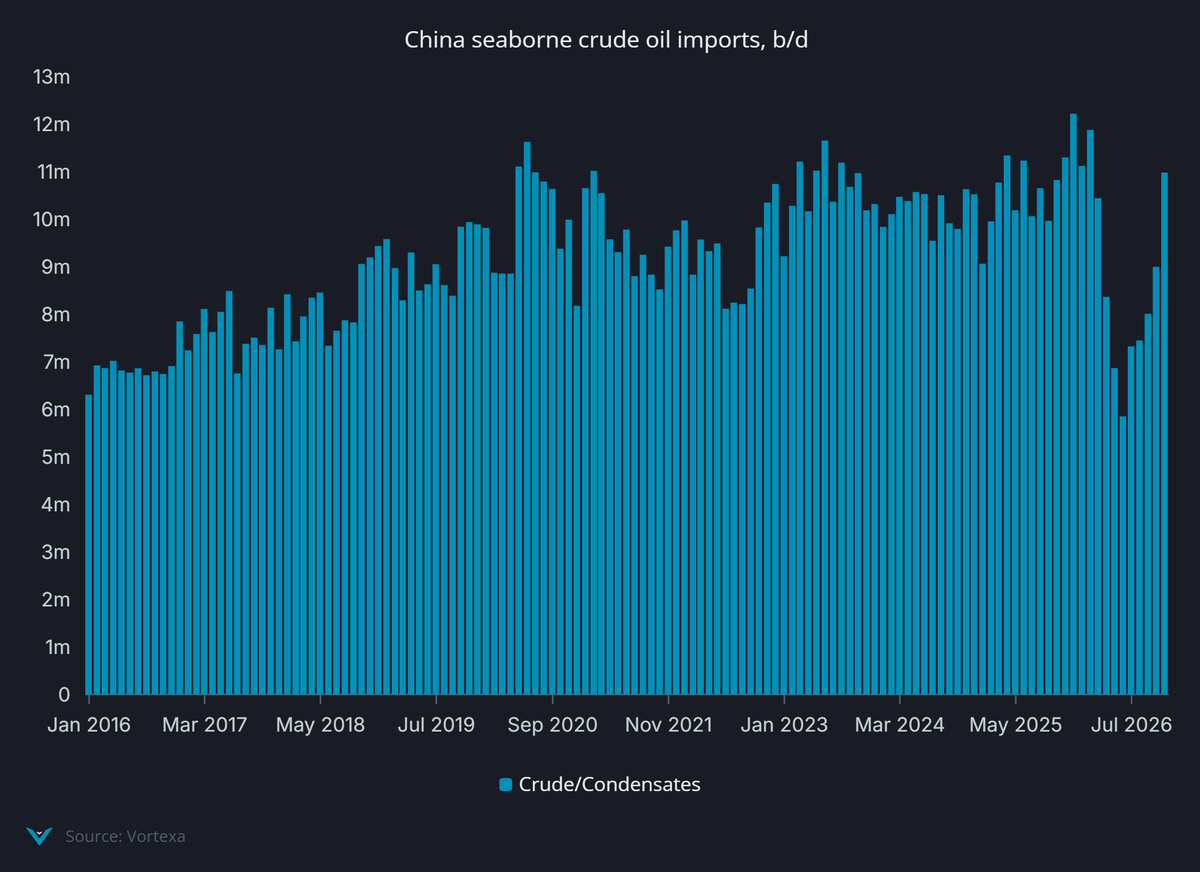
China's crude imports are back near pre-war levels, according to @JavierBlas and @Vortexa.
That's positive, but imports aren't consumption.
Until refinery runs confirm stronger demand, inventory rebuilding is just as likely.
It's a partial-month estimate rather than a completed monthly observation.
That makes confirmation especially important.
CHART OF THE DAY: Chinese seaborne crude oil imports have jumped to near pre-war levels (Nov 1-15 data via @Vortexa) of around 11m b/d. Beijing is taking advantage of high Persian Gulf flows to bring purchases to normal levels (despite it, oil prices have continued falling).
Higher rates discourage investment in resource supply.
But Volcker showed that monetary policy can defeat inflation through demand destruction.
The Fed cannot create supply.
Its tools are blunt, but that doesn't mean they are ineffective.
@TaviCosta
If you wanted to engineer a deflationary bust like 2008, you’d start by doing exactly what this Fed is doing now.
Accelerating rate hikes into a slowing economy that depends entirely on easy money.
And here is the irony…
They’re fighting inflation by cutting off the investment needed to increase natural resource supply, worsening the very problem at the root of inflation.
https://t.co/olXFSXP5FL
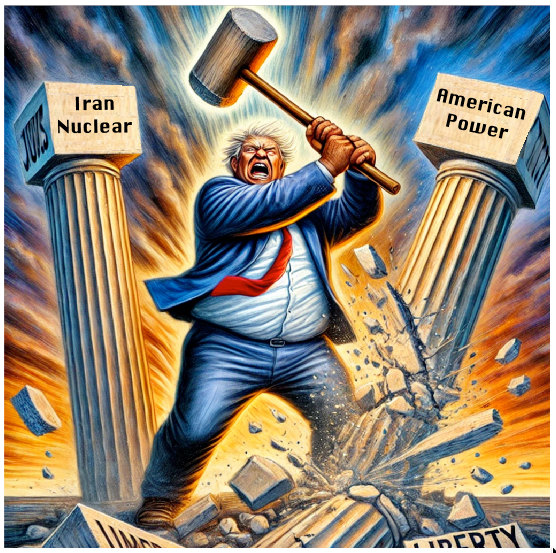
Trump wants to make an Iran nuclear agreement permanent so that an incompetent future president cannot undo it.
That's precisely what he did to the agreement negotiated by Obama.
Donald Trump is the most incompetent U.S. President on foreign affairs in history.
Trump, with an extraordinary degree of self-awareness:
"I'm going to make a deal that is going to be permanent...So what I'm doing is I'm going to make it so that if we have an incompetent president in four years or 15 years or 20 years, I'm going to make a deal that is going to be permanent."
MP Materials deserves credit for producing rare earth magnets in the U.S.
But production-ready is not the same as production at scale.
China has ~210,000 tons of annual magnet capacity.
MP targets 10,000 tons EVENTUALLY.
A milestone, not independence.
@SantiagoAuFund
COP31 has the same problem as every previous summit: consensus without accountability.
But the deeper failure is mitigation itself, @jrockstrom
Even unanimous agreement can't overcome physical and economic constraints.
We need Plans B, C and D—not more promises.
https://t.co/5NW1FcuoHi
Trump promised stabilization, economic recovery and democratic transition in Venezuela.
So far, he's focused on oil deals while neglecting the other objectives.
Washington risks strengthening the same corrupt system it promised to replace.
https://t.co/a2UMzHZ4KY
The Democratic blue wave won't fix affordability.
Ending the Iran war should come first. It's driving up energy prices and federal spending.
The authors' proposals for Ukraine, Taiwan and AI are more wishful thinking than practical solutions.
https://t.co/L2hVzzYCUB
@IvoHDaalder@JamesMLindsay
I agree with @JohnFMauldin that taxing the rich won't solve America's debt problem.
What's missing from his analysis is energy.
Debt is a claim on future economic production, not merely a mismatch between tax revenues and spending.
That production depends on energy.
https://t.co/kphvtjbTcV
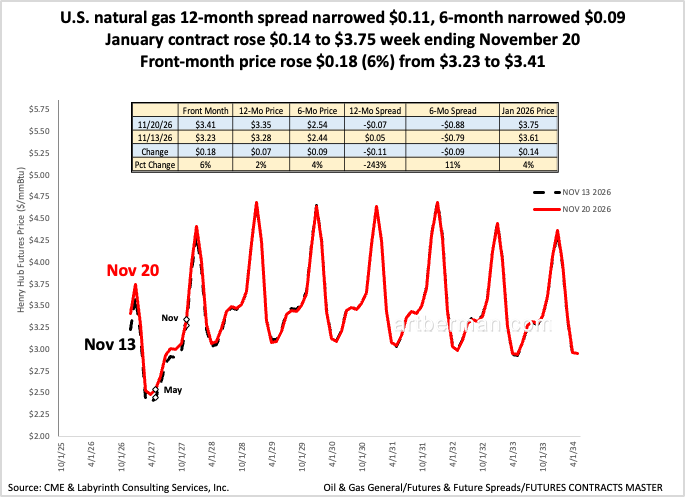
U.S. natural gas 12-month spread narrowed $0.11, 6-month narrowed $0.09
January contract rose $0.14 to $3.75 week ending November 20
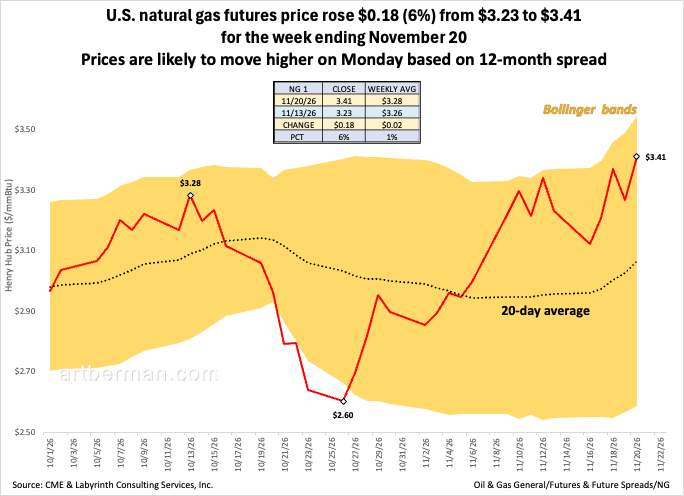
Front-month price rose $0.18 (6%) from $3.23 to $3.41
U.S. natural gas futures price rose $0.18 (6%) from $3.23 to $3.41 for the week ending November 20
Prices are likely to move higher on Monday based on 12-month spread
@aeberman12 Is the current system sustainable? To a layman like me it seems too risky, too expensive, and too difficult to plan large expensive projects around. What are your thoughts about the long term?