New pinned tweet, as the links broke for the old one:
"Petroleum and Progress in #Iran: Oil, Development, and the Cold War." https://t.co/jeVAp8VXbz
"The Struggle for #Iran: Oil, Autocracy, and the Cold War, 1951-1954." https://t.co/WIet3Z6z3e
Trump believes that he can force Iran's capitulation. Netanyahu is advocating for another round of bombing that can cause collapse inside Iran and regime change. Trump appears to be leaning in that direction.
We truly are back to February. https://t.co/o8zaqb82ev
COLUMN: Don't mistake Mideast oil rebound for normality
Crude oil prices remain near five-month highs despite a recent surge in Middle East crude exports above pre-war levels and intensifying Iranian attacks on tankers in the Strait of Hormuz. This suggests investors may already be bracing for another round of regional escalation.
The rebound in crude flows from the Gulf is striking. Middle East oil exports have averaged 17.3 million barrels per day (bpd) so far in October, up from 16.4 million bpd in September and above the 16.9 million bpd average in the two months before US-Israeli strikes on Iran began on February 28, according to Kpler data.
The sustained traffic is a clear sign that Gulf producers and tanker owners are willing to tolerate the risk of attack.
But higher flows should not be mistaken for a return to normality.
Read my full Reuters Open Interest column
https://t.co/c3BB9niVgE
"Briefly re-touching" is right.
At the moment, it looks like flows on 14-18 Oct spiked hard (thanks in part to a big day of loadings at Yanbu on 17 Oct), but slumped again right after.
All prelim data, we'll have a better sense of things next week, but the WSJ headline may have been a bit premature.
Briefly re-touching prewar total Middle Eastern crude export volumes is really impressive
Keeping them there for any durable period of time is gonna be a lot harder.
Refineries don’t set fuel prices. So who does?
Crude costs, tanker rates, refining and a global market all play a role. API’s @T_Mason_H breaks it down 💡
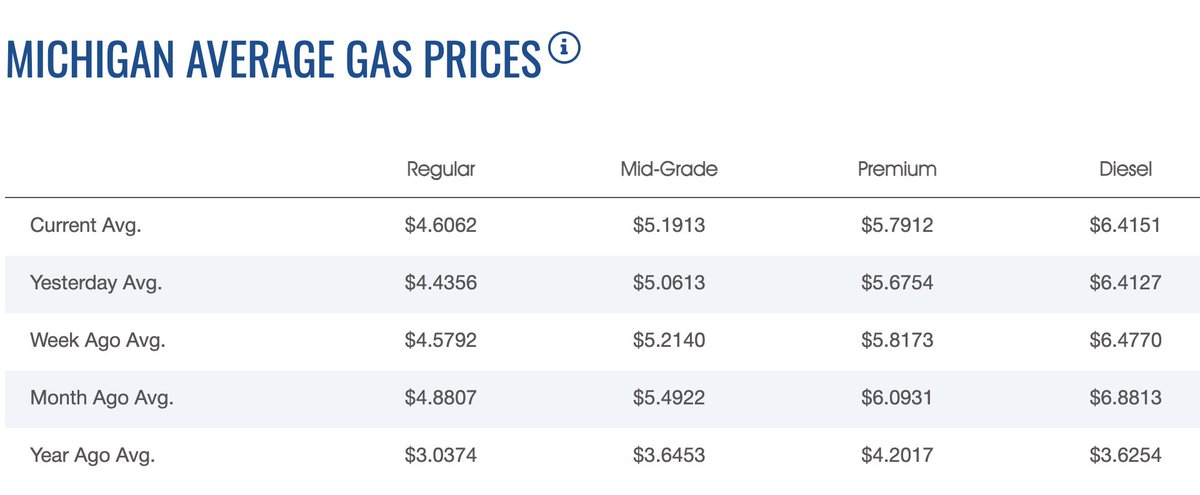
Drivers in Michigan woke up to an unwelcome October surprise today: Spiking gas prices.
The Michigan average spiked by 17 cents (!) today. Not just Michigan
Illinois: +2 cents
Wisconsin: +6 cents
Indiana: +8 cents
Ohio: +10 cents
Michigan has experienced biggest 12-month spike
Iranians were reportedly annoyed by these warnings, since to them it looks like blackmail--accept Trump's demands or he'll bomb you--and also because they suspect Trump will bomb them regardless of whether a deal is reached ahead of Nov 3 or not.
Once again: military pressure doesn't have a great track record as a means of compellence on Iran. Their instinct is to resist. And that's what they're going to do.
'Mediators are warning Iran to take the negotiations seriously, or Trump may lose interest and launch new strikes'
Senior Middle East Correspondent @Ariel_Oseran joins @Nicole_Zedeck on #MiddleEastNow
Read more here 👉 https://t.co/lu7bw76CNJ
Data suggests that Iran's stock of oil on the water has been depleted.
FWIW on average 2026 will likely be a profitable year for Iran, given high prices and several periods (Mar-Apr, July) of very high loadings.
But earnings in 2027, absent an end to the US blockade, will be zero. https://t.co/tI1UPkoxyA
A fascinating interview with Rezaee from @DropSiteNews. He lays out Iran's position and strategy in clear language.
-The goal is not to survive to the end of Trump's term, but to restore deference by inflicting costs.
-Iran remains open to a deal based on the MOU from June, which was incorrectly implemented.
-Iran is ready for war and will retaliate--civilian infrastructure could be a target (though Rezaee is a bit more conditional here than in other recent interviews).
⚡️ EXCLUSIVE: Iran could expand its targets to include data centers, AI facilities and communications cables if the U.S. resumes attacks, Gen. Mohsen Rezaei, Iran’s top security official, told Drop Site News.
Rezaei, Secretary of Iran’s Supreme National Security Council and personal representative of Supreme Leader Ayatollah Mojtaba Khamenei, spoke to Drop Site in an exclusive written interview.
“If the question is whether Iran still has the ability to continue missile and drone operations, the answer is yes,” Rezaei said.
“The United States has valuable assets in the region. In the event of war, cables, data centers and artificial intelligence facilities could also come within range. If the conflict begins again, we will have a broader plan.”
🔗 A short summary of the report is linked below. Read the full report from Jeremy Scahill, Ryan Grim and Peiman Salehi linked in the replies.
There was a plan to attack in October (some reports put it at 10-11 Oct) but Trump decided not to at the last minute.
He also ordered strikes on the Houthis last month, but changed his mind.
A resumption in the war is subject to his whims.
US officials cited here think that an intense, brief (as in, a few days) air campaign will push Iran into making concessions on its nuclear program.
These predictions have been made before. They have proven incorrect. Iran is broadly signaling it is ready for an attack, that it expects one, and will retaliate aggressively.
Trump has yet to make a decision. https://t.co/pPOhGGRvr4
Iran fully expects the US and/or Israel to attack. That much is clear.
It is unlikely that Iran fires the first shot. But they do appear ready to fire the last.
Some U.S. sources said they had the impression that Israel was hoping the Iranians would fire at the aircraft, providing a justification for launching strikes against Iran
You're right that it's a burst, with loadings much higher 15-18 Oct than the two weeks before. Also an unusually busy day at Yanbu on 17 Oct, at 11m bbls, which helped to drag up the average.
As ever, the question for me is not whether the US can get this kind of volume out, but whether it can do so sustainably, in such a way that prices drop and the curve comes down. Movement in the last three weeks has been in the opposite direction.
Iran has little hope that current talks yield progress--instead, it is preparing for US escalation, which it sees as likely.
Araghchi also issues a thinly veiled threat: any escalation "will put civilian lives and the wellbeing of all regional states and the global economy at great risk." https://t.co/cbLjyAgn0R
Netanyahu wants to resume the war, he's comfortable striking sensitive Iranian civilian infrastructure, and he wants to do so before 27 October elections, but can't (it seems) because Trump won't move until after the 3 Nov midterms. None of this seems too surprising.
https://t.co/tLXunLmExL
After falling for two weeks, regional flows bounced back, with the average for total liquids spiking above 23 million bpd, higher than the prewar level, per Kpler's tracker.
Iranian attacks pose risks, but the rewards for tankers are worth it. https://t.co/lgJnfFcLch
Persian Gulf oil exports have surpassed prewar levels, as an improvised shipping system under U.S. protection is helping tankers move oil through one of Iran’s fiercest waves of attacks in the Strait of Hormuz. https://t.co/hjmlt17brV