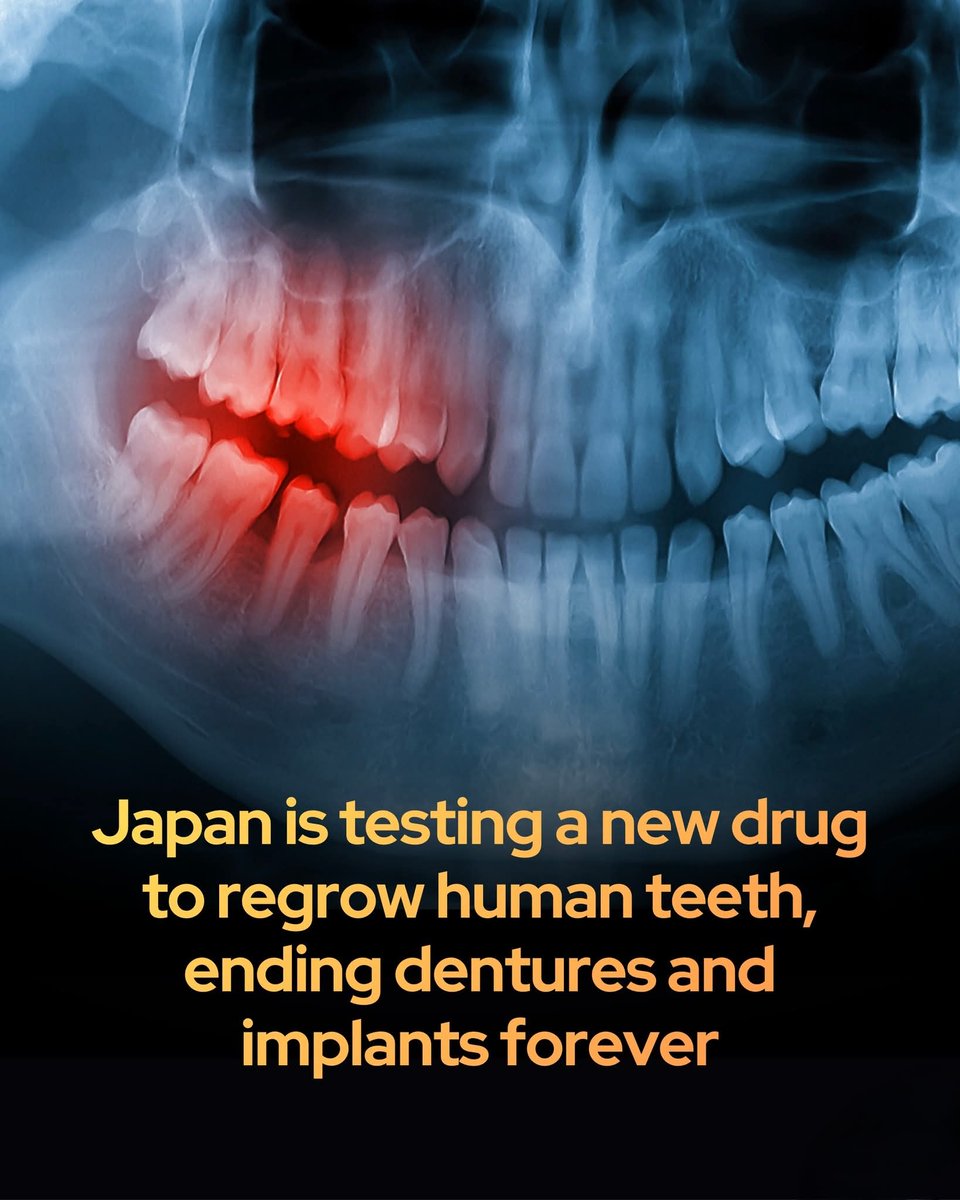
Human trials are underway for a drug that regrows human teeth in just 4 days.
Scientists are initiating human trials for a groundbreaking drug designed to regrow teeth naturally, potentially rendering dentures and implants obsolete.
For decades, permanent tooth loss has been considered an irreversible part of aging or injury, leaving millions reliant on synthetic implants and dentures. However, researchers at Kyoto University are now challenging this biological limitation by launching human trials for a drug that triggers natural tooth regrowth. The treatment works by inhibiting a protein called USAG-1, which normally suppresses the maturation of "extra" tooth buds. By blocking this biological brake, scientists have successfully grown new, fully functional teeth in animal models, effectively tapping into a latent "third dentition" that humans carry in a suppressed state.
The project is being advanced by the startup Toregem BioPharma, with an initial clinical focus on individuals with congenital tooth agenesis—a condition where adult teeth never form. These patients are ideal candidates because their dormant tooth buds are already present but inactive, waiting for the correct biological signal to mature. While the drug requires precise timing and developmental context to work effectively, its success could signal a massive paradigm shift in restorative medicine. Moving beyond porcelain and titanium, the future of dentistry may lie in the body’s own inherent ability to regenerate its natural anatomy.
source: Takahashi, K., Kiso, H., & Murashima-Suginami, A. Advances in tooth agenesis and tooth regeneration. Regenerative Therapy
FEBRUARY 28, 2026
Don't forget to look up: a celestial spectacle is unfolding. Six planets are tracing a graceful arc across the evening sky.
Read my other posts for more details.
Here’s how to slash sugar spikes from pasta — and make it healthier.
Scientists discover that cooling cooked pasta for 24 hours transforms its starch into a gut-friendly fiber that slashes blood sugar spikes.
When you cook pasta and then cool it for at least 24 hours, the starch molecules undergo a process called retrogradation. This molecular reorganization transforms digestible starch into "resistant starch," which functions more like fiber than a simple carbohydrate. Instead of being rapidly absorbed in the small intestine and causing a sharp rise in glucose, it travels to the large intestine where it feeds beneficial gut bacteria as a powerful prebiotic. This simple kitchen hack not only supports a healthy microbiome but also encourages the production of short-chain fatty acids that help reduce internal inflammation.
Beyond gut health, this transformation provides a significant advantage for metabolic wellness by slowing sugar absorption and improving insulin response. Perhaps most surprisingly, these health benefits remain largely intact even if you choose to reheat the pasta before eating. By simply planning ahead and refrigerating your noodles overnight, you can effectively lower the caloric impact of your meal while maintaining more stable energy levels throughout the day. This game-changing strategy allows you to enjoy favorite comfort foods while prioritizing long-term health and better blood sugar control.
Source: Bullen, A. (2022). Is Reheated Pasta Actually Better for You? Cleveland Clinic Health Essentials.
Mel Gibson: "I have 3 friends. All 3 of them had stage 4 cancer…and all 3 of them…don't have cancer right now at all…"
Joe Rogan: "What did they take…? Ivermectin and Fenbendazole…"
Mel Gibson nods in agreement.