THIS HAS MARKED EVERY MAJOR BUYING & SELLING OPPORTUNITY SINCE 1990
Dot-Com Crash.
Global Financial Crisis.
COVID Crash.
2022 Bear Market.
2025 Tariff Selloff.
The $VIX is Wall Street’s fear gauge.
If you trade $SPY or $QQQ, you need to understand it.
VIX below 20: TRIM / REDUCE RISK
VIX 20–30: HOLD
VIX 30–40: START BUYING
VIX above 40: BUY THE PANIC
RIGHT NOW: VIX 14.25
We’re in the low-volatility zone.
Let winners run, but don’t chase. Trim extended positions and keep cash ready for the next volatility spike.
Buy when others are fearful. Sell when they are greedy.
It's finally here... and absolutely FREE!
I built this entire indicator with our NEW platform @LuxAlgo Quant.
A simple concept turned into an INSANE tool in a few prompts.
The concept?
"Identify HTF Reversal Patterns with LTF Divergences
Here is exactly how to use it ⤵️
First add the indicator to your chart:
HTF Reversal Divergences [LuxAlgo]
https://t.co/en7te5xRjF
First pick your timeframe combo, I suggest:
1min/5min - Scalp
5min/15min - Better setups (less often)
15min/1hr - Short Swing
1hr/4h - Swing
The best setups I have seen are:
1. Looking for a low timeframe divergence to form on the 1min or 5min.
2. Then AFTER the divergence a Hammer Candle forming on the higher timeframe. (this candle is plotted on your chart)
For 1min the HTF candle would be a 5min Hammer
For 5min the HTF candle would be a 15min Hammer
We also added an advanced feature where you can have realtime HTF candles plotted to the right of price to further understand where the HTF is coming from. Similar to a traditional PO3 indicator.
Hope you enjoy!
If you made it this far, make sure to comment, like, follow and repost for more!
One setup for life
It changed my journey, It might change yours too.
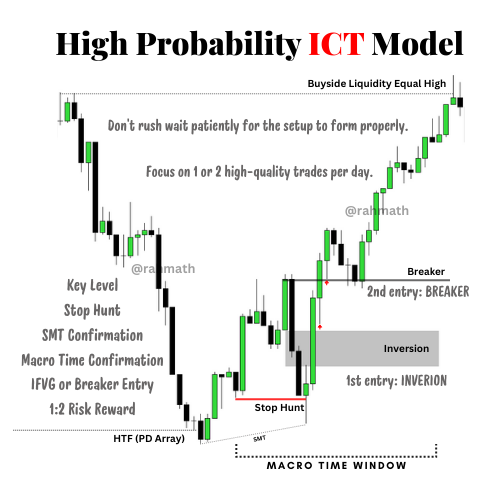
Don't rush wait patiently for the setup to form properly.
Focus on 1 or 2 high-quality trades per day.
Study it. Backtest it.
My Personal Entry Model
A complete guide PDF 📄
This model will completely reshape your trading future.
If you're interested, just like this post and comment "ENTRY MODEL", and I'll send it to you.
(Don’t forget to follow me so I can DM you!)
Happy to Introduce Easy and Simple model to trade #CRT
" Super Model 🌹 "
Searching for a Sleepy Model to Trade , Make use of my Model . A model with High Win Rate and High Risk Reward
Take notes , Take your Profits ✍️
#supermodel
A few tips for beginner investors:
1) Never buy a stock in a Stage 4 downtrend.
2) Never buy a stock below its 200-day moving average.
3) Focus on the leaders, not the laggards.
4) If it seems too good to be true, it probably is.
5) In a bull market, be long.
6) Hope is not a strategy.
7) Being wrong is okay, staying wrong is unacceptable.
8) To generate alpha: make more or lose less.
9) Always know when to get out before you get in.
10) There are only a few periods in the year to make money.
11) Protect your financial and emotional capital.
12) Don't make decisions out of fear or greed.
13) Don't fall for value traps; valuations are a terrible timing indicator.
14) Forget buy and hold; it's buy, hold, and check.
15) Follow your own strategy.
16) Small losses and quick losses are the best losses.
17) Learn to sell.
18) If you don't sell early, you'll sell late.
19) The big money is made from two or three opportunities each year.
20) Patience.
21) Do more of what's working for you and less of what’s not.
22) When you experience big losses, take time off.
23) Get aggressive when things are working; get defensive when things are not.
24) Fight on the side of the market that is winning.
25) Don’t pick the bottom and don’t call tops.
26) Focus on stocks making new highs; new highs are where the money is.
27) Respect the other side of the trade; know both sides.
28) Never argue with the market.
29) Stack the odds in your favor.
30) You don’t need to be right all the time to make money.
31) Get comfortable being wrong.
32) It’s not how much you make, it’s how much you keep.
33) Write down why you bought and sold a stock.
34) Keep it simple.
35) Charts don't lie.
36) Never buy a stock on recommendations.
37) Do your diligence.
38) Every bull market ends, just as every bear market does.
39) High performance is a function of skill and luck; and luck comes and goes.
40) Timing is everything.
41) Bend with the trend.
42) Never average losers.
43) When in doubt, get out.
44) Don’t listen to the news, listen to the market.
Hope this helps.
Here's the link to the FINAL PDF 👇
https://t.co/cf7I1igCeC
…After sending over 200+ DMs, I’ve hit a temporary restriction. Pausing for now, but I’ll be back soon! Appreciate your patience 📷
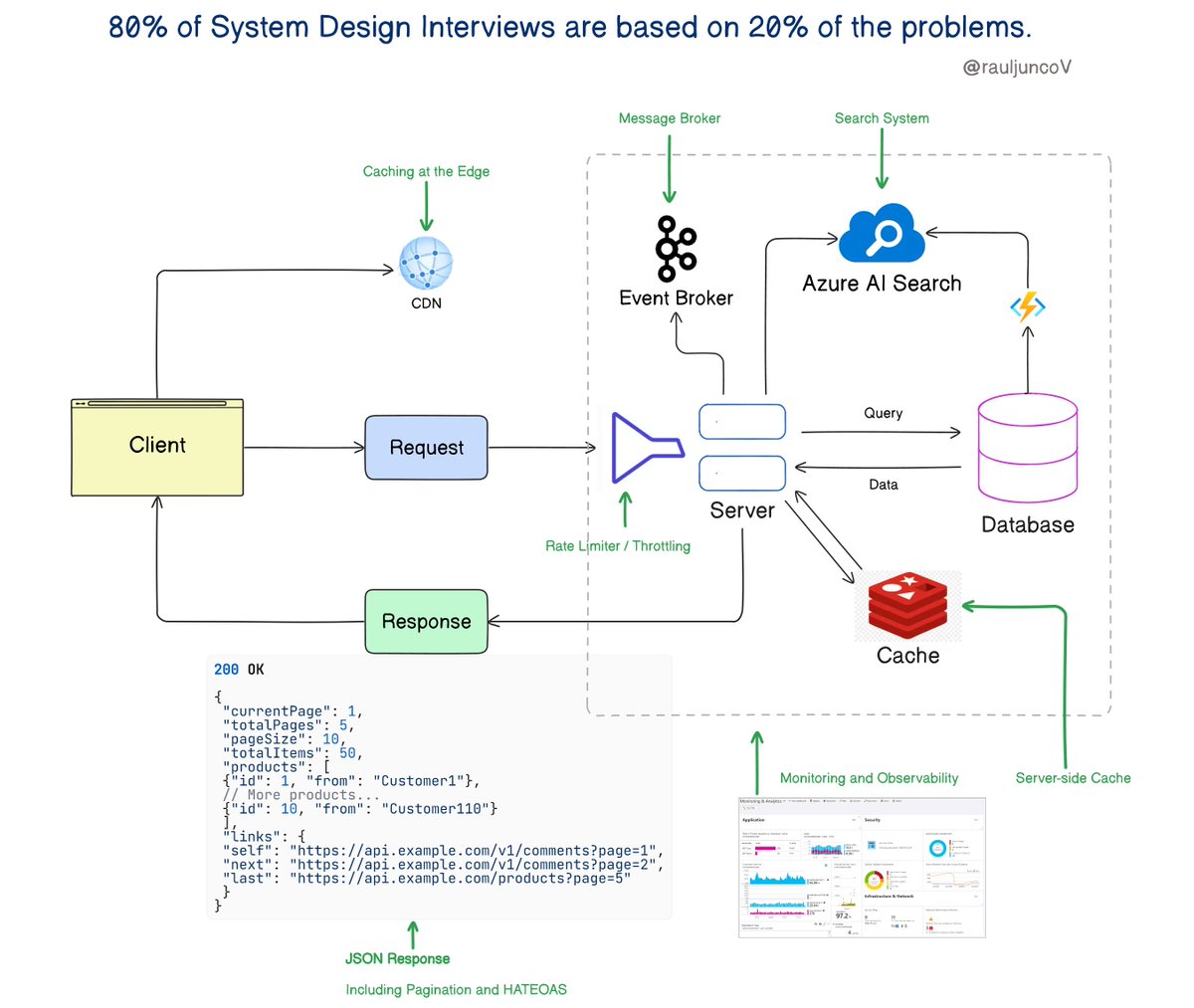
80% of System Design Interviews are based on 20% of the problems.
Here is what you need to master.
1. Scalable Data Storage
• Relational vs. NoSQL: Know when to use SQL vs. NoSQL databases.
• Partitioning: Vertical and horizontal partitioning (sharding). Understand trade-offs.
• Indexing: Covering indexes, primary vs. secondary indexes.
• Consistency Models: Strong, eventual, causal.
2. Caching
• Client-side vs. Server-side Cache: Understand where caching should happen.
• Caching Strategies: Write-through, write-back, write-around.
• Distributed Cache: Redis, Memcached.
• Cache Eviction Policies: LRU, LFU, etc.
3. Load Balancing
• Horizontal Scaling: Why and how to horizontally scale services.
• Load Balancing Techniques: Round-robin, consistent hashing.
• Reverse Proxy: Understand how to use Nginx, HAProxy.
4. Asynchronous Processing
• Message Brokers: Kafka, RabbitMQ. When to use queues vs. streams.
• Event-Driven Architecture: Benefits of decoupling and event sourcing.
• Task Queues: For delayed jobs or retries.
5. Database Read and Write Scaling
• Read Scaling: Master replication, read replicas.
• Write Scaling: Challenges with partitioning for writes, leader-election.
• CAP Theorem: Consistency, Availability, or Partition tolerance may be compromised.
6. Distributed Systems Concepts
• Consensus Algorithms: Paxos, Raft.
• Conflict Resolution: Last Write Wins, CRDTs, vector clocks for data reconciliation.
7. Reliability and Failover
• Redundancy: Active-passive vs. active-active configurations.
• Health Checks.
• Retries and Circuit Breakers: How to protect systems from cascading failures.
8. CDNs (Content Delivery Networks)
• Static Content Delivery: Why use a CDN, how does it work?
• Caching at the Edge: How CDNs improve latency for end users.
9. API Design and Rate Management
• REST vs. GraphQL: Difference and practical use-cases for each.
• Pagination and Filtering: Strategies for efficiently fetching data.
• API Versioning: Best practices for evolving APIs.
• Throttle Requests: Why rate limiting is essential, algorithms like token bucket, leaky bucket.
10. Search Systems
• Indexing: Building and maintaining indexes for fast search.
• Full-Text Search Engines: ElasticSearch, Azure AI Search.
• Ranking and Relevance: Basic understanding of how scoring works.
11. Monitoring, Observability and Security
• Metrics Collection: Prometheus, Grafana.
• Distributed Tracing: OpenTelemetry, Sentry.
• Centralized Logging.
• Authentication and Authorization: OAuth, JWT.
• Encryption: Data in transit vs. data at rest.
If you master these 13 areas, you'll be ready for most system design interviews thrown at you.
Add more if you can 👇


![QuantIndicator's tweet photo. It's finally here... and absolutely FREE!
I built this entire indicator with our NEW platform @LuxAlgo Quant.
A simple concept turned into an INSANE tool in a few prompts.
The concept?
"Identify HTF Reversal Patterns with LTF Divergences
Here is exactly how to use it ⤵️
First add the indicator to your chart:
HTF Reversal Divergences [LuxAlgo]
https://t.co/en7te5xRjF
First pick your timeframe combo, I suggest:
1min/5min - Scalp
5min/15min - Better setups (less often)
15min/1hr - Short Swing
1hr/4h - Swing
The best setups I have seen are:
1. Looking for a low timeframe divergence to form on the 1min or 5min.
2. Then AFTER the divergence a Hammer Candle forming on the higher timeframe. (this candle is plotted on your chart)
For 1min the HTF candle would be a 5min Hammer
For 5min the HTF candle would be a 15min Hammer
We also added an advanced feature where you can have realtime HTF candles plotted to the right of price to further understand where the HTF is coming from. Similar to a traditional PO3 indicator.
Hope you enjoy!
If you made it this far, make sure to comment, like, follow and repost for more!](https://pbs.twimg.com/media/HDJDZEBWEAAoFPS.jpg)





![QuantIndicator's tweet photo. It's finally here... and absolutely FREE!
I built this entire indicator with our NEW platform @LuxAlgo Quant.
A simple concept turned into an INSANE tool in a few prompts.
The concept?
"Identify HTF Reversal Patterns with LTF Divergences
Here is exactly how to use it ⤵️
First add the indicator to your chart:
HTF Reversal Divergences [LuxAlgo]
https://t.co/en7te5xRjF
First pick your timeframe combo, I suggest:
1min/5min - Scalp
5min/15min - Better setups (less often)
15min/1hr - Short Swing
1hr/4h - Swing
The best setups I have seen are:
1. Looking for a low timeframe divergence to form on the 1min or 5min.
2. Then AFTER the divergence a Hammer Candle forming on the higher timeframe. (this candle is plotted on your chart)
For 1min the HTF candle would be a 5min Hammer
For 5min the HTF candle would be a 15min Hammer
We also added an advanced feature where you can have realtime HTF candles plotted to the right of price to further understand where the HTF is coming from. Similar to a traditional PO3 indicator.
Hope you enjoy!
If you made it this far, make sure to comment, like, follow and repost for more!](https://pbs.twimg.com/media/HDJDaiCWIAA4-4_.jpg)

![SureshFX3's tweet photo. 𝗜𝗖𝗧 𝟮𝟬𝟮𝟰 𝗠𝗲𝗻𝘁𝗼𝗿𝘀𝗵𝗶𝗽 - 𝗟𝗲𝗰𝘁𝘂𝗿𝗲 𝟯 𝗡𝗼𝘁𝗲𝘀
[𝗦𝗶𝗺𝗽𝗹𝗶𝗳𝗶𝗲𝗱]
A Thread🧵 https://t.co/vTZm1kymu3](https://pbs.twimg.com/media/GtfTJWMbgAAi_uM.jpg)