So, I wanted to create a #Kubernetes cluster on bare metal. After tinkering and PoC-ing stuff, I have a working cluster.
Decided to use VirtualBox to create VMs. Sure I could use minikube, kind, or something else, but where is the fun in that?
I've got an agent in a loop optimizing a renderer with the goal to minimize frame times (and tests to measure). It got times down from 88ms to 2ms and allocations down from ~150K to 500. Sounds good, right? Wrong. This is exactly why agent psychosis is a big fucking problem.
As an experiment, I rewrote the Ghostty core render state in Go, with access to identically laid out data structures as Ghostty and the exact same validation tests. I made a purposely naive renderer (simple, correct, but slow). 88ms per frame with 150,000 allocations (horrendous, lol)!
I then kickstarted a Ralph loop to bring the frame times down. I told it it can't modify input data structures or the public API or tests (they're correct), but it can do anything else it wants. It got to work.
It has worked for about 4 hours. I've spent around $350 on this experiment so far. The results?
88ms => 1.5ms
150K allocs => ~500 allocs
Incredible right? Nope.
My hand-written renderer I ported has frame times (same benchmark) of ~20us (0.020ms) and 0 allocations in the update path.
This is the problem with psychosis and lacking systems understanding. If you don't understand the system, you're going to accept that this is an incredible result. If you understand the system, you'll see better solutions immediately and can do roughly 75x better on throughput.
The people who blindly trust agent output are in the former camp. They're sheeple, overdrinking from a fountain of mediocrity.
Standard disclaimer: I use AI all the time. I like AI. The point I'm making is to not blindly accept results. Think. Analyze. Learn.
I strongly believe there are entire companies right now under heavy AI psychosis and its impossible to have rational conversations about it with them. I can't name any specific people because they include personal friends I deeply respect, but I worry about how this plays out.
I lived through the great MTBF vs MTTR (mean-time-between-failure vs. mean-time-to-recovery) reckoning of infrastructure during the transition to cloud and cloud automation. All those arguments are rearing their ugly heads again but now its... the whole software development industry (maybe the whole world, really).
It's frightening, because the psychosis folks operate under an almost absolute "MTTR is all you need" mentality: "its fine to ship bugs because the agents will fix them so quickly and at a scale humans can't do!" We learned in infrastructure that MTTR is great but you can't yeet resilient systems entirely.
The main issue is I don't even know how to bring this up to people I know personally, because bringing this topic up leads to immediately dismissals like "no no, it has full test coverage" or "bug reports are going down" or something, which just don't paint the whole picture.
We already learned this lesson once in infrastructure: you can automate yourself into a very resilient catastrophe machine. Systems can appear healthy by local metrics while globally becoming incomprehensible. Bug reports can go down while latent risk explodes. Test coverage can rise while semantic understanding falls. Changes happens so fast that nobody notices the underlying architecture decaying.
I worry.
Here is my prediction:
The Magnificent Seven - Alphabet, Amazon, Apple, Meta, Microsoft, Nvidia, and Tesla - will continue to push AI down our throats despite diminishing returns to its users, simply because they’ve invested so much they’ve gone past a point of no return.
That notwithstanding, the inevitable Great Implosion will happen to companies such as Anthropic and OpenAI because open source models that can be run locally - with minimal capex and zero risk of surveillance - are quickly and irreversibly becoming good enough.
The whole ”AGI is just around the corner” is a meaningless and silly distraction.
Just migrated our entire production stack from @DigitalOcean to @Hetzner_Online in just 24 hours — $1,432 → $233/month. Zero downtime. 30 MySQL DBs (248GB), 34 Nginx sites, GitLab EE, Neo4j. All automated with Python scripts.
Full write-up on my blog 👇 https://t.co/337rGgGHxB
Scripts on GitHub: https://t.co/66ETOX7Mml
#devops #hetzner #digitalocean #mysql #migration #linux
9 interesting observations from my conversation with Mitchell Hashimoto (@mitchellh, creator of Ghostty, founder of HashiCorp):
1. Vagrant was created because dev environment setup was an unbillable time sink at a consultancy. At the Ruby on Rails shop where Mitchell worked, jumping onto another client’s project could waste half a day. This inspired building Vargant.
2. Terraform won, despite being 7th to market. Terraform won through relentless conference presence, community building, and a better developer experience — not timing.
3. HashiCorp had no real business for four years and their first commercial product was a full-on failure. The initial product, Atlas, required customers to adopt the entire HashiCorp stack. It was a hard sell. HashiCorp pivoted to selling individual services like Vault, and this approach proved to be a winner.
4. VMware almost bought HashiCorp for ~$100M, and Terraform would have not happened if it did. VMWare took took the offer to their board, where they rejected to buy with a single vote. Mitchell said that Terraform probably never would’ve existed if the VMWare purchase went through.
5. Mitchell’s new rule for building software: always have an agent running in the background doing something. He kicks off tasks before leaving the house — research, edge-case analysis, library comparisons — so work progresses while he drives or is away.
6. Open source is moving from “default trust” to “default deny” — and Mitchell thinks that’s how it should be. This is because AI makes it trivial to create plausible-looking but incorrect and low-quality contributions. As he put it: “open source has always been a system of trust. Before, we’ve had default trust. Now it’s just default deny.”
7. Git and GitHub may not survive the agentic era in their current form. Agents cause so much churn that merge queues become untenable, branches proliferate, and repos balloon. Mitchell compares the needed shift to Gmail’s revolution for email: “We’re at the Gmail moment for version control... never delete, archive everything.”
8. The best engineers Mitchell ever hired had boring, invisible backgrounds. No GitHub contributions, no public profiles, companies you’ve never heard of. “Every moment you spend on social media is taking away from something else... the best engineers are the ones that context-switch the least.”
9. Mitchell’s advice for AI-skeptical engineers: start by reproducing your research, not your code. As he puts it:
“There’s a lot of people like, ‘I don’t want it to write code for me.’ But just delegate some of the research part.”
He uses agents for library comparisons, edge-case analysis, and deep research — not just code generation. Mitchell: “You don’t need to pick up on the ‘it must replace you as a person’ kind of propaganda.”
Watch the full episode here: https://t.co/eETyr20fQA
Other platforms and transcript: https://t.co/yl0WdFRbA4
⚠️🧵RL researchers have detected continued malicious activity on #VSCode as part of a Dec 2025 campaign, first described by KOI. Here's the latest example: https://t.co/mL4kxsrK6B
://
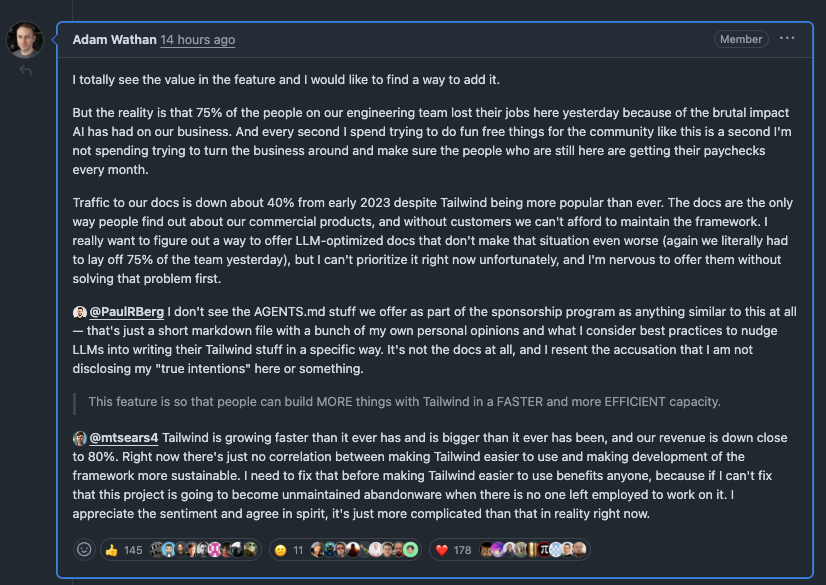
Lets hope it het sorted out good for @tailwindcss it's a phenomenal good product
TLDR: tailwind have lost 80% revenue and laid of 75% of the staff probably mostly due to AI
The Rawkode Academy is taking on sponsors for 2024. Each level comes with a ton of perks.
We have plans at 10,20,40, and 80k (per annum)
The best part? All plans come with some of my time (or a lot of my time), website placements, and bespoke content or courses.