@Macrobysunil Bessent is putting Warsh in a policy box: expand FIMA and the Fed balance sheet, or tolerate destabilizing Treasury sales. Warsh wants a smaller balance sheet, but Bessent’s solution requires the Fed—not Treasury—to act. Fiscal dominance is starting to show up in the plumbing.
The coming clash between Warsh not wanting to expand the balance sheet vs the fiscal dominance situation that Bessent recognizes is going to be interesting. Using this facility short term accomplishes little. They will have to roll this and grow the Feds balance sheet for it to be effective.
Governments are increasingly suppressing financial pressure in the two main policy battlegrounds: sovereign yields and FX. Repo facilities, intervention and central-bank balance sheets can alter the path, but they cannot eliminate the underlying loss.
The pressure must migrate somewhere. Precious metals and BTC remain the cleaner release valves because policymakers are not presently defending a price ceiling there. In gold’s case, central banks are actually buying it.
Trade the pressure-release valve, not the policy battleground.
Fair point on the plumbing: Japan does not need to sell Treasuries on the exact day it intervenes. It can draw cash, use private repo, tap FIMA or access other official dollar facilities.
That addresses the short term but not the long term sourcing issue. Once Japan sells the dollars for yen, those dollars have left Japan’s reserve portfolio. The intervention still has to be funded economically through some combination of reduced foreign assets, lower reinvestment, diversion of future dollar income or extended official borrowing.
The prior TIC and reserve data suggest this is not merely a hypothetical concern. Japan appears already to have used securities liquidation as a material part of the intervention funding process.
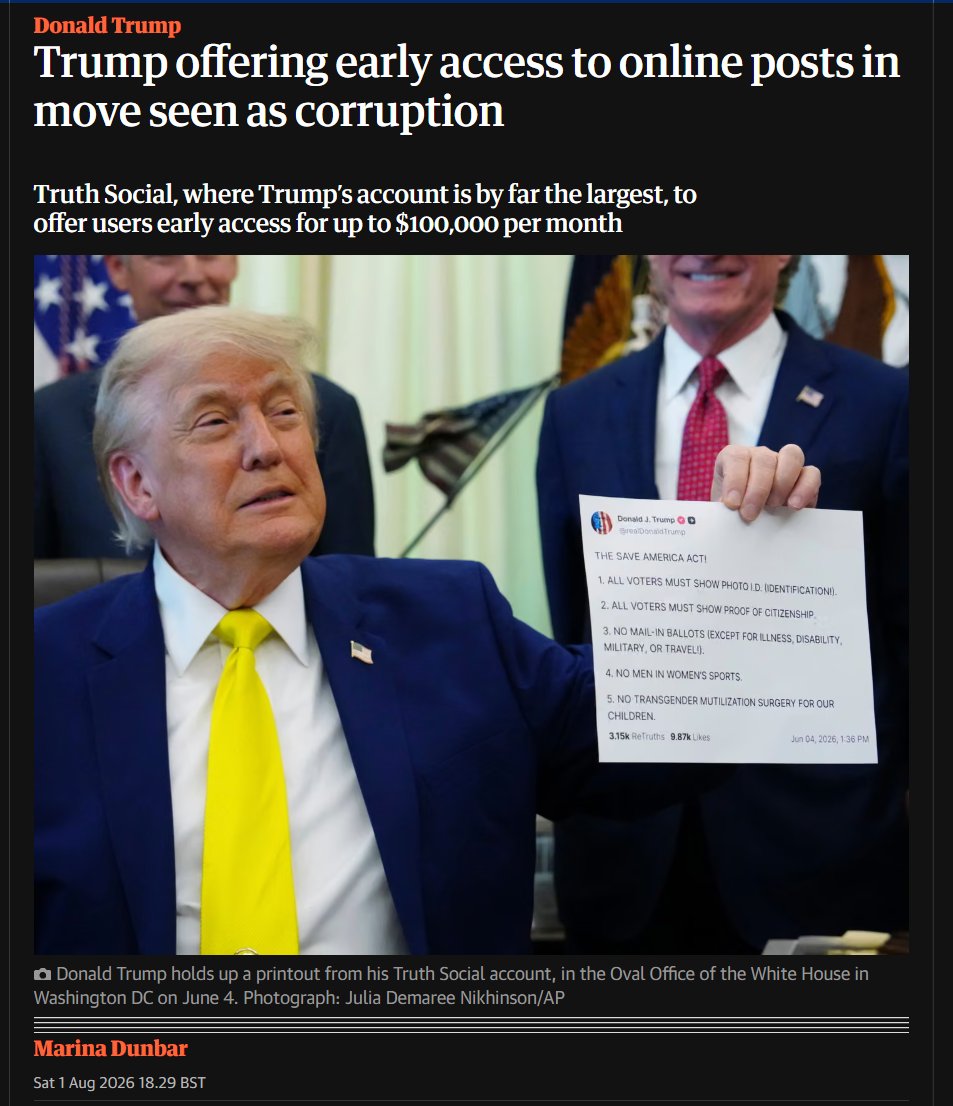
Trump is now charging Wall Street a subscription fee of $100,000 per month for early access to his market moving Truth Social posts.
How is this legal?
US equities are 70% of global equity market cap bc the USDs have already rushed here
In a true deflationary bust, US equities and bonds will be sources of funds for USD denominated debt and Eurodollar obligations bc they have nowhere else to get the USD
And as US stocks fall, US consumer spending and GDP fall, and US deficits blow out, pushing US interest expense + entitlements way above receipts, forcing print or default choice
That may be right—the 10-yr could reflect part of the price required to keep the U.S. absorbing global excess production while surplus capital remains in $ assets. But the cost is being distributed across the system, not cleared solely through the 10-year. Treasury has shifted marginal financing toward bills (now a larger pressure valve that 10 yrs), while U.S. technology equities attract return-seeking foreign capital & gold absorbs growing diversification demand away from UST's. A 5% 10-year may be one cost of preserving the arrangement, but not the only—or even primary—release valve.
A bond may pay interest, but it pays that interest—and ultimately returns principal—in a currency whose purchasing power the government has a strong incentive to dilute.
That is why a 4.67% Treasury yield is not automatically superior to gold.
The bond offers nominal income. Gold offers protection against what that nominal income is measured in.
I’d defer to Harley’s view below.
All I'll add is after nearly 3 yrs of shifting issuance to the front end to prevent a long end spike yrs ago (left), annual UST roll is now going exponential (right), which means raising rates 50 bps will be like throwing gasoline on a bondfire, IMO.
Investors may be focusing too much on longer term Treasiry rates. With 80% of new issuance under one year in maturity, the real vulnerability is in the short end. Rollover frequency is steadily increasing and making Treasury uber dependent on money-market funds, repo liquidity, stablecoin reserves, and continuous bill reinvestment. This is the crucible of debt financing stress.
Kevin Warsh’s message today was clear:
• Inflation control comes before market comfort
• One soft CPI print does not mean victory
• The Fed does not want to be in the bailout business
• Reckless investors should not assume an automatic Fed rescue
• The balance sheet should become smaller over time
• Markets must become less dependent on constant liquidity and forward guidance
Those are the words.
But the reality is that the entire financial system is already drugged on bailouts, money expansion and artificially suppressed interest rates.
Asset prices are no longer just about Wall Street wealth.
They support:
• Retirement accounts
• Pension funds
• Insurance balance sheets
• Bank collateral
• Credit creation
• Government tax revenues
• Broader financial stability
The system may talk about market discipline, but it cannot tolerate genuine market-clearing interest rates or a prolonged collapse in bonds, equities and real estate.
Once asset prices fall far enough and the plumbing begins to break, central banks will capitulate again.
My view remains unchanged:
Yield-curve control and Gold repricing is inevitable.
Because the debt-based system will eventually leave them with no other choice.
Strategy is still structurally dependent on continued capital-market access because the reserve is too small relative to recurring cash obligations.
What would actually fix it? A reserve of at least:
* $3B+ = roughly 2 years of coverage;
* $5B+ = more credible bear-market cushion;
* $8B+ = roughly 5 years and largely removes the forced-sale narrative.
Until then, the market can still ask:
What happens if BTC falls, MSTR premium compresses, and Strategy cannot issue common/preferred on acceptable terms?
A move to 5 RMB per USD would be politically and economically disruptive for China’s export model - agree on that. However, the exchange rate is not just: “Will China allow the RMB to rise?” It is also: “What happens to the dollar side of the pair?”
A material RMB rally could happen less because China becomes strong and more because the USD weakens due to:
- Fed/Treasury forced liquidity support;
- QE/YCC/market-functioning intervention;
- U.S. asset decline forcing policy response;
- foreign Treasury recycling weakening;
- fiscal dominance;
- declining real confidence in dollar assets;
- capital moving from U.S. paper claims toward gold/real assets.
In that scenario, USD/CNY can fall even if China is only passively allowing some RMB strength. If the U.S. is eventually forced into dollar-negative policy, gold becomes the cleaner neutral asset for both sides.
So the more important cross may not be just RMB vs USD, but: Gold vs both RMB and USD.
@KobeissiLetter Chinese investors are being boxed in:
Foreign stocks restricted.
Real estate in a multi-year bear market.
Low domestic rates.
Yuan depreciation risk.
Where does trapped capital go?
Precious metals.
@TaviCosta The post frames dollar devaluation as an intentional policy goal. I think the cleaner framing is:
The U.S. does not choose dollar devaluation directly. It chooses to defend the bond market, and dollar devaluation becomes the consequence.