RAG vs. retriever-free RAG, clearly explained!
(powered by decision models like Jev)
In a standard RAG setup, documents are split into chunks, converted into embeddings, and stored in a vector index.
When a query arrives, the system embeds it and pulls the top-k chunks with the closest vectors.
A reranker then reorders those candidates against the query, and the best few go to the LLM as context.
The problem is that the similarity search decides what the LLM can ever see.
If the right passage never made the top-k, nothing later in the pipeline can bring it back, not even a strong reranker.
Retriever-free RAG, from a new Cornell and ASAPP paper, keeps the documents and the LLM but replaces similarity search with navigation.
The documents are organized as a document tree, like a table of contents, and a decision model (Jev 1.13) walks down it.
A decision model doesn't generate text. It reads one shared context and returns a probability for every yes/no question about it, in one forward pass per stage.
Here's how a query moves through the tree:
↳ Top documents: the model reads the query beside every candidate document, asks "Is this relevant?" for each, and keeps the best few.
↳ Top passages: it opens only those documents and asks the same question for every passage inside them.
↳ Most relevant? (optional): a single multiple-choice question reorders the top 20 passages (top 5 on Natural Questions).
Dropped documents are never opened, so their passages are never scored.
On Natural Questions (2.68M Wikipedia paragraphs), its top pick contained the answer 65.4% of the time. Embedding search plus an 8B reranker got 48.0%, and GPT-5 reranking got 60.8%.
The gain comes from ranking, not coverage. Embedding search's top 100 holds the answer more often than the navigated shortlist (98.4% vs 94.0%), but navigation is better at putting it first.
Median retrieval takes under 2 seconds per query, but each method was timed in a different setup, so it isn't a controlled speed comparison.
The main limit is that it needs a sensible hierarchy, and a document pruned early is gone for good. It also skips embedding search only at query time, since the Wikipedia tree was built offline using embeddings.
The diagram below depicts the complete flow.
- RAG retrieves by similarity, then reranks.
- Retriever-free RAG navigates a document tree with a decision model.
- The LLM answers from the top passages.
If you're building a RAG system, this is worth benchmarking against your current setup.
Here's the paper: https://t.co/U7cCcIfZV1
If you're new to decision models, I've quoted my full breakdown of how Jev works below.
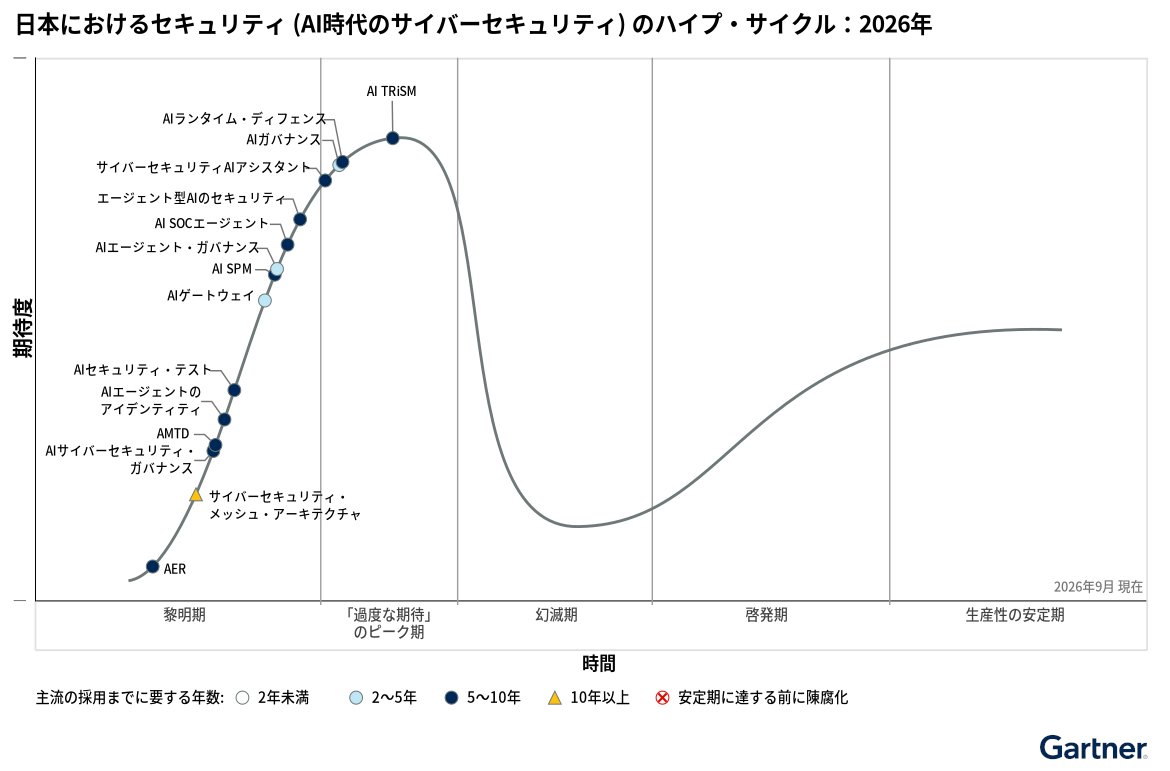
Gartner、日本におけるAI時代のサイバーセキュリティに関するハイプ・サイクルを発表
アナリストは「可能な限り早い段階からこうしたテクノロジの試験的利用を開始し、AI活用を進めながらセキュリティを発展させていくような試行錯誤の姿勢を取ることが重要」とコメント。
▼企業はAI時代のサイバーセキュリティを議論するべき視点
Security for AI (AIのためのセキュリティ)
・セキュリティ体系全体の再構築を迅速に進める必要がある
AI for Security (セキュリティのためのAI)
・フロンティアAIがもたらす新たな攻撃に対しては既存のルール・ベースの異常検知メカニズムが有効に機能しない可能性が指摘されている
・技術動向を丁寧に注視し、フロンティアAI時代の新たな脅威に立ち向かうための新しいアーキテクチャへとシフトさせていくことが急務
===============================================
セキュリティは企業経営の最優先課題という認識と、技術要素にかなり依存するので技術動向にいち早くキャッチアップすることが重要。
$OUSD is live.
Build with OUSD via @Coinbase@Mastercard@Stripe and @Visa. Each integration path supports 1:1 USD conversion at no cost.
Read the announcement: https://t.co/177w9TlM77.
We Must Pace the Frontier: I’ve written a new essay on why the AI industry should slow down, with a three-part plan for doing so.
Anthropic is unilaterally committing to the first of these steps. We’ll provide third-party evaluators with permanent, employee-level access to our systems, so that they can verify adherence to our safety measures, report on incidents, and assess models’ alignment during training.
You can read the full post here: https://t.co/OGyPb7yaYt