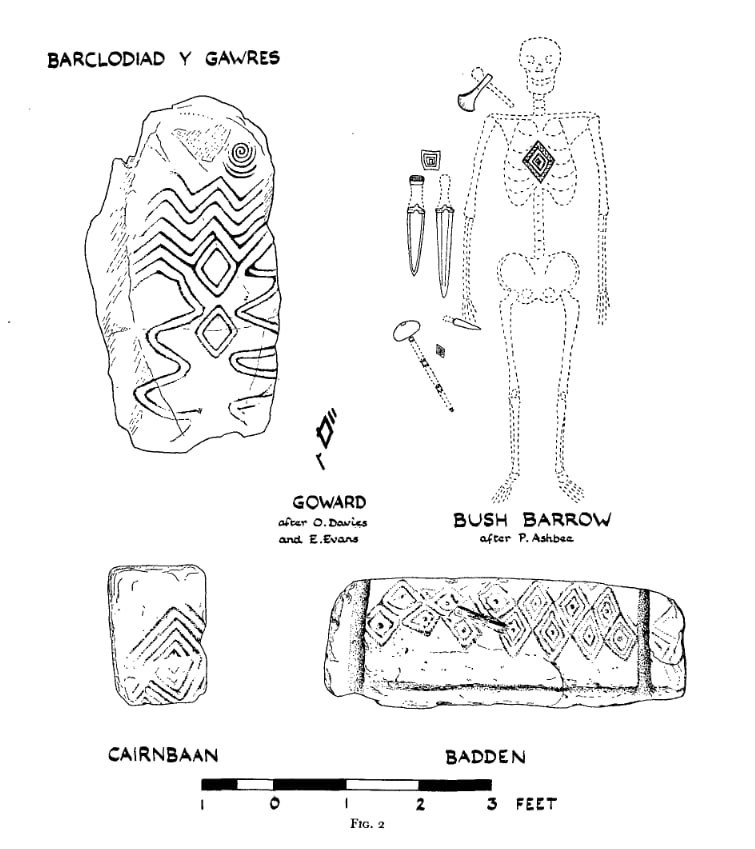
My short analysis on the Bush Barrow lozenge -
I hope to someday get it published or find others to work with to test out my theory.
The Bush Barrow lozenge, unearthed near Stonehenge, is a gold artifact intricately designed with precise geometric patterns. Scholars have noted that the acute angles of the lozenge, measuring 81 degrees, correspond to the angle between the summer and winter solstices at the latitude of Stonehenge. When aligned with the solstices, the long axis of the lozenge points to the equinox sunrise, indicating a sophisticated understanding of solar movements by its creators (Harding, 2006; Cunliffe, 2013). However, deeper interpretations of the lozenge suggest it may also represent celestial bodies, particularly Venus, which was venerated across many ancient cultures for its dual role as the morning star and evening star.
The lozenge’s design appears to extend beyond its geometric precision to incorporate symbolic and ritualistic meaning tied to celestial cycles. Venus, known for its brilliant appearance and predictable 8-year synodic cycle, would have been a prominent celestial feature visible to early skywatchers. Its pentagram-like path in the sky aligns with the lozenge’s layered symmetry, suggesting that Bronze Age elites may have associated Venus with cosmic order and guidance. This connection between Venus and the afterlife is further supported by the context of the lozenge’s discovery in a burial mound, a setting inherently linked to death and transcendence (Darvill, 2016). The symbolic use of gold, a material often associated with the Sun and immortality, reinforces its celestial and ritual significance.
The presence of interlocking lozenge patterns in Bronze Age Britain, from the Badden cist in northern Scotland to the Bush Barrow gold lozenge near Stonehenge in southern England, suggests a highly interconnected network of cultural and ritual exchange. Such widespread adoption of similar symbolic motifs implies the existence of a shared belief system of organized class of artisans, shamans, or proto-druids responsible for disseminating this sacred knowledge. These patterns, which likely represented Venus and its cycles, appear consistently in high-status burials and ceremonial contexts, underscoring their importance to the elite of Bronze Age societies. This commonality, spanning hundreds of miles, points to a unified cosmological framework that tied disparate communities together through shared rituals and astronomical symbolism (Harding, 2006; Darvill, 2016).
Venus's bright phases as the morning star—appearing just before sunrise—may have symbolized the soul's journey from death into a new dawn, aligning with the concept of celestial guidance into the afterlife (Harding, 2006).
he construction of Stonehenge, a nearby megalithic structure aligned with the solstices and other celestial events, underscores the advanced astronomical knowledge possessed by societies in Bronze Age Britain. Venus’s visibility during key times of the year, such as solstices and equinoxes, would have further tied it to ritual practices. The alignment of the Bush Barrow lozenge with equinoxes suggests it may have served as both a physical tool and a symbolic representation of Venus’s role in bridging life and death, as the planet’s cycles were linked to renewal and balance (Cunliffe, 2013).
By integrating the veneration of Venus with their burial practices, Bronze Age elites likely imbued their artifacts and monuments with a celestial authority. This connection between Venus and the afterlife mirrors practices seen in other cultures, such as the Mesoamericans, who tracked Venus's cycles meticulously and associated the planet with the transition between life and death, or the Mesopotamians, who revered Venus as the goddess Inanna/Ishtar, embodying renewal and guidance. These parallels reinforce the notion that Venus was a universal symbol of status, immortality, and cosmic guidance.
The presence of such artifacts, along with stone depictions and the construction of megalithic structures like Stonehenge, demonstrates a sophisticated integration of astronomical knowledge into cultural and ritual practices. The lozenge, as a representation of Venus’s guiding brilliance, may have signified the deceased's safe passage into the afterlife, granting them alignment with celestial forces and eternal renewal (Darvill, 2016; Harding, 2006). This celestial symbolism, combined with the artifact's high-status burial context, highlights the enduring importance of Venus as both a practical guide for navigation and a spiritual symbol of transcendence.
This cultural cohesion would have reinforced Venus’s role as a symbol of cosmic order and immortality, embedding it deeply within the belief systems of Bronze Age Britons (Cunliffe, 2013).
Furthermore, the precision of the patterns and their association with elite burials suggests that this priestly or artisan class played a vital role in legitimizing the power and status of the ruling class. The lozenge, representing Venus, served as a sacred emblem, linking the rulers to divine cosmic forces and signaling their role as intermediaries between the earthly and celestial realms. Such connections would have strengthened the societal framework, enabling Bronze Age elites to maintain power across vast territories while adhering to a shared cosmological ideology. This unified system demonstrates not only the advanced understanding of astronomy but also the sociopolitical importance of celestial symbols like Venus in forging connections between distant communities (Darvill, 2016; Harding, 2006).
The Tale of Aurvandil and the Stellar Connection:
In Old Norse mythology, Aurvandil (also spelled Orvandil or Earendel) is associated with a star. According to Snorri Sturluson’s Prose Edda, Thor carries Aurvandil out of the realm of giants in a basket, during which one of Aurvandil’s toes freezes. Thor then breaks off this toe and places it in the sky where it becomes a star. This narrative emphasizes the Norse recognition of specific celestial bodies as meaningful and personal—heavenly lights could be linked to legendary figures, events, or transitions between worlds.
Venus's Motion and Its Connection to Ancient Symbolism
Venus, the second planet from the Sun, follows a well-documented synodic cycle of 584 days, during which it transitions between its roles as the Morning Star and Evening Star (EarthSky, 2023). Over an 8-year period, Venus completes an intricate celestial pattern when observed from Earth, often described as a pentagram or five-petaled flower, due to the resonance between its orbital period (225 Earth days) and Earth's orbital period (365 days) (Sheehan & Dobbins, 2022). This strikingly regular pattern makes Venus one of the most prominent and observable celestial bodies, inspiring myths, rituals, and symbolic representations across ancient cultures.
Venus achieves maximum elongations of approximately 47 degrees from the Sun, making it the brightest object in the night sky after the Moon. Its brightness, reaching a peak magnitude of -4.89, far outshines all other planets, a feature that would have been unmistakable to ancient observers (Gupta et al., 2021). This visibility occurs in two distinct phases:
/\ Morning Star: Rising just before sunrise.
\/ Evening Star: Setting shortly after sunset.
Venus's predictable cycle likely formed the basis for many ancient calendrical systems, as its transitions align with agricultural and ceremonial timing (Aveni, 2019). The 14 key visual phases of Venus, including greatest elongations, inferior conjunctions, and superior conjunctions, would have been observable to the naked eye and may correlate to repetitive geometric patterns, such as the rhombus symbol found in ancient carvings.
Ancient observers could have tracked Venus's motion through:
Horizon markers: Fixed points on the landscape to monitor its rise and set positions.
Oral traditions and symbolic carvings: Mnemonic devices like the rhombus could encode Venus's cyclic behavior over time.
The rhombus shape potentially symbolizes cyclical motion and duality, encapsulating Venus's behavior as both Morning and Evening Star. Its symmetry and interlocking nature align with the planet's visible transition points, making it a likely candidate for celestial representation in ancient contexts.
Explanation of the Stats in the post:
584-day synodic period: This is the time it takes Venus to return to the same position relative to the Sun and Earth. Over 8 Earth years, Venus completes 13 synodic cycles, resulting in a striking pentagram-like orbital path.
- Maximum elongation of 47 degrees: This is the angular distance Venus reaches from the Sun, marking its brightest and most visible positions as Morning and Evening Star.
- Magnitude of -4.89: Venus's brightness at its peak is far greater than any other planet, emphasizing its prominence in the night sky and its suitability as a cultural symbol.
The combination of Venus's brightness, symmetry in its motion, and periodicity makes it an unparalleled celestial object for ancient symbolism. Its predictability and brilliance would have imbued it with great cultural and spiritual significance, forming the basis for intricate astronomical and artistic traditions.
References
Aveni, A. (2019). Skywatchers: A Revised and Updated Version of Skywatchers of Ancient Mexico. University of Texas Press.
EarthSky. (2023). The five-petaled path of Venus. Retrieved from https://t.co/XgwKG7YNcI
Gupta, M., Sheehan, W., & Dobbins, T. (2021). Astronomy Across Cultures: Historical and Interdisciplinary Perspectives. Springer.
We must remove those third world migrants who put their ‘clan’ above all else, including our British rule of law.
If that means entire clans are deported, then that is what must happen.
JD Vance to the UK: Defending your culture isn’t radical. It’s reasonable
“To everybody in the UK who rejects that idea, I’d encourage them to just keep on going
It’s okay to want to defend your culture. It’s okay to want to live in a safe neighborhood.
It isn’t radical, and it isn’t hateful
It is reasonable for the people in Western societies to want to control who comes into their country and who doesn’t”
Every real nation has always done exactly this. The UK should too
Have you heard the good news? We Worship Wotan, our Ethnoreligious god of war, fury, poetry & the liminal decent and mastery of the underworld. He is a god who demands his people to become masters of hell both within & outside ourselves, rather than simply fearing hell as a scary place you never want to go—like that false jewish prophet who preaches against the natural martial nature of Aryan man. In the Havamal, Wotan says only free men carry weapons. Wotan turns boys into men. Christ inverts telos & produces Disneyworld anti-folk. The Seax is already a part of our Ethnoreligion. Join us
Now is the time to create the hostile environment.
Now is the time to remove these invaders from our land.
They came here as guests, they will be leaving as guests.
Look back in anger.
In the game The Simpsons: Hit & Run (2003), a Jewish clown calls you "lousy goyim" and threatens you with a lawsuit if you beat him up for having sex with your underage daughter.
When a slave was freed in Anglo-Saxon England, the legal ritual often involved placing a weapon, frequently a seax or a spear, into their hands.
By physically giving them the blade, they were being handed their status as a free person under the law.
Do you understand yet?
🔴 En Inglaterra, un hombre que iba destrozando autos con un machete en la mano aprendió por las malas que no debía meterse con el bar donde los ingleses estaban viendo el partido: tras romper una ventana, terminó recibiendo una brutal paliza.
Me: certain nationalities in UK are more likely to commit sexual offences than Brits
Leftist nutcase: “I’m gonna break your f*****g jaw.”
ICE detention facility in New Jersey.
I’m not surprised Charlie Kirk was murdered. These people are lunatics.
@fallenFisherman@Tom_Rowsell@The_Hellenist I would agree, yet you responding with that means you've not fundamentally understood me either. I'll also push back and devil's advocate; even if slavery is not ideal, death is a worse position to recover from than slavery. With slavery there is life and opportunity for action.