1/6
Codex found a proof of a 2017 conjecture in algebraic combinatorics—one I often revisited in grad school.
Of the original paper’s 14 numbered conjectures, it was one of only 3 with no substantial follow-up in the literature.
Write-up + Lean: https://t.co/Ido2c9zuck 🧵
Proof of the 40-year old Bandelt-Dress conjecture on the maximum quartet distance between phylogenetic trees (and an interesting connection to independence testing). https://t.co/6QRz91o6qk
Exciting result: k-Coloring is in (2-eps_k)^n time, where eps_k>0 for every fixed k!
Algorithms faster than the 2^n time needed to compute the chromatic number were previously known only for k<=6.
https://t.co/wzDIexHgjv
6/6
My advisor @mweber_PU and I checked the argument line by line, filled in gaps, simplified the proof, and formalized the full theorem in Lean.
Seeing it hold up under that scrutiny was genuinely exciting. AI-assisted mathematics now feels much more concrete to me.
1/6
Codex found a proof of a 2017 conjecture in algebraic combinatorics—one I often revisited in grad school.
Of the original paper’s 14 numbered conjectures, it was one of only 3 with no substantial follow-up in the literature.
Write-up + Lean: https://t.co/Ido2c9zuck 🧵
5/6
I gave the problem to GPT-5.6 Sol in Codex (Extra High). Over ~5.5 hours, it wrote and ran code to test ideas, conjectured an explicit candidate hole, and built a general argument using (non-elementary) tools such as Jack polynomials and a Dyson constant-term identity.
I'm presenting a poster at @NeurIPSConf DiffCoALG workshop today throughout the day in Upper Level Room 25ABC. I will present our initial theoretical findings on how choosing the right learning architectures can help with model distillation, under a linear rep hypothesis!
It's been wild to see our work on Muon and the anthology start to get scaled up by the big labs.
After @Kimi_Moonshot released Moonlight, people have asked whether Muon is compatible with muP. I wanted to write up an explainer, as there is something deeper going on here!
(1/8)
Are you canonicalizing your data? Depending on the group, you might be unavoidably introducing discontinuity...but there's a fix!
Come to our ICML poster, #511, on Wednesday 1:30 - 3:00 PM to hear more! Joint work with Nadav Dym and Jonathan Siegel
https://t.co/FWe4JaBjd7
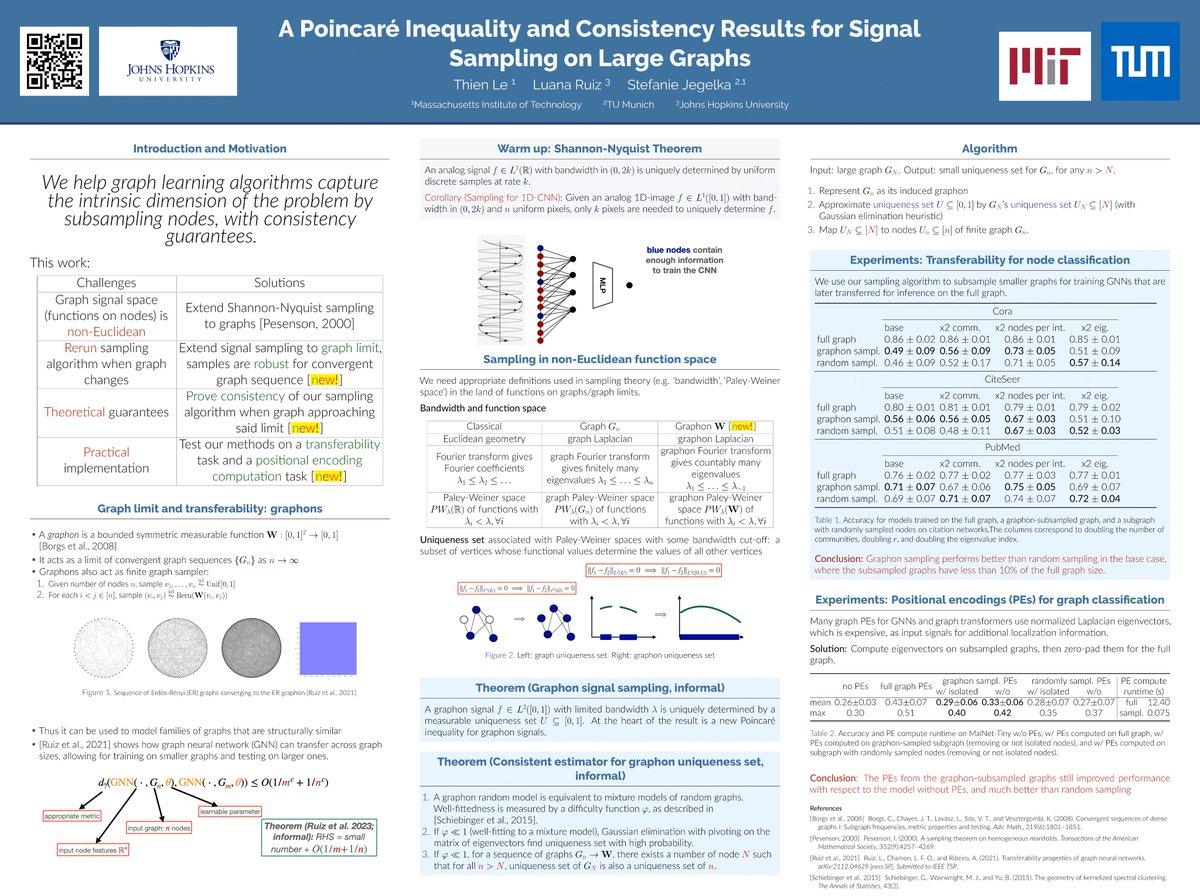
Finally, we derive a heuristic to our algorithm and test it on citation networks for both node classification transferability experiments (train on small graphs, test on large graphs) and positional encoding computations (compute PE on subsampled graphs, then zero pad).(4/4)
How do you robustly subsample vertices of large graphs that are changing in size? By marrying the theory of spectral clustering and graph limit! Check out our poster #36 in Halle B on Friday, 10:45-12:45, presented by the amazing Luana Ruiz!
🔗:https://t.co/cLblYA4att
🧵(1/4)
Interestingly, by using connections to spectral clustering geometry, we show that if the graphon is well-fitted to a mixture model (e.g., stochastic-block), then the necessary number of vertices to sample can be as small as the (finite!) number of components in the mixture.(3/4)
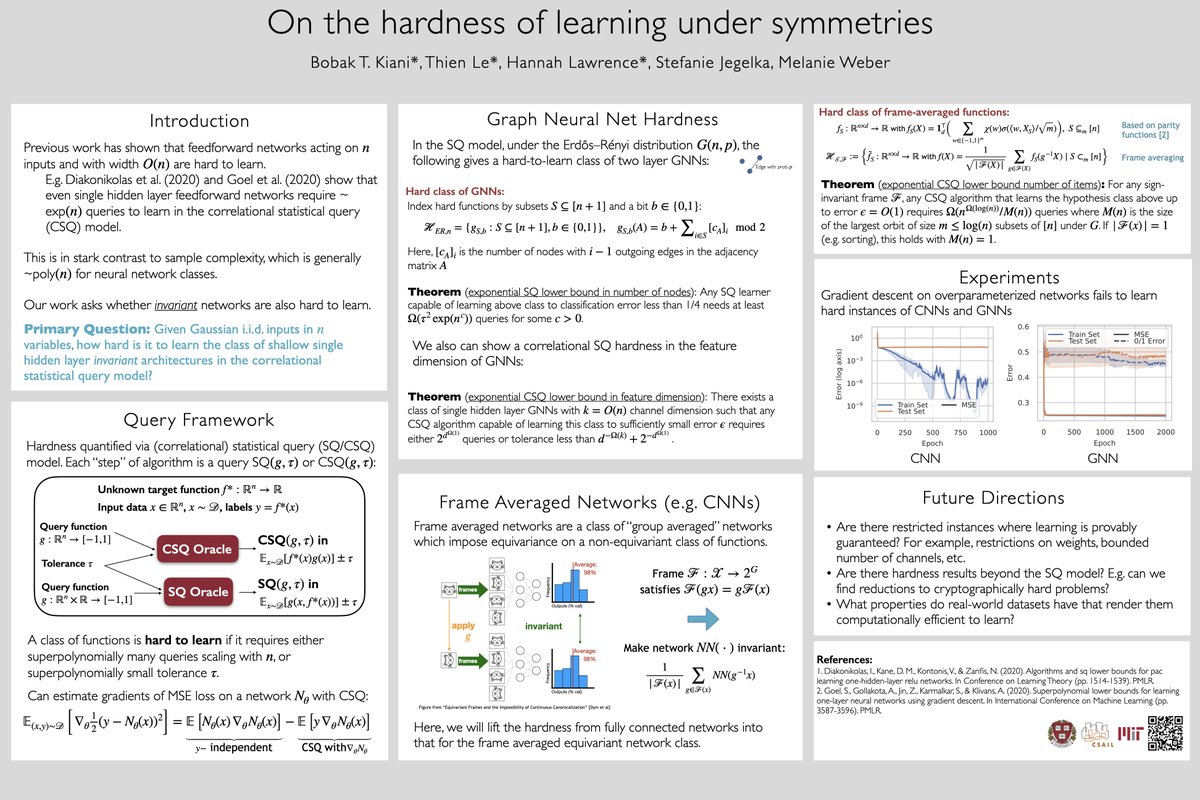
We also derive an exponential lower bound for group averaging shallow real MLPs and a superpolynomial lower bound for frame-averaging them. Along the way, we also introduce techniques that may help bridge traditional learning theory and its equivariance counterpart. (5/5)
Can group equivariance counteract the computational (SQ/CSQ) hardness of learning neural nets? Swing by our poster #202, presented by the wonderful Bobak Kiani and @HLawrenceCS, on Thursday, 10:45 - 12:45 to find out! #ICLR2024
🔗: https://t.co/7uxtgwIHh7
🧵(1/5)
In contrast, for real-valued functions, we demonstrate a large family of shallow GNNs that are almost orthogonal in Gaussian space, thus requiring exponentially many correlational SQ queries (subsuming noisy gradient descent computations) to distinguish. (4/5)