Intraday Options Trader. Intraday trading isn’t about predicting, it’s about managing risk.
Disclaimer: Not SEBI registered | Views are educational only | DYOR
सोनिया गांधी जी की जो किताब आई है, उसमें उन्होंने सिखों के कत्लेआम के मामले में अपने परिवार को Self Clean Chit देने की कोशिश की है।
किताब में उन्होंने लिखा है कि 31 अक्टूबर की रात को राजीव गांधी ने आर्मी चीफ जनरल वैद्य से कहा कि सेना को बुलाया जाए। इस पर जनरल वैद्य ने खुद यह फैसला लिया कि दिल्ली के आसपास जो सेना तैनात है, वह सिख रेजिमेंट है, इसलिए सिख सेना को नहीं बुलाया जाना चाहिए। उन्होंने दिल्ली से दूर देहरादून और अन्य जगहों से सेना को बुलाया।
सोनिया गांधी के अनुसार, यह जनरल वैद्य का अपना निर्णय था और सेना के आने में देरी होने के कारण ही उसकी तैनाती में विलंब हुआ।
यह दावा वास्तविक तथ्यों के बिल्कुल खिलाफ है। पहली बात तो यह है कि मिश्रा आयोग की रिपोर्ट के अनुसार, 31 अक्टूबर की रात और 1 नवंबर की सुबह दिल्ली में 6,100 सैनिक उपलब्ध थे, मगर उन्हें समय पर तैनात नहीं किया गया। आयोग ने यह भी लिखा है कि यदि इनमें से 5,000 सैनिकों को 1 नवंबर की सुबह दिल्ली की सड़कों पर मार्च करवाया जाता, तो कम से कम 2,000 सिखों की जान बचाई जा सकती थी।
मिश्रा आयोग और नानावती आयोग, दोनों ने अपनी रिपोर्टों में यही बात लिखी है।
जनरल वैद्य ने भी अपना बयान दिया और कहा कि उन्होंने कहीं नहीं कहा कि राजीव गांधी या प्रधानमंत्री ने उन्हें ऐसा करने को कहा था।
मिश्रा आयोग का कहना है कि भले ही राजीव गांधी ने जनरल वैद्य को सतर्क कर दिया हो, लेकिन सेना प्रमुख का काम केवल सेना को जुटाकर रखना होता है, जबकि सेना को बुलाकर मैदान में तैनात करने की जिम्मेदारी प्रशासनिक अधिकारियों की होती है। प्रशासनिक तंत्र ने न तो सेना को समय पर बुलाया और न ही उसकी तैनाती की।
राजीव गांधी उस समय देश के प्रधानमंत्री थे। अगर वे खुद इसके लिए प्रत्यक्ष रूप से जिम्मेदार नहीं थे, तो सिखों के इन कातिलों को शरण देने वालों और 1 नवंबर की सुबह दिल्ली में मौजूद सेना को सक्रिय न करने वालों के खिलाफ उन्होंने क्या कार्रवाई की?
इसके विपरीत, राजीव गांधी ने अपनी पहली जनसभा में यह बयान दिया था कि, 'जब कोई बड़ा पेड़ गिरता है, तो धरती थोड़ी हिलती है।' इस तरह उन्होंने पूरे नरसंहार को सही ठहराने की कोशिश की।
सोनिया गांधी द्वारा अपनी पुस्तक में राजीव गांधी और अपने परिवार को इस मामले में क्लीन चिट देना आधिकारिक रिकॉर्ड के पूरी तरह खिलाफ और एक सफेद झूठ है।
- सरदार @hsphoolka
The most normalized open extortion in Indian middle class life:
The Sub Registrar office on property registration day.
You spend 10 years saving every rupee from your salaried job.
You pay 30% TDS on your income.
You pay 7% official stamp duty online via net banking.
You pay 1% registration fee through a government treasury challan.
Every single paisa is accounted for on your bank statement.
Then you reach the government registration office with your builder or seller:
The deed writer pulls you aside into a dusty corridor:
"Sir, ₹25,000 to ₹40,000 cash alag se lagega for the desk. Official receipt nahi milegi."
You: "Bhaiya, I already paid ₹4.5 lakhs in official government stamp duty online!"
Agent smiles with complete indifference:
"Sir, mat do. Phir file 'Property Under Valuation' mark hoke audit me chali jayegi. 6 mahine chakkar kaatna."
You stand in an airless hallway, walk to the nearest ATM, withdraw ₹30,000 cash, and slip it inside the file folder just to get your own thumb impression scanned.
We aren't a digital, cashless economy.
We are a country where honest taxpayers have to withdraw physical cash just to get legal permission to own what they already paid for.
Did your property registration happen 100% clean, or did you have to pay the "corridor settlement fee" too?
“𝐑𝐞𝐠𝐢𝐦𝐞 𝐂𝐡𝐚𝐧𝐠𝐞,” 𝐭𝐡𝐞𝐲 𝐬𝐚𝐲.
Their mask is off. The sinister agenda is now out in the open. Unable to win the trust of 140 crore Indians during elections, the INDI Alliance and its radical cabal are openly challenging the very foundations of the Indian Republic.
Their own words expose their intent.
Rahul Gandhi brazenly declares, “Our fight is against the Indian State itself.” Not against a political party. Not against a government policy. But against the Indian State itself and its constitutional machinery.
Prashant Bhushan openly calls for “regime change” and has spoken of revolution involving bloodshed, guns and the Army. This is not the language of democratic dissent or a peaceful transfer of power through elections. It raises a fundamental question: when they speak of regime change, are they talking about defeating a government at the ballot box or bringing the State to its knees through street violence?
Then comes Neha Bora, glorifying foreign turmoil with the slogan, “Lal Salaam to Bangladesh for showing the way.” This is an open romanticisation of the upheaval, violence and mob lynchings associated with Bangladesh’s political crisis, while holding up events beyond the constitutional process as a model to follow.
𝐓𝐡𝐞 𝐩𝐚𝐭𝐭𝐞𝐫𝐧 𝐢𝐬 𝐮𝐧𝐦𝐢𝐬𝐭𝐚𝐤𝐚𝐛𝐥𝐞: 𝐜𝐡𝐚𝐥𝐥𝐞𝐧𝐠𝐞 𝐭𝐡𝐞 𝐒𝐭𝐚𝐭𝐞, 𝐩𝐫𝐨𝐯𝐨𝐤𝐞 𝐜𝐨𝐧𝐟𝐫𝐨𝐧𝐭𝐚𝐭𝐢𝐨𝐧 𝐰𝐢𝐭𝐡 𝐥𝐚𝐰 𝐞𝐧𝐟𝐨𝐫𝐜𝐞𝐦𝐞𝐧𝐭, 𝐚𝐧𝐝 𝐭𝐡𝐞𝐧 𝐜𝐫𝐲 “𝐨𝐩𝐩𝐫𝐞𝐬𝐬𝐢𝐨𝐧” 𝐰𝐡𝐞𝐧 𝐭𝐡𝐞 𝐩𝐨𝐥𝐢𝐜𝐞 𝐩𝐞𝐫𝐟𝐨𝐫𝐦 𝐭𝐡𝐞𝐢𝐫 𝐜𝐨𝐧𝐬𝐭𝐢𝐭𝐮𝐭𝐢𝐨𝐧𝐚𝐥 𝐝𝐮𝐭𝐲 𝐭𝐨 𝐦𝐚𝐢𝐧𝐭𝐚𝐢𝐧 𝐥𝐚𝐰 𝐚𝐧𝐝 𝐨𝐫𝐝𝐞𝐫. 𝐅𝐫𝐨𝐦 𝐬𝐭𝐫𝐞𝐞𝐭 𝐯𝐞𝐭𝐨𝐞𝐬 𝐭𝐨 𝐫𝐡𝐞𝐭𝐨𝐫𝐢𝐜 𝐚𝐛𝐨𝐮𝐭 𝐛𝐥𝐨𝐨𝐝𝐬𝐡𝐞𝐝, 𝐭𝐡𝐢𝐬 𝐩𝐨𝐥𝐢𝐭𝐢𝐜𝐬 𝐫𝐢𝐬𝐤𝐬 𝐩𝐮𝐬𝐡𝐢𝐧𝐠 𝐚 𝐫𝐢𝐬𝐢𝐧𝐠, 𝐜𝐨𝐧𝐟𝐢𝐝𝐞𝐧𝐭 𝐁𝐡𝐚𝐫𝐚𝐭 𝐭𝐨𝐰𝐚𝐫𝐝𝐬 𝐢𝐧𝐬𝐭𝐚𝐛𝐢𝐥𝐢𝐭𝐲 𝐚𝐧𝐝 𝐜𝐡𝐚𝐨𝐬.
But India is not Bangladesh. It is not Nepal.
India is a strong, resilient Republic, anchored in its Constitution, democratic institutions and the will of its people. And beyond law enforcement stands the greatest safeguard of all: crores of law-abiding Indians who will not allow the sanctity of our Republic, our Tricolour or our sovereignty to be undermined.
No political ambition is greater than the nation. No street mobilisation can substitute for the people’s mandate. And no call for upheaval can override the Constitution. Every attempt to undermine democratic institutions must be confronted through the rule of law, constitutional safeguards and the unwavering resolve of the Indian people.
𝐋𝐨𝐧𝐠 𝐋𝐢𝐯𝐞 𝐭𝐡𝐞 𝐈𝐧𝐝𝐢𝐚𝐧 𝐑𝐞𝐩𝐮𝐛𝐥𝐢𝐜. 🇮🇳
Jai Hind!
Mr. Musk, yes, no billionaire should dictate a nation’s policy - Indian or American.
India must welcome competition in satellite internet, from Indian and global providers, whoever offers the most practical and affordable last-mile solution for those in remote regions. In countries with lower per-capita incomes, satellite internet must be affordable too. High subscription fees and equipment costs risk putting it beyond the reach of ordinary households. Connectivity must bridge the digital divide, not create a new one.
India knows our networks and spectrum are strategic infrastructure, not merely commercial assets. India’s national security safeguards are non-negotiable.
Every country makes choices based on its own interests. Those in the West cannot preach free markets while practicing protectionism at home. USA imposed 100% tariffs on Chinese EVs to protect its domestic industry, just as India takes measures to protect its own domestic manufacturers. Both India and the US have restricted Huawei over security concerns. One cannot demand a level playing field from others only when it suits its own agenda.
Indians will internally debate, question and address our strengths and shortcomings as a democratic country.
Take BharatNet, India’s programme to bring broadband to village-level local bodies. We will question why, as the CAG’s 2026 audit report found, the programme is struggling to meet its original objectives. Why were only 33.2% of service-ready Gram Panchayats operational, despite ₹39,888 crore being spent? At the same time, we know to appreciate our telecom sector and regulations, which has made internet data among the world’s most affordable, bringing millions online.
India is a democracy, not a colony. We welcome the world, but we, the Indian people, will decide our own future - not Western vested interests, their double standards or any billionaire - Indian or American.
Tax She and Modi Govt increased.
> LTCG from Zero to 12.5%
> STCG from 15 to 20%
> STT from 0.05% to 0.15% in F&O
> Debt funds indexation removed and taxed at slab rate that is as high as 39%
> SGB secondary market taxed
> 10% Surcharge introduced at 50L from 1cr
> Dividend taxed at slab rate
> PF interest above 2.5L taxed at slab rate
> Health and education cess increased from 3% to 4%
So better you don't talk about your work. No one should be proud of the lies and incompetency.
Now that the government is addressing the benchmarking challenge for foreign funds by introducing CAS, can we also request the “head of the family” to rethink STT for its own kids?
I am sure we want our Indian participants to survive, and our market microstructure to thrive.
Every morning, traders sit down at their screens and map out the levels.
We fight our own cognitive biases, balancing the fast and slow thinking that dictates every entry and exit. We risk our own capital, patiently hunting for that one clean setup, just trying to carve out a living and survive the grind.
Then, the government drops a document.
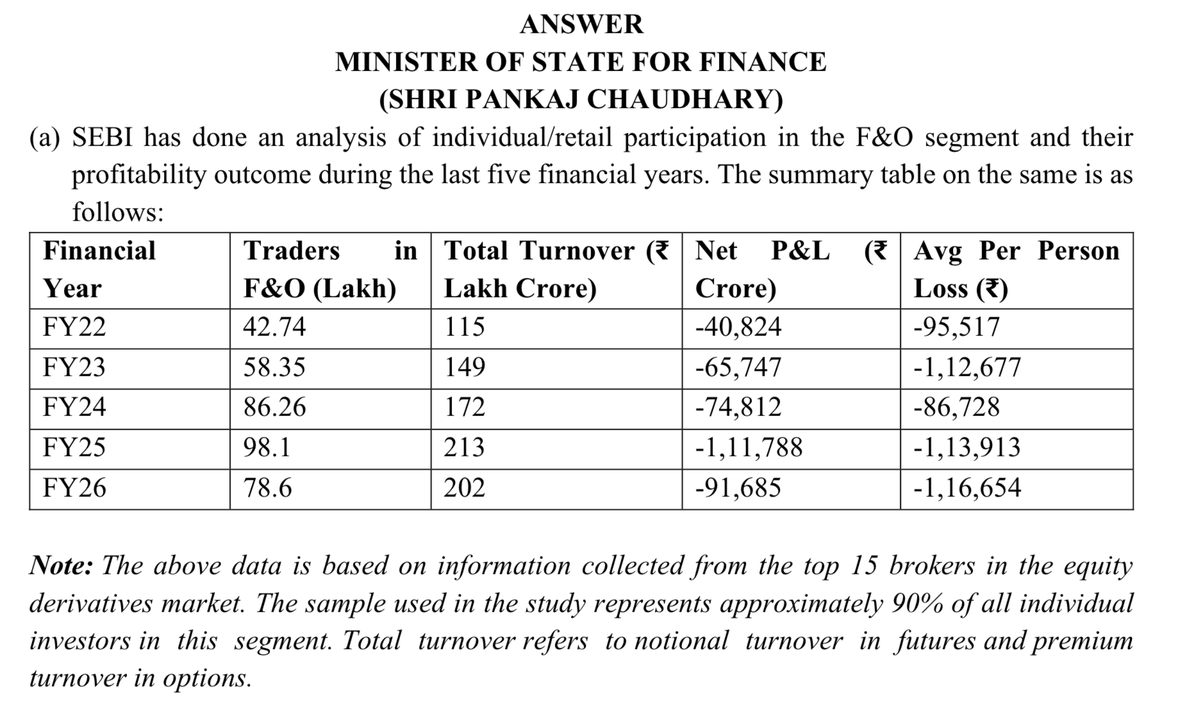
They point to this spreadsheet of retail F&O losses, shake their heads, and play the role of the concerned protector.
"Retail needs saving," they say, drafting up heavier regulations.
But here is the part of the story they conveniently leave out.
While we shoulder 100% of the market risk, the State is collecting a guaranteed, risk-free fortune. Look at that ₹200+ Lakh Crore turnover column. Whether our trades hit the target or trigger our stop-loss, the toll booth operators take their massive cut in STT, GST, and exchange fees.
The biggest threat to our P&L isn't a failed setup or a sudden gap-down. It's the systemic friction that bleeds our mathematical edge dry before the trade even has room to breathe. They are weaponizing our casualties to justify building a higher toll booth, and it's easy to point fingers at retail traders when you hold the winning ticket on every single execution.
The Solution: Stop treating retail liquidity like a limitless tax ATM. Drastically slash STT and systemic fees. Give a trader's hard-earned edge a genuine chance to survive.
True protection means lowering the cost of doing business, not regulating the everyday participant out of existence. 🛑📉