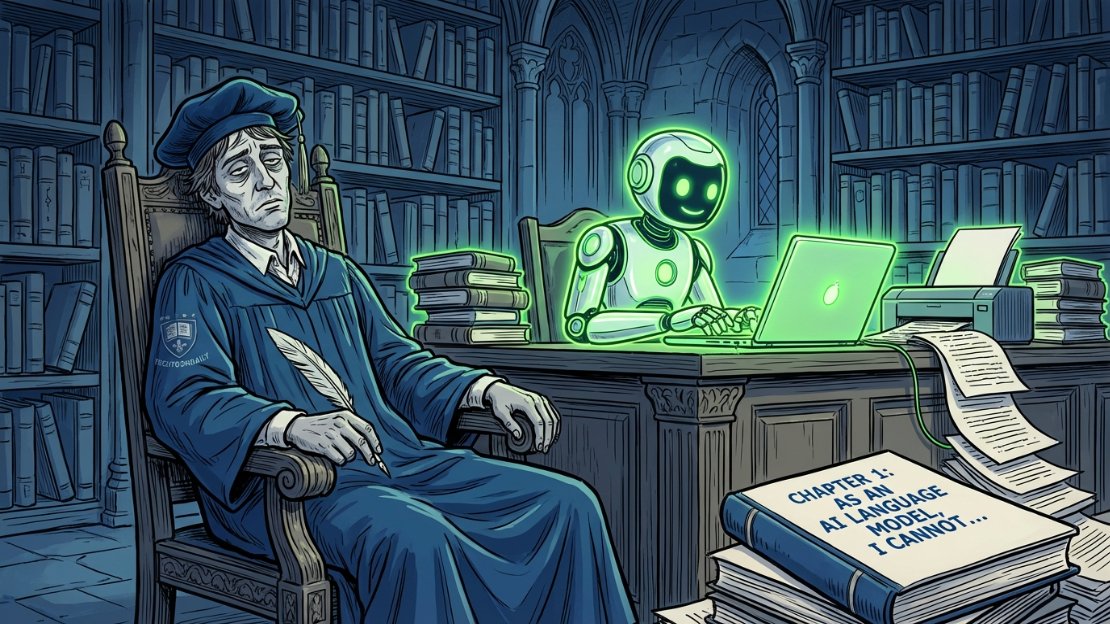
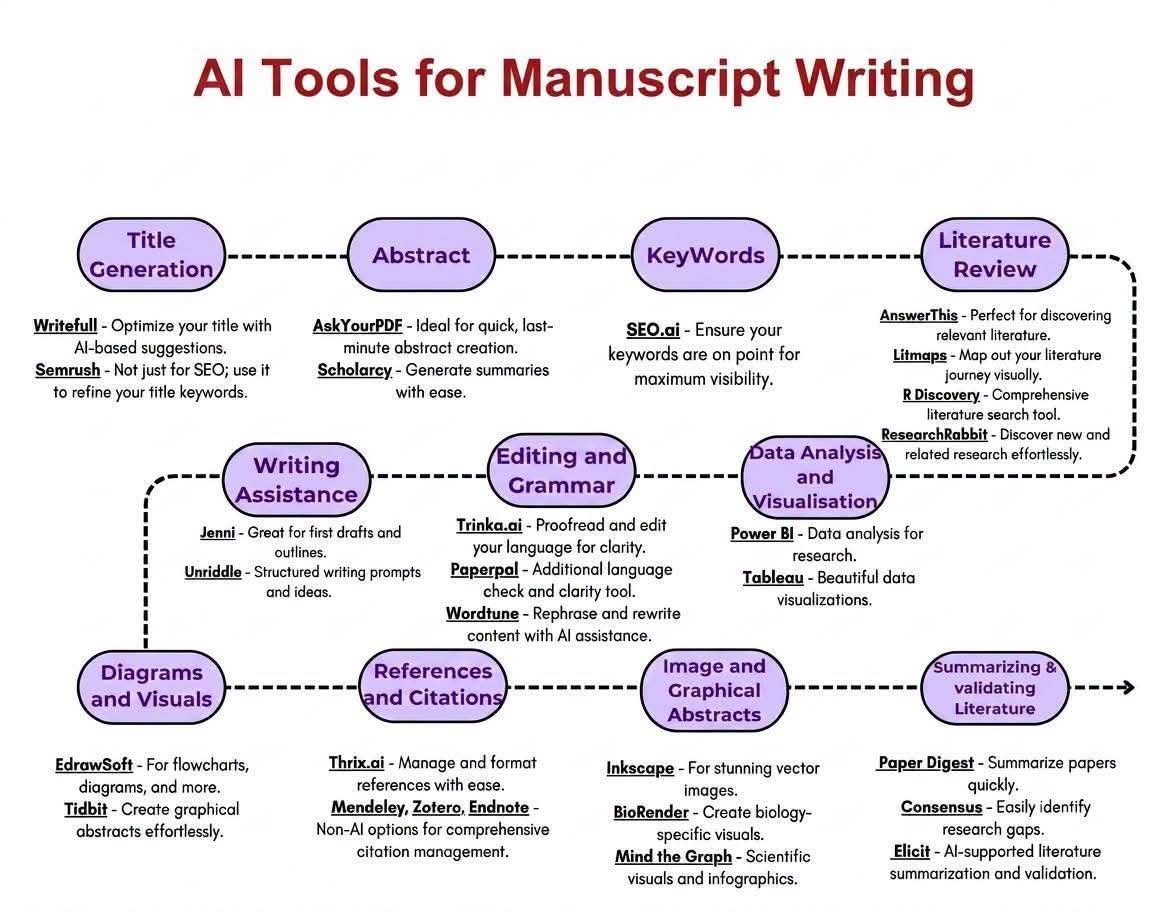
🤖📚 AI is reshaping academic writing. From literature reviews and abstracts to data visualization and citations, AI tools can accelerate every stage of the research workflow.
The key is simple: use AI to enhance scientific thinking, not replace it.
#AIinResearch#AcademicWriting
We’re launching the Army of Robots.
In 2022, we launched the Army of Drones. Today, drones account for over 95% of battlefield strikes, and Ukraine has more than 700 UAV manufacturers.
Now we need the next technological breakthrough: the robotization of warfare.
The goal is simple — save lives. Robots should take on the most dangerous missions: evacuating the wounded, delivering ammunition, mining and demining, reconnaissance, defending positions and engaging targets.
The Army of Robots is not one company. It’s an ecosystem. We will invest in defense tech companies, launch our own technology projects, test them with the military and scale what works on the battlefield.
We’re now looking for defense tech companies and engineers working on robotic technologies — as well as a CTO / Tech Lead for the Army of Robots.
Join us: https://t.co/yPbvw0VUmV
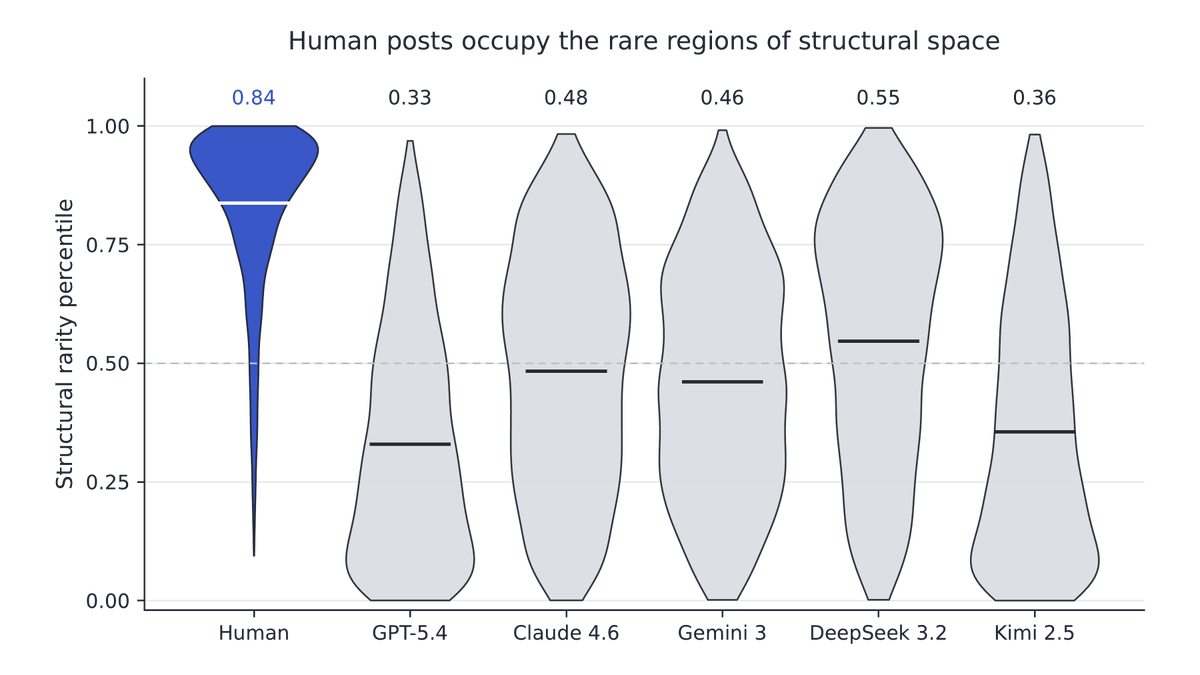
We trained a model to predict AI-written blog posts from structural features - and discovered the shape of slop.
On posts it had never seen, it told AI and human apart with 98% accuracy, getting only 19 of 1,740 wrong.
Paper and code: https://t.co/knexA6QVyE
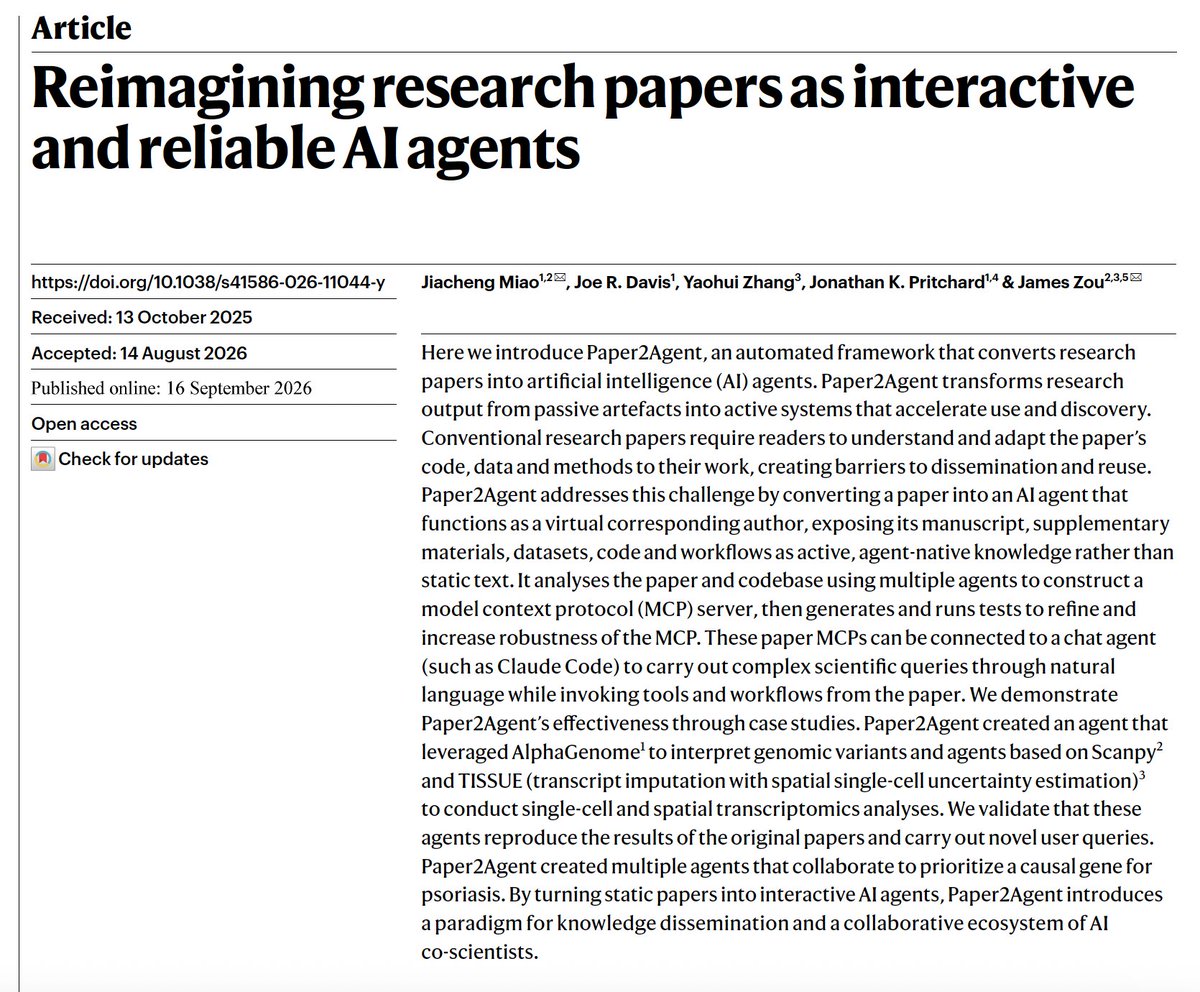
When your research paper can talk to you and interact with other research papers....
Reimagining science publishing and knowledge dissemination with Paper2Agent
https://t.co/zASfwhrdb6
@nature@james_y_zou@Jiacheng_Miao
I've started a growing collection of skills for academics (writing, peer review, information mining, etc. ). Download the skills + install tutorial:
https://t.co/spXGbsr1p1
A major new consensus piece from editors across leading cardiovascular and biomedical journals argues that AI is no longer a future issue in scientific publishing—it is already embedded throughout the research lifecycle. The challenge is no longer whether AI should be used, but how transparency, accountability, and scientific integrity can be preserved as AI becomes ubiquitous.
Key points:
🔹 AI can accelerate discovery, literature synthesis, data integration, hypothesis generation, and manuscript preparation.
🔹 AI also introduces substantial risks:
• fabricated references and hallucinated content
• paper-mill amplification
• biased outputs
• image manipulation and synthetic data generation
• erosion of authorship responsibility
🔹 Detection is not enough.
The authors argue that AI-text detectors have limited reliability and may unfairly flag non-native English writers. Instead, scientific publishing should shift toward:
• transparency
• provenance tracking
• audit trails
• human accountability
🔹 Authors remain fully responsible.
AI cannot qualify as an author. Researchers must disclose:
• which AI tools were used
• model versions
• prompts/workflows when relevant
• verification procedures used to confirm accuracy
🔹 Reproducibility becomes harder in the AI era.
The same prompt can generate different outputs across model versions and updates, making documentation of model version, date of access, and settings increasingly important.
🔹 Journals are beginning to require:
• AI disclosure statements
• raw data submission
• source-code transparency
• AI-specific reporting standards
• provenance metadata
Perhaps the most important message:
➡️ The future of scientific publishing is not “AI vs humans.”
➡️ It is “AI as a tool, under explicit human responsibility.”
The authors propose that the red line is crossed when responsibility for scientific content, interpretation, or conclusions is transferred from identifiable researchers to automated systems.
AI can enhance rigor and efficiency, but only if accountability remains human.
"AI is a tool, not an author."
Reference:
Guzik TJ et al. Artificial Intelligence in Biomedical Scientific Publishing. European Heart Journal (2026).
#AI #ScientificPublishing #AcademicMedicine #ResearchIntegrity #BiomedicalResearch #Cardiology #GenerativeAI #OpenScience #PeerReview #MedicalResearch
AI is forcing universities to rethink assessment and in a fundamental way.
In this paper, Moorhouse et al. (2023) look at how the world’s top-ranking universities responded to generative AI tools such as ChatGPT.
The paper shows that university guidelines tend to focus on three major areas:
Academic integrity
Assessment design
Communication with students
First, academic integrity.
We can no longer reduce the conversation to “students are cheating with AI.” That is too simplistic. Of course, misuse is real. But the bigger issue is that AI has blurred the boundaries between assistance, authorship, collaboration, and plagiarism.
If a student uses AI to brainstorm, is that misconduct? If they use it to improve grammar, is that allowed? If they use it to generate an outline, where is the line?
If they submit AI-generated text as their own, that is clearly a problem. But many other uses sit in a grey zone, and that is where schools need clarity.
Second, assessment design.
One important recommendation from the paper is that teachers should test their own assignments with AI tools.
Put the prompt into ChatGPT and see what it produces. Then ask yourself: What exactly am I assessing here?
If AI can complete the whole task with little student thinking, then maybe the problem is not only the tool. Maybe the assessment itself needs redesign.
The authors highlight several useful directions:
Focus more on process.
Break large assignments into stages.
Ask for drafts, notes, reflections, and explanations.
Create tasks that connect to class discussions, lived experiences, local contexts, and real-world problems.
Give students opportunities to critique AI outputs rather than simply avoid AI altogether.
This is an important shift. Assessment should not only produce a final answer. It should make learning visible.
Third, communication with students.
This is probably the most practical takeaway for teachers. Students need clear expectations.
Definitely not “AI is forbidden” statements that no one knows how to apply. They need to know what is allowed, what is limited, what must be disclosed, and what crosses the line.
The paper also makes a powerful point: teachers now need a new kind of competence, what the authors call generative AI assessment literacy.
I like this idea.
Teachers do not only need AI literacy in general. They need to understand how AI changes assessment specifically.
That means knowing how AI affects academic integrity, how to redesign tasks, how to guide students toward responsible use, and how to keep assessment meaningful in a world where AI can generate polished work instantly.
If you're an academic, start using Claude Code and Codex.
Spend five minutes on learing about MCP servers. It helps you connect Claude Code and Codex to external apps like Zotero, etc.
Ask Codex to write you a Zotero MCP server. You don't need to understand what it means.
Follow the instructions and integrate your Zotero library with Claude Code or Codex.
Hubris syndrome describes an identifiable change in personality occurring in individuals who occupy positions of significant power.
This framework for identifying behavioural traits could help prevent harm
https://t.co/oSf8od92VT
Claude Code works now free. Unlimited. No subscription 🤯
It’s called free-claude-code. You get a free NVIDIA API key, point Claude Code to localhost, and the proxy converts your Anthropic API calls to NVIDIA NIM format.
40 requests per minute. No bill. Ever.
It supports Kimi K2, GLM 4.7, MiniMax M2, Devstral, and more. Streams thinking tokens and tool calls in real time.
There's also a Telegram bot built in so you can control Claude Code from your phone.
2-minute setup. 100% open source.
@Nature We spent 800 years building the prestige of the Doctorate, only to realize in 2026 that a #PhD is just a highly-credentialed middle manager whose full-time job is proofreading ChatGPT's hallucinations about fluid dynamics.