Majority would trade better if they did not identify as a bull or a bear
Your goal is to be objetctive & I feel strongly bias gets in the way of this
Sure when you are right, bias is an edge because it gives you the confidence to slam orders
But what about when you are wrong?
a lot of people using orderflow now because it "looks cool" but there's a ton of noise in this and assumptions being made (a lot being incorrect).
you'll always be making assumptions, some are just more informed than others.
bookmark this, should be somewhat of a starting point.
for alts this gets even more jaded. start with btc a bit easier to attempt to get some sense of who's carrying which can be helpful.
and then spend a grueling amount of hours trying to figure out what behavior equates to what outcome. this will also vary depending on context, location etc.
i.e. this shit isn't some holy grail in fact it can def. make you worse if you don't know what you're looking for
https://t.co/OBl8bDobT1
while crypto twitter can be a cesspool of the dumbest and shadiest people you can find, there are still a lot of cool people building cool stuff.
What I recently enjoyed a lot is this spawn of new terminals, often led by single devs.
to name a few that I found really cool
@Pivot922@backquant@derivativemonky@iam4x
Most people don't have an edge, at best they have a messy "strategy" with no predefined rules which they haven't tested yet.
For reference this was my weekly plan from about 3 years ago, nothing fancy. Wrote this article a while back on how i think about edge.
The TradingRiot course covers how markets and derivatives really work from the ground up, then how to trade fully systematic strategies, each with exact rules so you never have to build your own.
All 12 parts are free to read at https://t.co/CHgHiWBWsS
alright so I tried to figure out why things are blowing up
simple summary: it's geopolitics. and if the Middle East gets bad enough, then the backers for OpenAI's $1.4T funding round could pull out so that's sending shockwaves through markets bc they're the big data center tenant ppl are worried about. the incremental appears to be that Ukraine is also getting unhinged
there's not an AI specific catalyst this seems more like geopolitics. Last night TSM guided acceleration and Citi pressed if there was demand destruction on memory - TSM said no, that's already factored into the guide which means there's not some specific Korea fundamental thing -- and price action there is likely more of a margin call
Ukraine bonds have dumped 20% since July. He just asked for $70b Euros from the EU while Trump denied shutting off Starlink (Elon had said it wasn't him, so it just looks like a sht show). Trump told Zelensky to stop attacking Russian refineries. Zelensky has since crashed out and said "The block is out, we're done". And is now vowing to hit Russian refineries. And it appears he's already followed through hitting a facility in Surgut with drones
Indonesia got delisted from the MSCI and the entire country equity index is -14% in a day, increasing the likelihood of EM contagion
Iran has moved their nuclear facilities under ground in PickAxe mountain and trump has talked about using the "MOAB" which stands for Massive Ordnance Air Blast - which is just shy of a nuclear blast. THis is a 21,600 pound bomb that isn't even particularly effective at hitting underground sites so might just be generically destructive. For some reason Trump thinks that doing this after mid terms is fine - but oil is already pumping
reports from Israel meanwhile: Israel now deploying mobile bomb shelters in major cities, with 2 reportedly spotted in Ashdod and Tel Aviv within 24hs, as IDF raises its alert level to highest across all fronts amid preparations for a possible strike on Iran
fun times
Habits that have a high ROI in trading:
- not trading from your phone
- focusing on a non pnl related goal each day
- replaying the biggest moves of each week
- creating a time delay between plan & execution
- hyperfocus on specific pairs
- approach each day with a net-zero approach
- treating fees & slippage as pnl (they are)
- screen record & commentate over every trade
- calculate expected value per setup
- turn off pnl completely
- strictly limiting time on socials
- logging sleep + mental state before trading
- building a war chest (never trade out of need)
- setting up proper alerts (never miss a move)
- starting out with majors (over small caps)
One of the best things you can do for your morning routine:
Create lists of your favorite follows by category.
– High value TA
– People whose opinions you actually care about
– Onchain
– Builders
– News
– Fintwit
Whatever you want.
Screenshot the names from each list or copy/paste them into Grok Bot.
Have your Grok Bot scan the lists and give you a concise recap every morning at a specific time or multiples times a day!
Tailor it to your specific needs and goals.
Takes under 5 minutes if you already have lists. Saves hours of mindless scrolling.
You have 1,000 free reads a day. My recap takes about 10-20 reads with a 55 account list.
How to build your own trading system
1/ This is where i'd begin if i were to start all over again. A super simple system with minimal variables. Short if then decision trees. If price does A at level B with C confirmation, enter with a risk of D.
2/ Write down why you think your simple system should work. Who are you trying to make money from (counter party). This line of thinking will allow you to generate new ideas moving forward too. It's the base as to why your system will/will not work. The most simple example of this is "trapped traders" , the whole premise is based off trading against those who get over excited at extremes and fade them at their entry point.
3/ Forward test your setups. With small size. You want to remove as much selection bias as possible when you are testing out any strategy. When doing so you are going to journal every trade you take and often recommend not only taking a screenshot with the trade but also a recording and yourself live commentating over the trade itself.
4/ Bet the same size on every trade until you have a big enough sample size to where you can start changing one variable at a time. Anything you do which you deem as discretionary should also be noted and tagged to see whether your "discretionary" inputs are having a + EV impact on your trading. Test, journal, review, refine (slowly).
I actually covered most first principles here. I wouldn't recommend initially setting yourself on trying to use AI to optimise anything. It's good at speeding up the process for something you initially intend to do manually. Just don't let it steer you away from what actually matters.
Why I trade with Aggr sounds on, and why it's not a gimmick and something most overlook.
Most of traders build their entire read through their eyes - looking at simple OHLC charts, footprint, DOM etc. This would simply mean that you have one channel doing all the work - which is never the optimal path.
Sound adds a second channel, and theres research that can back it up:
You react faster to sound. Auditory reaction times run roughly 20-40 ms faster than visual ones.
Now of course that alone isn't edge for a discretionary trader, but it means sound pulls your attention before your eyes catch up.
You hear rhythm better than you see it - the auditory system has finer temporal resolution than vision.
Tape reading is about tempo: aggression speeding up into a level, or prints drying up at a high - you can hear that change before it shows on a chart , and on most exchanges you would.
It works when you're not looking and this is my strongest argument as to why I would advise anyone to use it.
Quoting a study here
"In a 2004 Dartmouth study on market-data sonification, people detected direction changes significantly more accurately with sound. The effect got stronger when they were forced to look away from the chart."
In my opinion that last point is "edge". You're watching the footprint on ES while BTC tape starts ripping in your ears - you just can't miss that , unless somebodys dropping frags in your room continuously.
At the end of the day hearing a burst of large sells get absorbed with no followthrough, again and again, builds a pattern library that doesn't depend only on visual memory. This is seriously one of the best tools in my discretionary trading toolkit , I could show you 100+ trades that were executed mostly by listening to the tape.
How I use it: thresholds high enough that only meaningful size makes noise, different tones for buys and sells ( ofc ), and sound as a cue to look, never a signal on its own.
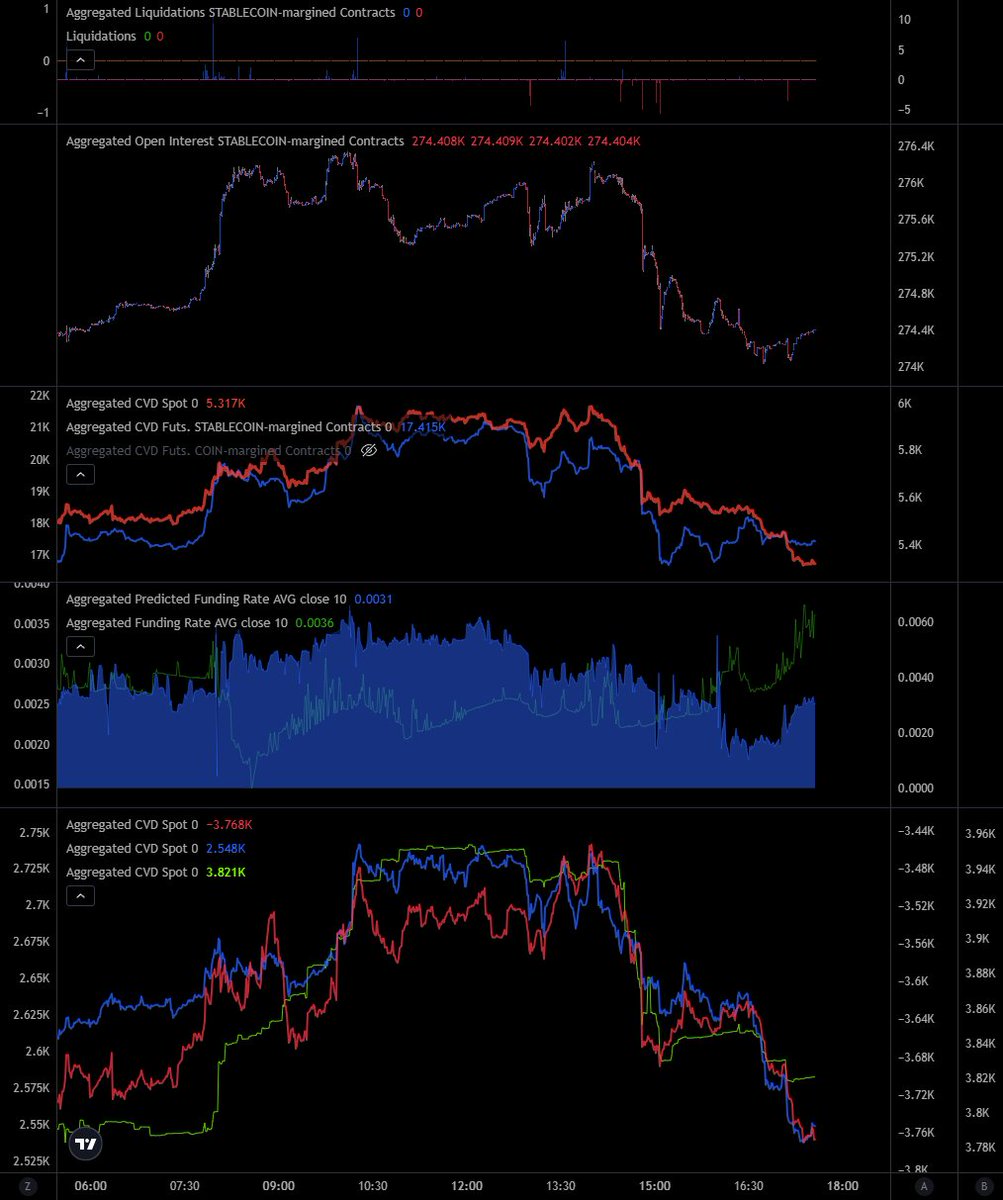
How do you watch perps vs. spot behavior?
What platforms do you use?
Why is it beneficial to watch this?
What does it mean?
Get asked this under every tweet so please just bookmark this long tweet.
This is probably the best detailed explanation of this you will find on here with nuances.
Here's the overarching answer.
If we break it down, what I like to keep an eye on is the following:
> aggressive perps
> aggressive spot
> passive spot
there are many platforms to gauge this behavior. Just remember that there's a lot of fragmentation and also inaccurate ways of reading this because it can tend to get noisy.
Your read will be based on assumptions as well as a lot of screen time (when x + y happens it leads to z happening, which points to ...)
Outlier behavior
So when we parse these participants out remember there is hedging behavior, there is behavior that you will see where someone might suppress the spot side to get their own perps positioning filled etc. Glazing over this to point out that this isn't just as straight forward as meets the eyes at first. But over time your assumed read will improve.
Why Spots vs. Perps
I want you to think of perps positioning as the "weaker" hand because you can lever up tremendously and have your liquidation 0.1% away from your entry (think exaggerated case) which means this positioning is liable to enter, exit and get vaporized fast when price isn't carrying in the desired direciton. Now you throw in an understanding of crowded positioning in the same area and it gives you the exact spot where if positioning is pressed it will unwind with haste.
Think of spot behavior as the whale which has the little fish that stick to its underside for the ride (the perps positioning). In other words, the real strength or weakness of a move is ultimately determined by spot follow-through (or lack there of)
understood? let's move on to what you're actually reading this for and probably skipped the rest to read.
There are many platforms to do this but here is one way I quickly scan this behavior:
1. Coinalyze
You can go on coinalyze for aggressive spot and perps behavior - both aggregated as well as parsing out exchanges (binance, cb etc.)
i.e. you can watch what both aggressive perps and aggressive spot are doing through the move as well as watching what is happening on individual exchanges.
Do this on LTF (I typically do not go above 5-15 mins here).
2. MMT
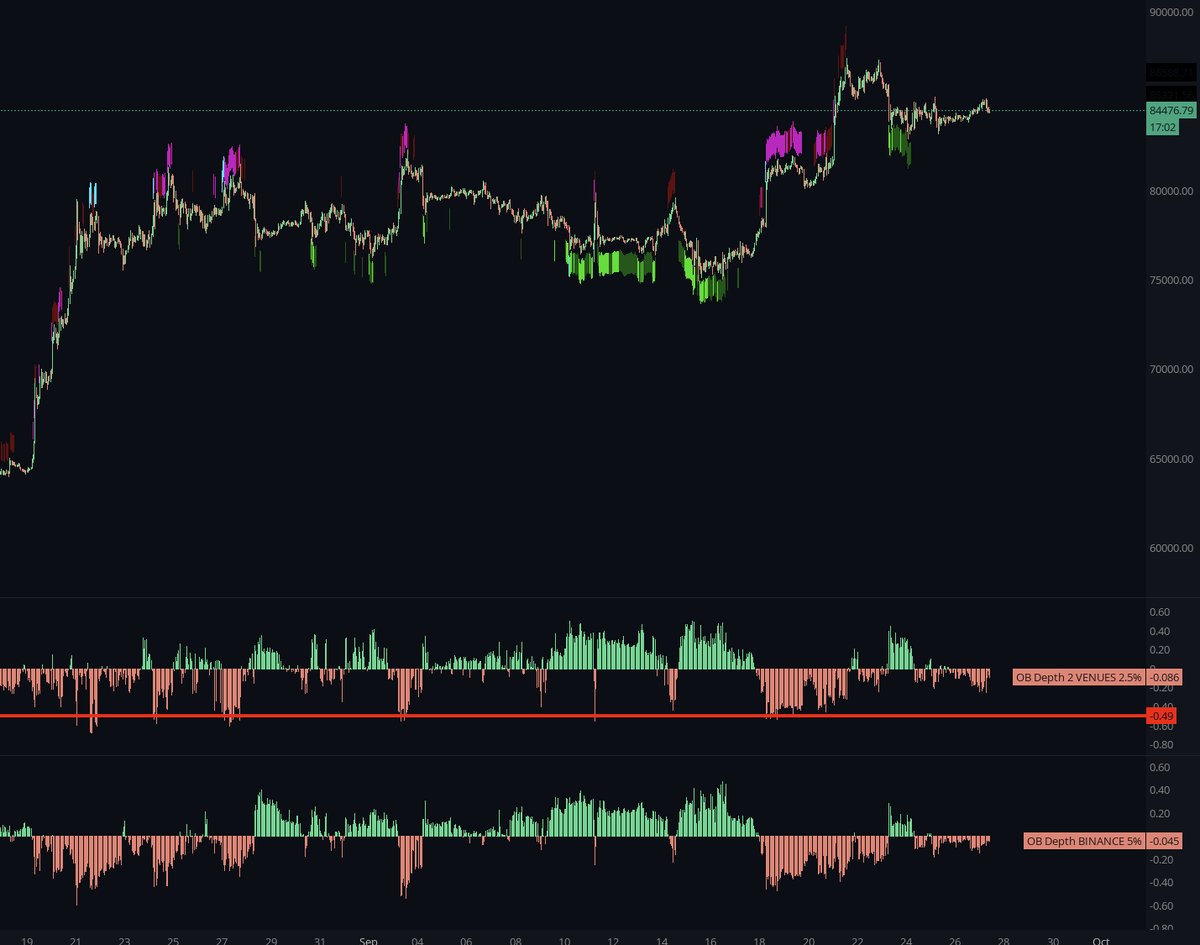
For passive spot, you can go to MMT and watch the spot orderbook skew which shows you how fat the supply/demand is on 2.5% and 5% depth.
The indicators are OB depth and OB pressure bands as shown in image. You can go to settings and change the exchanges as well as looking at spot vs. perps.
Think of this as a "wall" or a "cushion" when approaching from below or above.
Also, at the risk of oversimplifying I want you to visualize the aggressive positioning as "canonballs" when price is approaching a skewed book i.e. aggression can eat away at this skew if it is adequate enough or fall short.
two scenarios combined with context -
BTC is ranging and is trading towards range high for the 3rd time. Short squeeze takes out the range high into a stacked passive spot book skewed towards the ask side and aggressive perps start buying while aggressive spot starts selling. More likely than not this will revert.
BTC is pulling back into an OB that is skewed towards the buy side on passive spot. However aggressive perps continue to long a 1 min grind down and aggressive spot continues to sell unwinding that positioning into new lows. Good chance this passive wall will get eaten through unless this behavior stabilizes.
Keep an eye on the extent of the passive ob skew as well.
When you combine this with areas of confluence the pieces of the puzzle will start to come together.
ok enough yap.
hope this helps.
few notes from my 8 years trading only bitcoin
> focusing on one pair gave me an edge
> half size until it moves in my favour, then add
> add when the trade is working
> full size on the open gets you smoked
> cut losers faster than feels comfortable
> use denial mode to turn off pnl
> fees are pnl eliminate where possible
> dedicate 1 day per week for a weekly review
> execution should be boring
> review the biggest moves of the week
> base every decision on expected value
> recognise when your edge is fading
> simple rules > advanced ones you cant follow
> large wicks will usually at least partially fill
> heatmaps are kinda useless
> liquidation spikes help spotting mean reversion
> round numbers act as magnets
> you are most likely better off entering at limit
> you don't need to watch "every venue" **
> don't backtest shit with ai
> remove trading apps off your phone
> keep risk constant early on
> trading is a j-curve business
> time delays can create clarity
> get better at spotting trends vs ranges
> hard targets cap the best trades
> more screens isn't an edge
> drawdowns are part of what makes an edge
> trading via phone ends fucking badly
> know where you're targeting before entering
> set yourself one non pnl goal per day
> sitting on your hands is a trade in itself
> build sample size before you size up
I value longevity in this business, i want to be here for many years to come, that mindset is what shapes my rules and risk tolerance moving forward 🫡
Here's a quick way to gauge strength on coins:
1. Go to TradingView
2. search TraderXO Macro Trend Scanner - scan through H1, H4 and Daily (bonus: add 50 period EMA for slower trend)
3. Add yearly VWAP with 1 sd. dev. band. - observe where coin is trading relative to 1 sd. dev. band.
Stacked imbalance areas worth watching
Lower buying imbalances did their job.
Held price as support.
Now we’re entering the first smaller selling imbalance area.
But higher?
Still two bigger selling imbalance zones waiting.
Use them with orderflow triggers.
Scalp it. Day trade it. Chill
Sell into strength or let it run?
Whatever you decide comes with a side effect
This is the first data I have seen that says how big that side effect actually is 👇 https://t.co/0MsrchQd25
$BTC
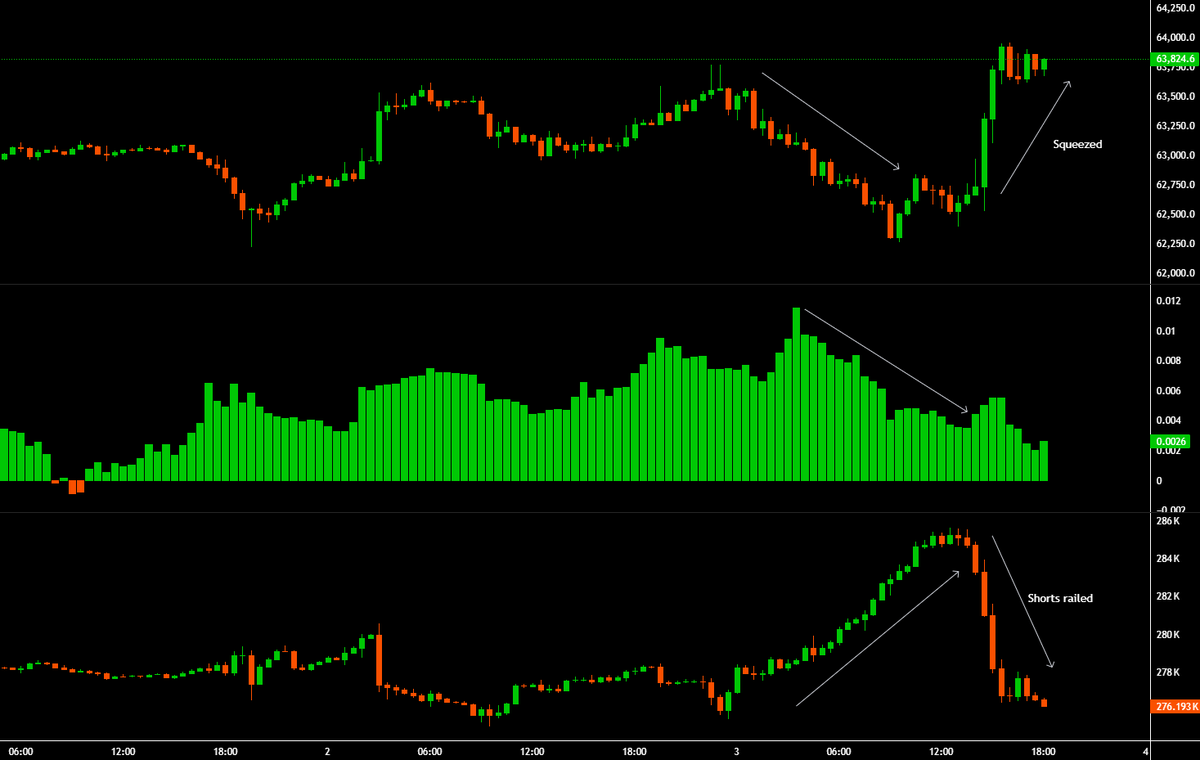
Pretty textbook short squeeze.
Leverage has been completely flushed out, while funding remains low.
Looks like a lot of people got caught on the wrong side of this LTF move higher.