Capital is not scarce
Credible businesses are
Banks, DFIs & investors all back businesses that reduce uncertainty
If your numbers are unclear, funding feels impossible
If they are clear, capital starts flowing in!
Steal my cool resource the Funding Rules Playbook
Find Link in Bio
Seth Godin gave a masterclass on how to build an unforgettable brand in the age of AI:
1. Marketing is not about spend. It is about creating the conditions for other people to eagerly spread your idea.
2. Authenticity is overrated. What customers actually want is consistency. Show up the same way every single time and that is worth more than any Super Bowl ad.
3. Everything your company does is a marketing decision. How you answer the phone. What you charge. How you design things. Marketing is not a department. It is everything.
4. Trust is simple. Make a promise. Keep it. Especially when it is hard.
5. Successful brands are built with your customers talking about you. Not you talking about you.
6. A brand is not a logo. A brand is a promise. Nike has a brand. Hyatt has a logo. One of them you know exactly what to expect. The other you do not.
7. You are measuring the wrong things. Follower counts. Stock price. Open rates. False proxies will take your business in the wrong direction faster than anything else.
8. Social media followers mean nothing. Godin has 400,000 Instagram followers and says if he posts about a new book maybe 12 people buy it. The number is a distraction.
9. Stop trying to be famous. The goal is not to get more famous. The goal is to get less famous and more trusted.
10. Average marketing reaches average people. Average people will not buy your product. You need the people who will talk about you, challenge you, and eagerly pay more for better.
11. When you pick your customers you pick your future. Stop trying to reach everyone. Start trying to deeply serve someone specific.
12. Better beats louder every time. One guy running a wine email list with 130,000 subscribers does $30 million a year in revenue. No ads. No social media hustle. Just consistently better.
13. The real opportunity with AI is not making things cheaper. It is making things better. The businesses that use AI to deepen relationships will win. The ones using it to cut costs will race to the bottom.
14. Your job is not to do your job. Your job is to solve problems for other people and make things better by making better things. Everything else is just noise.
15. When AI becomes the buyer it will always choose the cheapest option. If your entire business strategy is being the cheapest, AI will destroy you. The only protection is being worth it in ways that cannot be easily measured.
16. The next level of marketing is permission at a depth nobody has achieved before. The brand that knows your tools, your projects, your needs, and shows up to help without being asked will be impossible to replace.
17. Most businesses will use AI to spam more people faster. The businesses that win will use AI to serve fewer people better. That gap is the biggest opportunity in marketing right now.
18. You have a squadron of summer interns available for twenty dollars a month. They are not that good but they are very eager. The businesses learning to be good bosses of AI right now will have an enormous advantage over everyone waiting to figure it out later.
19. The question every business should be asking is not how do I get more attention. It is how do I become the kind of business that people would genuinely miss if it disappeared tomorrow. That answer is your entire marketing strategy.
Seth Godin gave a masterclass on how to build an unforgettable brand in the age of AI:
1. Marketing is not about spend. It is about creating the conditions for other people to eagerly spread your idea.
2. Authenticity is overrated. What customers actually want is consistency. Show up the same way every single time and that is worth more than any Super Bowl ad.
3. Everything your company does is a marketing decision. How you answer the phone. What you charge. How you design things. Marketing is not a department. It is everything.
4. Trust is simple. Make a promise. Keep it. Especially when it is hard.
5. Successful brands are built with your customers talking about you. Not you talking about you.
6. A brand is not a logo. A brand is a promise. Nike has a brand. Hyatt has a logo. One of them you know exactly what to expect. The other you do not.
7. You are measuring the wrong things. Follower counts. Stock price. Open rates. False proxies will take your business in the wrong direction faster than anything else.
8. Social media followers mean nothing. Godin has 400,000 Instagram followers and says if he posts about a new book maybe 12 people buy it. The number is a distraction.
9. Stop trying to be famous. The goal is not to get more famous. The goal is to get less famous and more trusted.
10. Average marketing reaches average people. Average people will not buy your product. You need the people who will talk about you, challenge you, and eagerly pay more for better.
11. When you pick your customers you pick your future. Stop trying to reach everyone. Start trying to deeply serve someone specific.
12. Better beats louder every time. One guy running a wine email list with 130,000 subscribers does $30 million a year in revenue. No ads. No social media hustle. Just consistently better.
13. The real opportunity with AI is not making things cheaper. It is making things better. The businesses that use AI to deepen relationships will win. The ones using it to cut costs will race to the bottom.
14. Your job is not to do your job. Your job is to solve problems for other people and make things better by making better things. Everything else is just noise.
15. When AI becomes the buyer it will always choose the cheapest option. If your entire business strategy is being the cheapest, AI will destroy you. The only protection is being worth it in ways that cannot be easily measured.
16. The next level of marketing is permission at a depth nobody has achieved before. The brand that knows your tools, your projects, your needs, and shows up to help without being asked will be impossible to replace.
17. Most businesses will use AI to spam more people faster. The businesses that win will use AI to serve fewer people better. That gap is the biggest opportunity in marketing right now.
18. You have a squadron of summer interns available for twenty dollars a month. They are not that good but they are very eager. The businesses learning to be good bosses of AI right now will have an enormous advantage over everyone waiting to figure it out later.
19. The question every business should be asking is not how do I get more attention. It is how do I become the kind of business that people would genuinely miss if it disappeared tomorrow. That answer is your entire marketing strategy.
More than 40 years ago, I arrived in Chicago in search of an idea. I was a young man looking for purpose, who believed deeply in America, was inspired by the Civil Rights Movement, and wanted to be a part of something larger. The America I believed in was one where everyone has opportunity, everyone is seen, everyone belongs—because that was an America that had a place for me, too.
How to use job posts to find customers every single day, almost for free
Every open role is a company publicly admitting they have a problem they'll pay a whole salary to fix.
• Hiring an SDR? Pipeline's broken.
• Hiring a data engineer? Their data's a mess.
• Hiring for the exact thing your product does? Congrats, they just qualified themselves.
And almost everyone scrolls right past it.
Here's how to actually work it:
Step 1) Pick the one role that signals your problem.
Find the job title that only gets posted when a company has the exact pain you fix.
Step 2) Find every company hiring for it.
LinkedIn Jobs, Indeed, their careers page. Filter by the role plus your ICP (size, industry, region).
Step 3) Skip HR.
Find the hiring manager. The VP or Director who'll actually own that hire and feels the pain today.
Step 4) Reach out before the seat gets filled.
Send them a message, something like:
"Saw you're hiring a [role]. We help teams handle that without adding the headcount. Worth a look before you commit to a salary?"
Step 5) Lead with the outcome, not a demo.
You're saving them an $80k/yr hire, not pitching software. Let that do the talking.
You're early, you're relevant, and you're talking to the one person who actually feels the pain.
A job post is a buying signal sitting in plain sight.
(btw, gojiberry(.ai) catches these hiring signals 24/7 and runs the outreach for you. but you can do it by hand too.)
this is one of the biggest secrets behind how we generated $2.8M for B2B companies:
multi-account linkedin funnels
while most founders post from 1 profile, we grab entire B2B teams and turn it into a 10-man GTM lead gen machine
and i’m about to leak the ENTIRE system:
- the exact profile infrastructure behind multi-account linkedin GTMs
(founder accounts, employee accounts, authority positioning, conversion-focused profiles)
- the profile setup responsible for turning profile views into booked calls
(headlines, banners, about sections, featured sections, custom buttons)
- the manus AI research stack that identifies what's already working in your market
- the competitor content intelligence system
(top-performing posts, engagement patterns, hooks, lead magnets, content formats)
- the ICP research workflow that extracts the exact language prospects use to describe their problems
- the warm lead extraction framework pulling decision-makers directly from competitor comment sections
- the content architecture behind multi-account distribution (authority posts, lead magnets, case studies, educational content, opinions)
- the lead magnet deployment strategy that allows multiple accounts to promote the same asset without looking repetitive
- the content repurposing engine that turns one post into linkedin content, twitter threads, lead magnets, emails, and outbound assets
→ the DM system responsible for converting commenters into booked calls
→ the warm outbound framework built around competitor audiences
→ the quote tweet chain strategy that expands distribution across multiple networks simultaneously
all backed by:
→ $950k+ added to client MRR
→ 50+ client Li accounts managed
→ multiple funnels generating $30k/mo
like + comment "SYSTEM" and i'll send you the full playbook
(must be following + RT for priority access)
I was sunbathing at a hotel's pool in LA when I met a guy who did $300M+ selling digital products and services
we did a little mastermind and he asked me how I did $5.2M+ selling ebooks organically.
So I begin explaining and show him my 60 modules blueprints and videos explaining how it all works
He looks at me, straight in the eye, and asks me why I'm not selling that for $10K at least???
I replied:
"Oh I don't feel like it. I'm busy with other stuff"
He said :
BRO AS SOON AS YOU GO HOME SELL IT TO YOUR FOLLOWERS FOR $10K PER PERSON THAT IS THE MOST VALUABLE PRODUCT YOU HAVE YOU COULD MAKE $100K TONIGHT JUST FROM DOING THAT
so now im giving it out to you guys.
but for free.
Comment "BLUEPRINT" and I'll send it to you via DM
**must be following + retweet
most SMEs don't fail because they cannot get funding
they fail because they cannot show evidence that they can repay the funding
that's where funding readiness becomes critical!
The Nedbank Top Empowerment Conference 2026 kicks off today, 17 June, at the Sandton Convention Centre, bringing together leaders from business, government and development finance institutions to explore The Next Phase of Transformation: Inclusive, Investable, Impactful.
As part of the programme, our Divisional Executive: Client Support and Growth, Lucretia Khumalo, will deliver a keynote address on day 1, sharing insights on the role of development finance in advancing inclusive and sustainable economic growth. She will also participate in a day 2 panel discussion titled “Inclusive Funding: Ensuring entrepreneurs are not left behind,” exploring how funding models can become more accessible and responsive to the needs of entrepreneurs.
Join the conversation at the Nedbank Top Empowerment Conference 2026: https://t.co/Us1pBox9DW
#IDCFunding #TopEmpowerment2026 #InclusiveFunding #EconomicGrowth
Just put your head down & build.
That's the only score that matters: build something.
Leave something behind.
Build something bigger than yourself.
At the end of the day, the only score that matters is the answer to the question “what have you built?”
@VusiThembekwayo As you build, measure
Revenue
Customers
Systems
Track record
Proof
That will come in handy when you approach potential partners, funders or investors.
Close observers of South Africa’s agriculture sector are aware that, for some time, I have been writing about South Africa’s ample maize harvest. Maize is prominent in agricultural discussions not only as a staple grain but also as an indicator of field-crop conditions.
If we have an ample maize crop, it is usually fair to assume that other crops are also in good condition. For the 2025–26 season, the maize crop planted in October 2025, now coming into harvest, is set to reach a record 17.1 million tonnes. We see larger harvests of other grains, vegetable oils, fruits and vegetables.
The primary catalysts are the favourable La Niña rains and farmers’ determination to plant on a slightly larger area.
But the harvest of the 2025–26 maize crop is a bit delayed compared to the usual pace. In the week of 5 June 2026, farmers had delivered to commercial silos about 2.1 million tonnes of maize (white and yellow maize). This is 17% behind last year’s pace.
But remember, last year was generally behind the typical harvest time. Also because of the late start of the season; this year is even more delayed. It is June, but the maize harvest is not yet in full swing across the country.
The main reason for the delayed harvest is the prolonged summer rains, which continued through to May 2026. In addition, there are various regions of the country where the maize planting season was also late by more than a month.
The reason for the late plantings in such areas was the excessive soil moisture earlier in the year.
Fortunately, with all these delays, the recent assessment suggests that South Africa is still in for an ample maize harvest.
In my recent drive across Free State and North West, I observed, from a distance, that in many parts, the maize crop is looking favourable, and that aligns with what we had already heard from farmers and the Crop Estimates Committee, which provides the crop forecast for the country.
Importantly, the fact that the season is more than a month late and the rains were far more prolonged than usual also doesn’t raise much concern for now about crop quality.
Typically, in wet years, maize or crop quality is a challenge. But this year, we are not hearing much of that. In fact, of the 2.1 million tonnes that farmers have delivered to commercial silos, about 94% is first grade or excellent quality.
If the remaining major area yet to be harvested shows similar quality, then South Africa will be in a far better place than in the previous 2024–25 season where, although we had an ample maize crop, there were quality challenges because of excessive moisture.
The slightly poor quality, although it generally has minimal impact on the ultimate maize availability and food prices in the country, does weigh on farmers’ incomes, as they receive a slightly lower price for their products.
--read my full article here: https://t.co/u2LaA7IQ8b
Paul Graham published “Startups in 13 sentences” back in 2009.
I reread them after being accepted into YC.
The advice is still relevant today.
Here’s the summary:
1. Pick good cofounders.
You can swap your idea overnight, but you're stuck with your cofounders, so pick them like you're picking a marriage.
2. Launch fast.
You haven't actually started until you ship, because launching is what teaches you what you should've been building.
3. Let your idea evolve.
Launch, then iterate. Most of the good ideas only show up once you're building.
4. Understand your users.
Growth comes from how much you improve people's lives, and you can't do that until you understand them better than they understand themselves.
5. Better to make a few users love you than a lot stay ambivalent.
Win a small group completely instead of half-winning everyone. It's easier to add users than to fake real love.
6. Offer surprisingly good customer service.
Treat your first users absurdly well, even in ways that don't scale, because that's how you learn what to build.
7. You make what you measure.
Track the one number that matters every single day and you'll start doing more of whatever moves it.
8. Spend little.
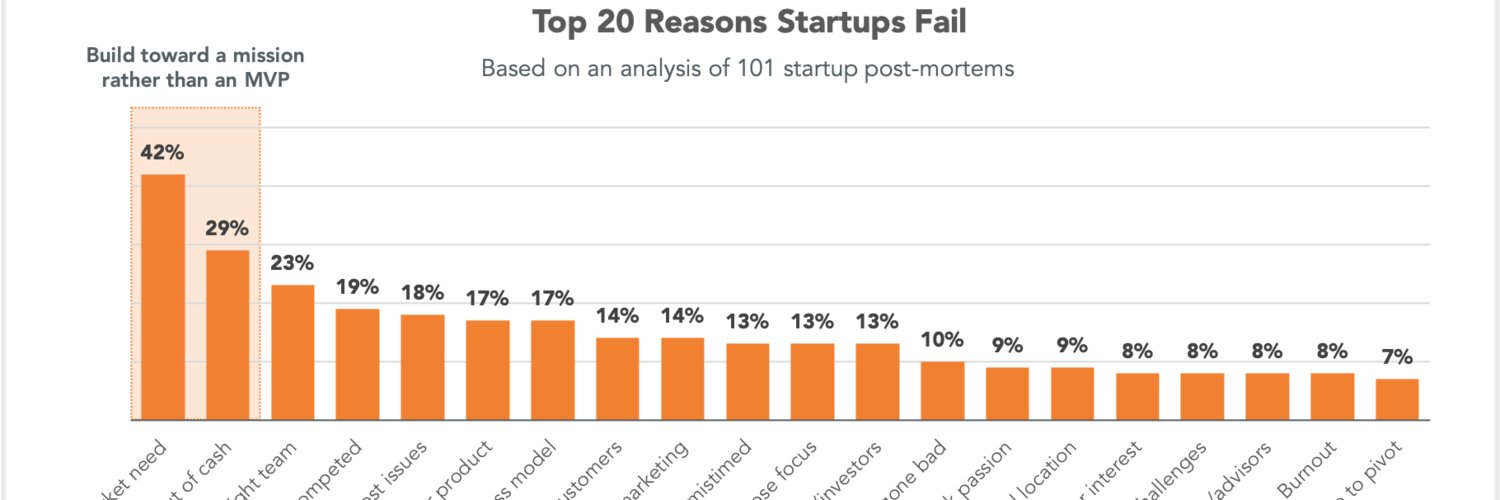
Most startups die by running out of cash, so staying cheap just buys you more shots on goal.
9. Get ramen profitable.
Make enough to cover the founders' rent and you flip the power dynamic with investors overnight.
10. Avoid distractions.
The deadliest ones are the things that pay you now: day jobs, consulting, even fundraising. You'll always take the call that pays today.
11. Don't get demoralized.
Most startups don't die from money. They die because smart founders got worn down. Protect your morale on purpose.
12. Don't give up.
In startups, sheer persistence usually wins, as long as you keep reshaping the idea while you hang on.
13. Deals fall through.
Treat every deal as dead until it closes. Depending on it kills your morale and somehow makes it less likely to happen.




![pierreeliottlal's tweet photo. How to use job posts to find customers every single day, almost for free
Every open role is a company publicly admitting they have a problem they'll pay a whole salary to fix.
• Hiring an SDR? Pipeline's broken.
• Hiring a data engineer? Their data's a mess.
• Hiring for the exact thing your product does? Congrats, they just qualified themselves.
And almost everyone scrolls right past it.
Here's how to actually work it:
Step 1) Pick the one role that signals your problem.
Find the job title that only gets posted when a company has the exact pain you fix.
Step 2) Find every company hiring for it.
LinkedIn Jobs, Indeed, their careers page. Filter by the role plus your ICP (size, industry, region).
Step 3) Skip HR.
Find the hiring manager. The VP or Director who'll actually own that hire and feels the pain today.
Step 4) Reach out before the seat gets filled.
Send them a message, something like:
"Saw you're hiring a [role]. We help teams handle that without adding the headcount. Worth a look before you commit to a salary?"
Step 5) Lead with the outcome, not a demo.
You're saving them an $80k/yr hire, not pitching software. Let that do the talking.
You're early, you're relevant, and you're talking to the one person who actually feels the pain.
A job post is a buying signal sitting in plain sight.
(btw, gojiberry(.ai) catches these hiring signals 24/7 and runs the outreach for you. but you can do it by hand too.)](https://pbs.twimg.com/media/HLISIiwbsAAPj0h.jpg)