🇺🇸 SAN FRANCISCO | 27th May 🇺🇸
A HUGE thank you to everybody who showed up on Wednesday to our latest event in San Fran where we discussed:
🧠 DeFi Yields and Risks 🧠
🗣️ Big shoutout to our:
Host: @tms7331
Co-host: @chrisliambender from @renegade_fi
A great turnout led to a room full of in-depth discussions and knowledge sharing! 🔥
🫡 Some of our attendees: @tms7331 // @chrisliambender // @willstrk // @coinwatchdotco // @mrrongxin // @oxsd
📝 As for us at WPRC, do show us some love:
👉 Follow us on LinkedIn: https://t.co/CRA3Fuxzmt
👉 Want to join future events? https://t.co/iYNZeg9nKk
‼️ THE EVENT BREAKDOWN > TL;DR ‼️
▶️ What should DeFi yields be to account for the risk?
General consensus seems to be: higher than they currently are, but probably not as high as the 12.55% that @dunleavy89 suggested!
▶️ A couple observations:
Many people outside of the US don't have access to US capital markets, so getting any yield on USD is amazing. Also, many people use lending as part of larger strategies in DeFi. If someone lends USDC but then borrows ETH against it, their risk profile changes. Similarly, a looping strategy provides a higher yield by introducing a couple other risks.
▶️ How should DeFi yields be priced?
Seems extremely difficult - appears like you can compare protocols (feels like @Morpho is safer than @aave) - and accurately modeling all the risk feels borderline impossible! If you could, a proper approach may involve something like estimating a full distributions of outcomes for each risk factor and combining them appropriately. And at the end of the day, it seems likely that most DeFi users are not heavily considering risk.
▶️ How will DeFi evolve in the future?
The role of curators or risk analysts seems important (for example, with the KelpDAO hack, there were some risks that weren't properly accounted for), but this is something that can evolve over time.
-----------
↔️ One of the conclusions of the paper was that @RenzoGov does not pose a systemic risk to the broader DeFi ecosystem, however the reality is that in large part it's because restaking as a whole hasn't lived up to expectations.
↔️ The structure of restaking creates the shape that would allow for cascading contagion.
↔️ An interesting question is how to prevent (or rather, should we try to prevent) this sort of risk from being present in the ecosystem. It ultimately feels like there's only so much you can do - what makes DeFi compelling is the permissionless nature of it!
↔️ But it does feel like there is an asymmetry with some of the risk. When a restaking protocol deploys across multiple chains, their overall TVL and profits increase. But this introduces bridge risk, and some of that risk is taken on by third parties (@kernel_dao hack being a perfect example of this)!
#Renegade #Web3 #Web3Event #Blockchain #Ethereum #WPRC #DeFi #DeFiYield #Crypto #DEX #CryptoTrading #KernelDAO
Whitepaper Reading SF:
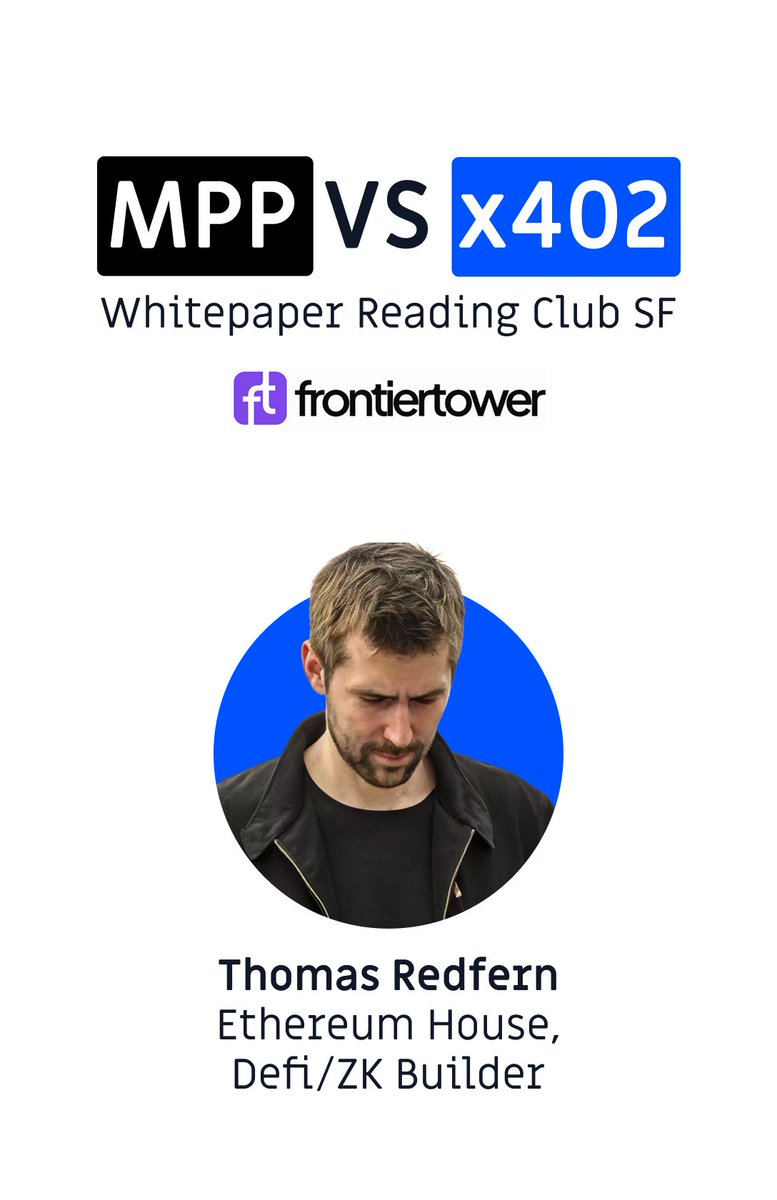
📝Topic: MPP vs X402
📍Location: Frontier Tower
📆Date: Wed Apr 22
This is becoming a new design space. Lots of old questions with new answers. Lots of new tools fixing old probolems.
Thank you @tms7331 for helping make this session possible and for leading the discussion! We appreciate @frontiertower for hosting us.
Register: https://t.co/RkNi4kVcNa