🚨 A SENIOR ANTHROPIC ENGINEER JUST DROPPED AN 11-PAGE PDF ON LOOP ENGINEERING.
The core shift: stop prompting the agent. Build the system that prompts it.
Inside the autonomous loop:
- Discover → Finds its own work (failing CI, open issues).
- Isolate → Uses separate git worktrees to prevent collisions.
- Verify → A second agent reviews the work. (Never let agents self-grade).
- Persist → Writes to disk, not temporary context windows.
- Schedule → Runs automatically on a timer.
This is a great framework for building more reliable agentic systems
link to the guide below.
Read it, then check out this ace article on Loop Engineering by @akshay_pachaar 👇
🚨 Gemini can now turn articles, PDFs, research papers, reports, and YouTube videos into clear, structured insights in minutes.
It's like having an MIT researcher working alongside you 24/7.
Here are 10 prompts that will completely change how you analyze information:👇👇
Bookmark 🔖
The new Google Finance is coming out of beta this week with new capabilities and a new @Android app.
Explore three ways it can help you better track and understand financial investments 🧵
INSTEAD OF WATCHING AN HOUR OF NETFLIX TONIGHT.
This 60-minute Cambridge lecture by Demis Hassabis will teach you more about the future of AI than most people will learn in the next 5 years.
Bookmark it and give it an hour, no matter what.
You can now fine-tune Gemma 4 (and 500 other open source models) in a free Google Colab 🔥
1. Open the Colab notebook below
2. Run the blocks to launch Unsloth Studio
3. Choose a model and dataset
4. Hit 'Start Training'
And you're done!
Gemma 4 can run on phones without an internet connection! 🤯
It can perform local agentic tasks, such as logging and analyzing trends. When connected, it can also make API calls.
Want to try it yourself? Get the Google AI Edge App on iOS or Android. (🔊 Sound on for the demo!)
Who wants to know how Gemma 4 works?
This visual guide breaks down the new architectures and how they process text, images, and (for the smaller models) audio.
👇
Start building with Gemma 4 now in @GoogleAIStudio.
You can also download the model weights from @HuggingFace, @Kaggle, or @Ollama. Find out more → https://t.co/GENFuH25uN
Build autonomous agents that plan, navigate apps, and execute multi-step tasks – like searching databases or triggering APIs – with native tool use.
With up to 256K context, it can analyze full codebases and retain complex action histories without losing focus.
Available in four sizes:
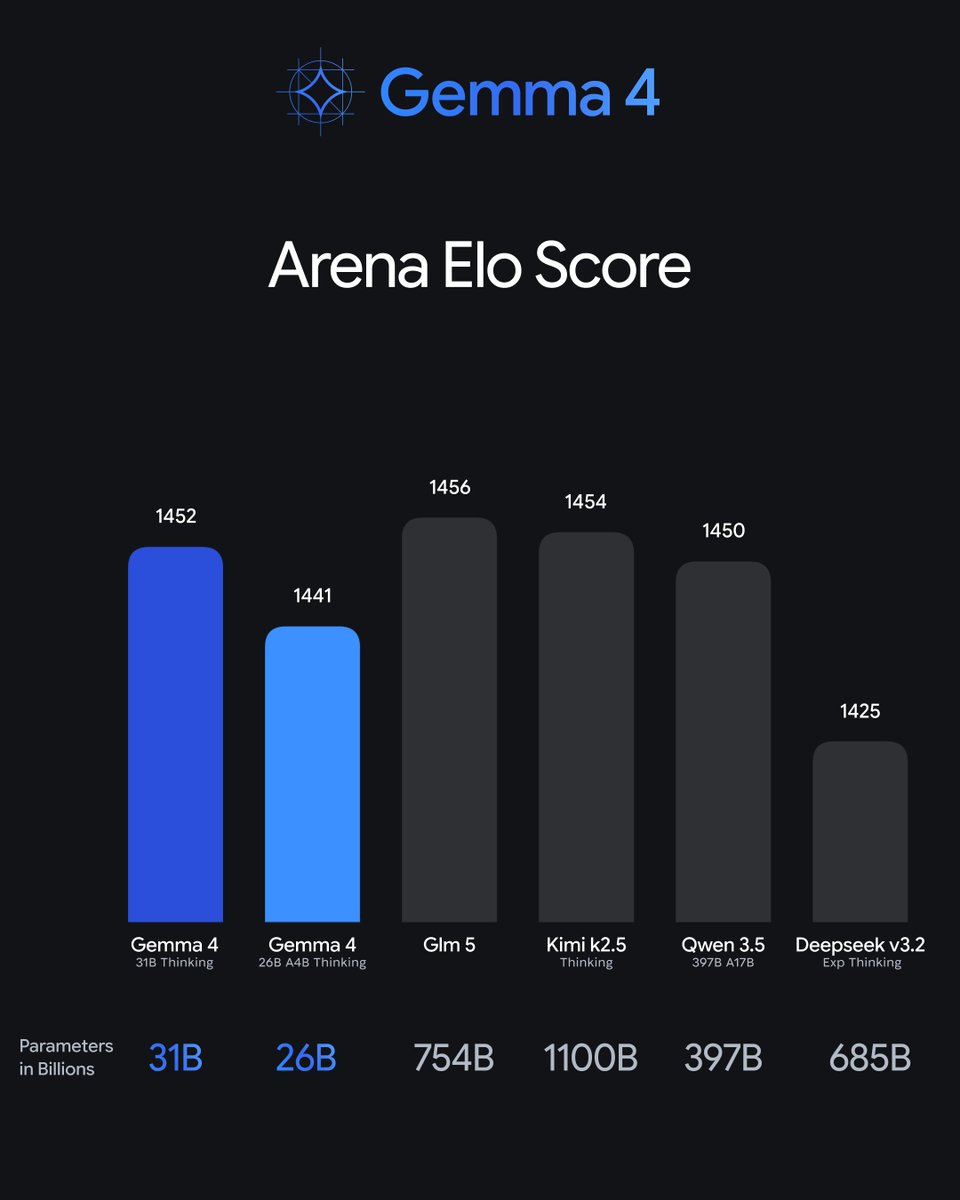
🔵 31B Dense & 26B MoE: state-of-the-art performance for advanced local reasoning tasks – like custom coding assistants or analyzing scientific datasets.
🔵 E4B & E2B (Edge): built for mobile with real-time text, vision, and audio processing.
Meet Gemma 4: our new family of open models you can run on your own hardware.
Built for advanced reasoning and agentic workflows, we’re releasing them under an Apache 2.0 license. Here’s what’s new 🧵
How do I transition from Data engineer to AI engineer?
Here's a structured 6-step transition path:
You already have the hardest part: engineering fundamentals + production mindset.
The goal is to add the AI layer on top.
Step 1: Work inside an AI-flavored data pipeline
- Ingestion + cleaning for RAG / analytics
- Chunking, metadata, indexing
- Observability and data quality checks
Step 2: Learn how model providers work
- APIs, limits, retries, rate limits
- Latency and cost trade-offs
- Privacy and data handling constraints
Step 3: Prompting as an engineering discipline
- Prompt templates
- Versioning + change logs
- Structured outputs (JSON schemas)
Step 4: Evaluation for generative systems
- Golden sets
- Automated checks (format, factuality signals, regressions)
- Human review loops when it matters
Step 5: Tool integration + agentic flows
- Function/tool calling
- Guardrails (allowed tools, timeouts, fallbacks)
- Tracing what the agent did and why
Step 6: Build 1-2 small projects end-to-end
Examples:
- RAG assistant over internal docs
- Ticket triage bot with tool calls + evals
For an experienced data engineer, this is usually not a multi-year shift.
With focused effort + hands-on work, ~3-4 months can be enough to become interview-ready.
If you're making this transition, what part feels most unclear: evals, prompting, or agents?
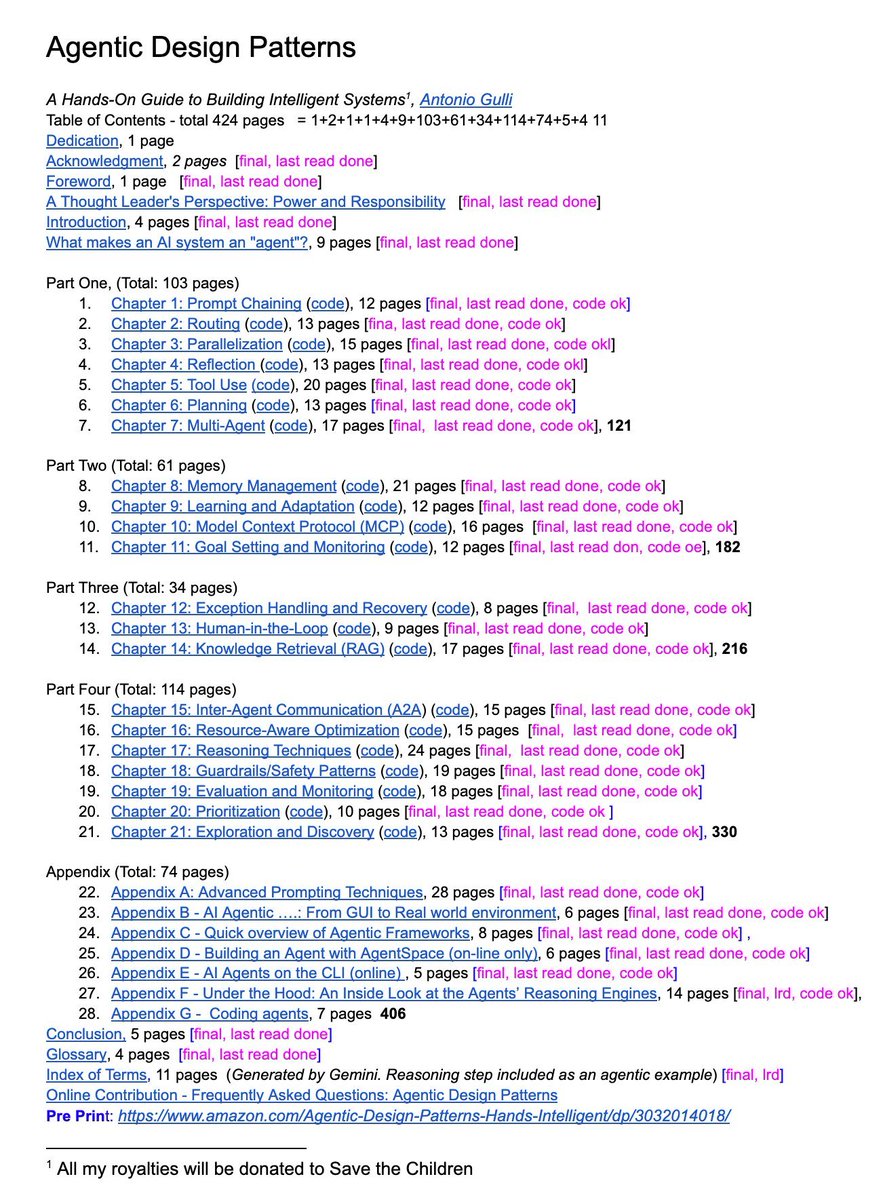
A senior Google engineer just dropped a 421-page doc called Agentic Design Patterns.
Every chapter is code-backed and covers the frontier of AI systems:
→ Prompt chaining, routing, memory
→ MCP & multi-agent coordination
→ Guardrails, reasoning, planning
This isn’t a blog post. It’s a curriculum. And it’s free.
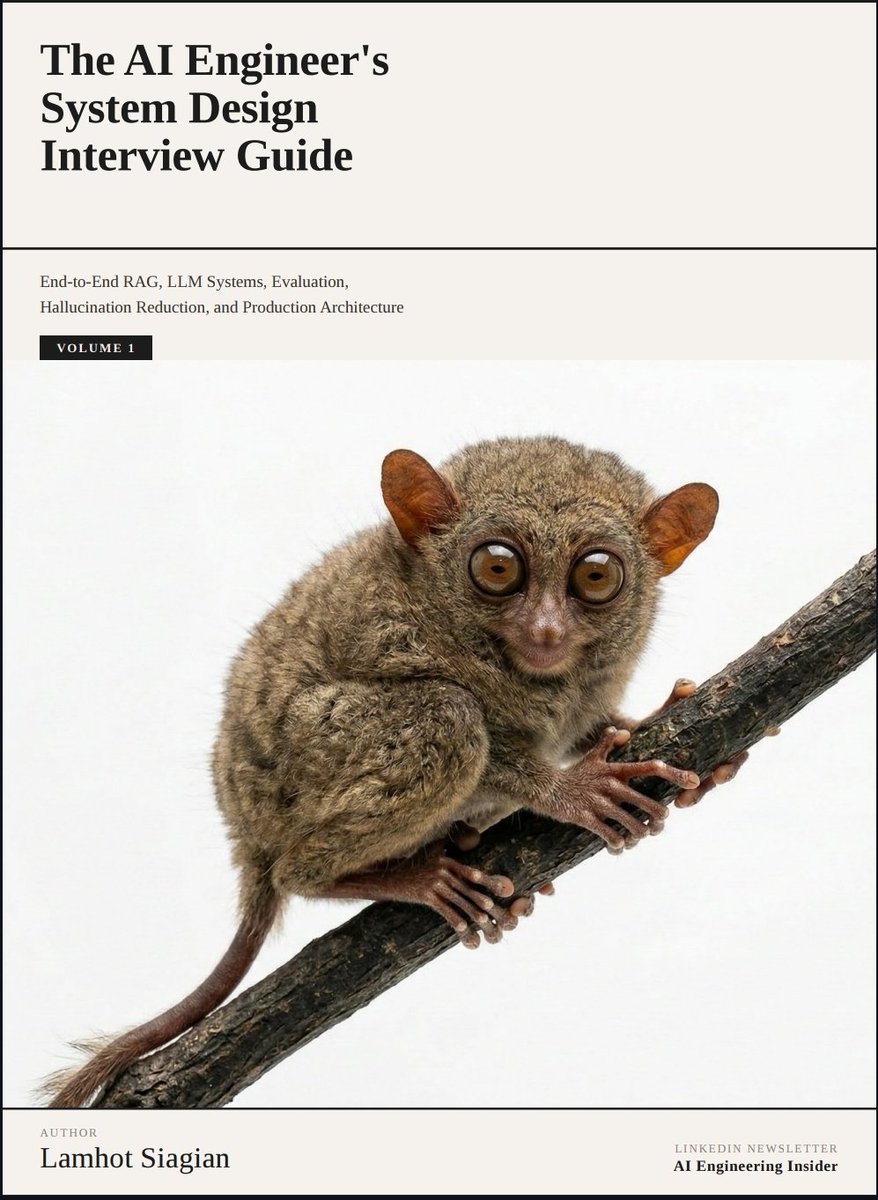
This AI System Design guide teaches RAG better than most courses.
And I'm giving it away for free (Only for First 4500)
Inside:
• RAG fundamentals & chunking strategies
• Hybrid retrieval (BM25 + vector search)
• Production-level RAG architecture
• Evaluation & RAGAS metrics
• Hallucination reduction techniques
• End-to-end LLM system design
How to get it:
• Follow me (must so I can DM)
• RT + Like
• Comment "book"
I'll dm you
Stop burning tokens on Claude Code.
Use this instead 👇
A free GitHub repo (80K⭐) that turns your CLI into a high-performance AI coding system.
Link → https://t.co/h0lbndmbT1
Why it’s different:
→ Token optimization
Smart model selection + lean prompts = lower cost
→ Memory persistence
Auto-save/load context across sessions
(No more losing the thread)
→ Continuous learning
Turns past work into reusable skills
→ Verification loops
Built-in evals so code actually works
→ Subagent orchestration
Tames large codebases with iterative retrieval
Most people think Claude struggles with complex repos.
It doesn’t.
They’re just using the wrong setup.
This fixes it.
Bookmark this for your AI stack. ♻️
#AI #Claude #AIAgents #LLM #GenAI #DevTools