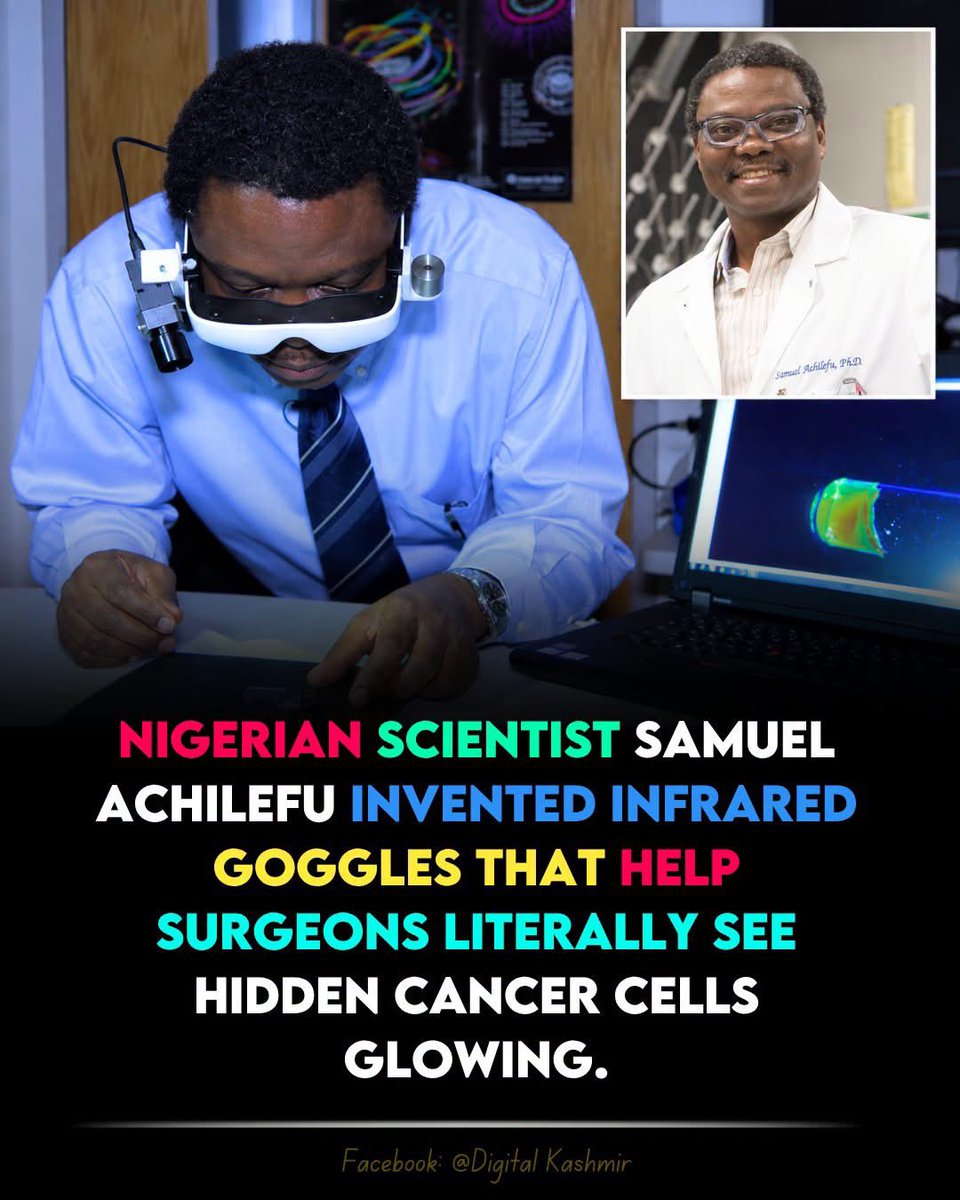
A NIGERIAN AGAIN!
Imagine a surgeon who can literally see cancer glowing inside a patient's body.
Nigerian born scientist Professor Samuel Achilefu made this possible by inventing infrared goggles for cancer surgery.
Surgeons often cannot tell if every cancer cell has been removed.
Achilefu's goggles use a safe dye that lights up cancer cells under infrared light so doctors can spot tumors the eye would miss.
This breakthrough has guided real breast cancer surgeries at Washington University in St Louis. Think about how many repeat surgeries this could spare cancer patients everywhere.
Achilefu now holds more than seventy United States patents and works at UT Southwestern Medical Center. Sometimes one simple idea can change how the world fights cancer.
~ Sources:
UT Southwestern Newsroom
Washington University School of Medicine
St Louis Public Radio.
Paediatrics long case exam:
I met a child with recurrent UTI secondary to posterior urethral valve
The professor asked me a question and gave him an answer, he looked at me as said " you are a text book doctor, I would have failed you but other examiners here think you deserve to scale through"
Advice to medical students;
Pls read to pass your exam, study the pattern your examiner wants, that's the most important task you have at hand.
When you graduate, you can always study to become a better doctor.
-Ask the seniors in your school how to maneuver a hurdle ahead
-Read every lecturers lecture notes and go to the ward to see patients
-Let your parents get you a Uworld account and a BNB subscription to master fundamentals and see tonnes of questions
Thank me later.
As a young medical graduate, if you feel rusty and don't know anything just carry USMLE step 1 first aid to read.
Read it with "the concept academy videos" come back later to thank me.
As promised, I’ve compiled everything I could remember and jotted down from the Saturday Space.
I initially wanted to make a thread out of it but I figured it would too long, so I decided to put everything in a document instead.
You can go through it at your convenience, download it and also share it with others who might find it helpful.
Here’s the link. Feel free to share it with others too.
I hope this helps. 🤍 🫶🏽
https://t.co/NvF85PVl72
funny thing about induction into medical profession, that uncle that has never sent you a dime nor advised you when you were a medical student will come that his child is inducting 😂
If you're a medical student and you have this thing where you're studying something and you're understanding it, but when it's time to explain it, you suddenly cannot explain it,
you need to understand that you are suffering from a problem of recognition, not recall.
You are recognising the information when you see it, but you are struggling to produce it yourself.
You might actually understand the topic, but if you cannot reproduce that understanding when somebody asks you a question, the examination hall is going to expose that problem very quickly.
You already know by now that studying is not just about seeing information and thinking, "Yeah, I understand this."
You must be able to reproduce it.
One way I make recall easier is by using ChatGPT's voice feature.
Don't ignore this feature.
When I finish understanding a slide with ChatGPT, I can tell it:
"Act as my viva instructor. I want to explain everything I have learned from this slide to you. Do not interrupt me. When I finish, assess my explanation against the slide."
Then I use the voice feature and start talking.
You can talk for several minutes, and the idea is simple: explain everything you remember without looking at the slide.
Try to cover the entire thing within the available time.
Don't read the slide while you're explaining it.
Don't look at your notes.
Just talk.
Explain the concepts as though somebody is sitting in front of you asking you questions.
When you're finished, tell ChatGPT to compare what you said with the actual slide and give you an honest assessment.
Ask it to identify:
- what you explained correctly
- what you skipped
- what you misunderstood
- what you got factually wrong
- what important details you failed to mention
- and how well you actually understood the material
You can even tell it to mark you honestly.
Don't ask it to make you feel good.
Ask it to assess you as though you were actually sitting for a viva.
And this is where the method becomes useful.
When you're reading something, your brain can easily convince you that you know it because the information is sitting right in front of you.
But once the slide disappears and you have to explain the topic from memory, you suddenly discover the holes.
That's exactly what you want.
You want to discover those holes before the examination does.
And honestly, doing this also makes studying more interesting.
It feels like you're studying with somebody else.
You're explaining things to a person.
The AI listens.
Then it comes back and tells you where you were wrong.
So instead of simply reading another slide and hoping you remember it, you're actually forcing yourself to retrieve what you have learned.
That is the difference between recognising information and being able to reproduce it.
And in medical school, you need the second one.
Good morning, Good morning.
Medical students, you're in the best course ever (the best being figuratively used). They're privates schools in Nigeria paying millions of naira for medicine, if it wasn't a good thing, those programmes would have folded, they have not. Guess what? They're multiplying. That tells you one thing — it is still very valuable.
Don't be discouraged, the only way through, is through.
One thing you realize very fast in medical school is that association is very underrated.
A guy who got 3/3 distinctions in the previous set was actually roommates with another guy who also got 3/3 distinctions.
I found this out when I was speaking with someone who came to crash at my hostel one day. We were just talking about academics, and he casually mentioned,
"Do you know that two of those guys who got three distinctions out of three were actually roommates?"
That honestly blew my mind.
Then I remembered another conversation I had with one of my seniors who recently passed his MB.
One thing he told me surprised me.
He said he didn't even start reading early.
According to him, he only became really serious about four months before the MB examinations.
But then he did something very interesting.
About one week before the MB started, he packed his things and went to crash at the lodge of one of his friends—a guy he already knew was extremely studious.
When he got there, he met other friends too. They had all gathered there to prepare for the MB.
And for those seven days, all they did from morning till night was study.
Study.
Quiz each other.
Recall.
Solve past questions.
Draw diagrams.
Teach one another.
Study again.
From morning till night.
Nothing else.
When the MB started, they would go and write the paper for that day, come back, and immediately begin preparing for the next paper.
Nobody was thinking about unnecessary distractions.
Everybody was reading different topics.
Testing one another.
Finding each other's weak points.
Filling in knowledge gaps.
Just teamwork.
After the examinations, something interesting happened.
The friend whose lodge they all stayed in—the naturally studious guy, ended up graduating with three distinctions out of three.
My senior, despite only becoming serious about four months before the examination, passed comfortably.
He didn't get distinctions, but he passed.
The other guys who stayed together in that lodge also passed.
That made me realize something.
Association matters.
A lot.
In medical school, you have to be honest with yourself.
You already know yourself.
You know whether academics has always come naturally to you or not.
Nobody needs to tell you.
Your past already tells you.
If you know you're someone who struggles to stay consistent, then intentionally place yourself around people who don't.
Sometimes the greatest motivation isn't a motivational quote.
It's simply seeing your roommate reading.
When you see someone reading seriously every single day, you subconsciously begin to tell yourself,
"This person isn't joking. Maybe I shouldn't joke either."
Human beings are creatures of imitation.
We imitate far more than we realize.
The people around you slowly become the standard your brain accepts as normal.
If everybody around you studies every evening, you'll gradually begin to feel uncomfortable not studying.
If everybody around you procrastinates every evening, you'll gradually begin to think that's normal too.
Will associating with brilliant people automatically make you brilliant?
No.
But it will almost certainly make you better than you would have been alone.
Even if you don't get their grades, you'll probably still pass because you've placed yourself in an environment where studying has become the normal thing to do.
So if you're entering medical school—or you're already in it, don't just choose friends because they're funny.
Choose at least a few friends whose academic habits are worth copying.
Sometimes your environment is the study technique you've been looking for all along.
BRO TO BRO:
If your phone gets stolen, the first thing thieves usually do is remove your SIM card.
Do this now:
Save your IMEI number somewhere safe.
Dial *#06#
A 15-digit number will appear.
Take a screenshot and keep it in your email or cloud storage.
If your phone is ever stolen, that number can help with tracking, blocking, and ownership verification.
Most people only learn this after losing their phone.