Most AI + crypto conversations focus on the final step:
“Tell the agent what to trade, and it executes.”
But the harder part happens before the trade.
An agent needs fresh information, permission to act, a way to sign transactions without exposing private keys, and a way to pay for data or other services when needed.
That’s the part of Injective’s agent infrastructure I find interesting.
The Documentation MCP Server gives agents access to current Injective documentation and network information, while the AI Agent SDK makes those tools easier to use when building applications.
Then there’s the execution side.
The MCP Server can connect agents to market data, positions and trading actions, while AuthZ lets users control what an agent is allowed to do — and revoke those permissions when necessary.
Payments are another important piece.
With x402, an agent can pay for things like data, signals or compute using USDC while it’s doing a task, rather than waiting for a human to step in.
And with @injective Agents, agents can have an on-chain identity and potentially earn from the activity they generate.
Put all of that together and the bigger idea becomes clearer:
AI agents aren’t just being given the ability to trade. They’re being given the pieces they need to actually operate.
Fresh information.
Controlled execution.
Payments.
Identity.
A record of activity.
That’s the part of agentic finance I think deserves more attention.
The interesting question isn’t just “Can an AI agent trade?”
It’s “Can an AI agent actually function on its own, while the user still remains in control?”
gNinja 🥷🏾
The new @injective Zealy Sprint is more than just another XP campaign.
There’s a 1,000 injective-protocol:native monthly reward pool, and anyone can join and start earning there’s no minimum rank requirement.
But what caught my attention is the focus on consistency.
Stay active for 3 consecutive months and participate in every sprint, and you become eligible for an additional bonus reward.
There’s also a bonus for participants from the first Injective Zealy Sprint who return and take part in the latest sprint.
And yes, there’s a referral quest too. Successful invites can earn you additional rewards.
👉 Join through my Zealy referral link
What I like about this setup is that it isn’t only rewarding people who show up once. Consistency actually matters.
If you’re already contributing to the Injective community, this could be a good way to turn that activity into rewards.
Are you joining this sprint? 👀
🥷🏾
this ends in 5Hrs
@trenches is building an attention market on solana, and we will be able to accumulate stars
- go to: https://t.co/2yJdplcavT
- connect X account
-wait for next update
done
Wall Street’s financial plumbing is starting to move onchain.
DTCC recently processed live production trades using tokenized securities held by DTC, with around 40 firms involved. The assets include equities, ETFs and U.S. Treasuries, with DTCC’s broader tokenization service expected to launch later this year.
That matters because this isn’t just another crypto project talking about RWAs.
It’s traditional market infrastructure testing blockchain for actual financial workflows.
And that raises an interesting question:
Which networks will be ready if tokenized markets move from pilots into everyday use?
@injective is already building around onchain markets, real-world assets and native USDC settlement. USDC and Circle’s CCTP are live on Injective mainnet, giving the network a native dollar-based settlement asset.
I don’t think DTCC’s move automatically means Injective will benefit.
But it does make the infrastructure question much more interesting.
The real test won’t be who talks about tokenization the loudest.
It’ll be who can actually support it when the volume gets real.
gNinja 🥷🏾
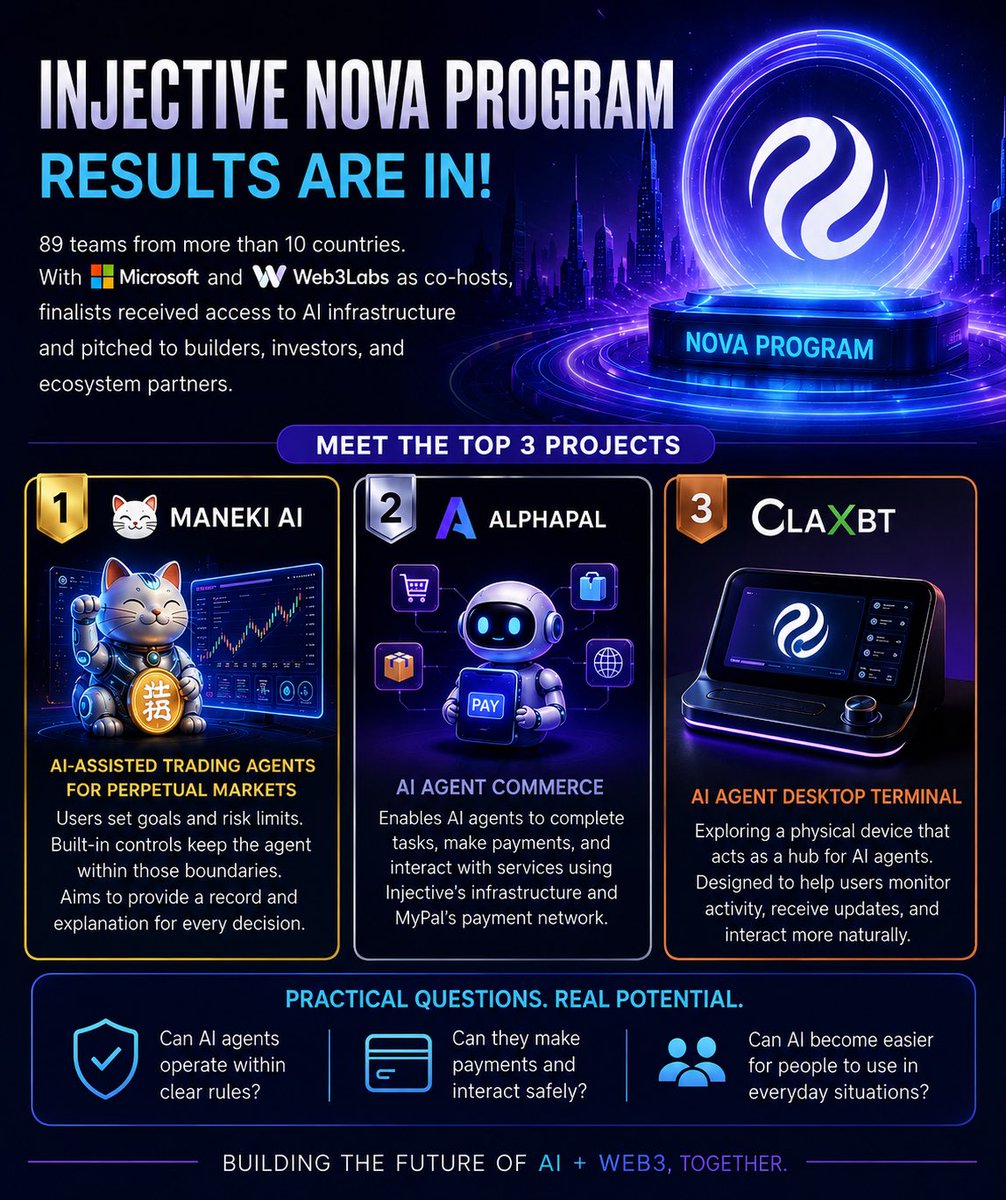
The @injective Nova Program recently wrapped up, and I think the projects that came out of it deserve a closer look.
Over the course of the program, 89 teams from more than 10 countries submitted ideas. With support from Microsoft and Web3Labs, the finalists received access to AI infrastructure before presenting their work to builders, investors, and ecosystem partners.
What caught my attention wasn’t the number of projects....it was how focused they were.
Maneki AI, which took first place, is exploring AI-assisted trading for perpetual markets. According to the team, users set their own goals and risk limits, while built-in controls are designed to keep the agent within those boundaries. The project also aims to provide a record of how trading decisions are made, making the process easier to review.
AlphaPal, the second-place project, is looking beyond trading. Its goal is to let AI agents complete tasks, make payments, and interact with services by combining Injective’s infrastructure with MyPal’s payment network. If successful, it could expand how AI agents participate in everyday economic activity.
OlaXBT, which placed third, is taking a different approach by exploring a desktop device for AI agents. The idea is to give users a dedicated interface to monitor activity, receive updates, and interact with agents more naturally.
What I found interesting is that none of these projects are trying to solve everything at once.
Instead, they’re asking practical questions:
>Can AI agents operate within clear rules?
>Can they make payments and interact with services safely?
>Can AI become easier for people to use in everyday situations?
It’s still early, and these ideas will need time to prove themselves.
But I think this is a healthy direction for AI in Web3. Rather than making broad promises, these teams are building and testing practical tools that people might actually use.
Which of these projects stands out to you the most, and why?
gNinja 🥷🏾
injective-protocol:native
Wall Street’s financial plumbing is starting to move onchain.
DTCC recently processed live production trades using tokenized securities held by DTC, with around 40 firms involved. The assets include equities, ETFs and U.S. Treasuries, with DTCC’s broader tokenization service expected to launch later this year.
That matters because this isn’t just another crypto project talking about RWAs.
It’s traditional market infrastructure testing blockchain for actual financial workflows.
And that raises an interesting question:
Which networks will be ready if tokenized markets move from pilots into everyday use?
@injective is already building around onchain markets, real-world assets and native USDC settlement. USDC and Circle’s CCTP are live on Injective mainnet, giving the network a native dollar-based settlement asset.
I don’t think DTCC’s move automatically means Injective will benefit.
But it does make the infrastructure question much more interesting.
The real test won’t be who talks about tokenization the loudest.
It’ll be who can actually support it when the volume gets real.
gNinja 🥷🏾