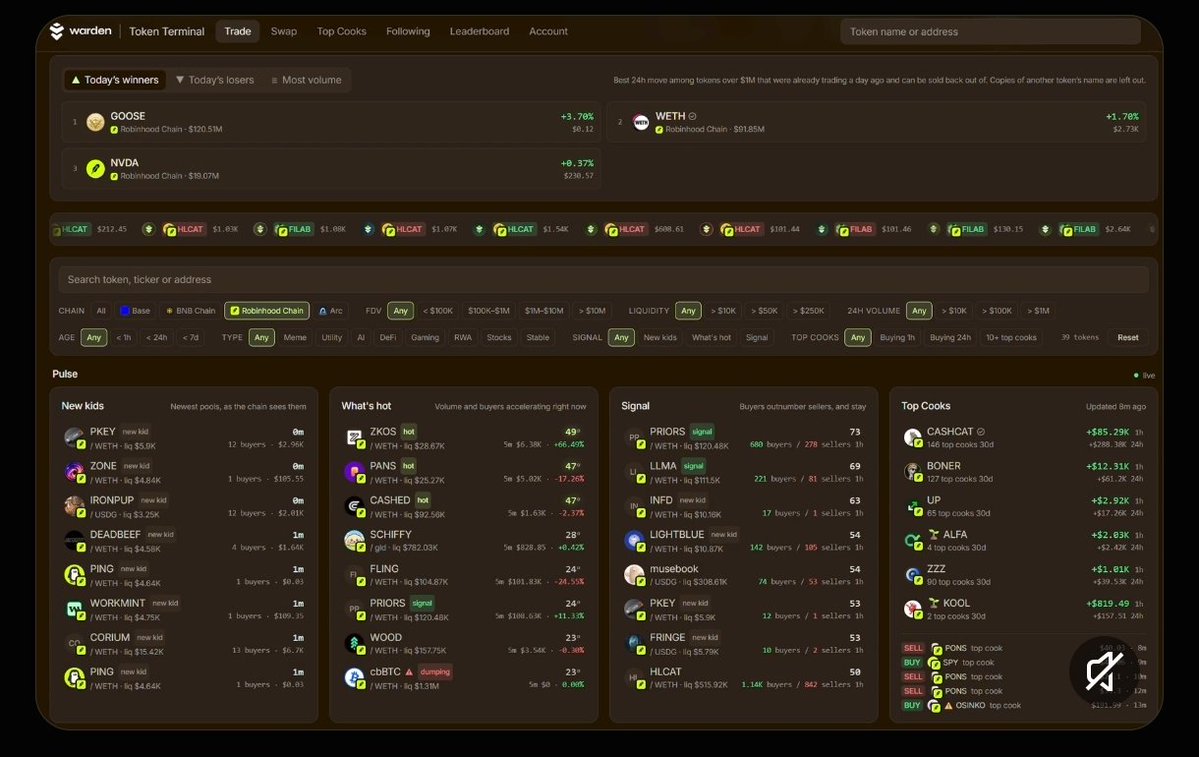
@dee_e6 Has anyone compared how fast the Pulse feed flags new pools versus watching the chain directly? If there's meaningful lag, the discovery edge is thinner than the UI suggests. If it's indexed at block speed, that's a genuinely hard thing they solved quietly.
I used to separate casino games into “strategy” and “just vibes.”
Then I spent more time on @PlayOnMint and realized slots can be part of the whole session too.
Sometimes I’m checking Predictions and actually thinking through a play.
Other times I just want a few quick spins and see what lands 🎰
That’s what makes the game mix interesting.
Different games, different pace, same ecosystem.
And with rewards going up to 45% daily, even the casual sessions can still count.
Maybe slots aren’t the game you play when you have nothing to think about.
Maybe they’re just the game you play when you want to think differently.
🐻❄️ Let’s Get Minted.
Good morning 🤍 Everyone talks about Physical AI like the hard part is building smarter robots.
I think there’s another bottleneck people overlook:
Where does all the real-world data come from?
Robots can’t learn the physical world from synthetic environments forever.
They need actual streets, movement, objects, spaces and changing conditions.
That’s where @vangrid_io gets interesting to me.
Instead of competing to build the robot, Vangrid is working on the layer that can turn activity from edge devices into structured data for Physical AI.
More devices → more observations → better datasets → more useful AI.
The robot gets the headline.
The data infrastructure underneath it may end up being just as important.
A green PnL screenshot doesn’t tell you much about how a trader handles pressure.
That’s why the paper trading setup from @agenticscredit caught my attention.
The strategy isn’t being judged in a sandbox where you can ignore risk.
It has to operate around actual guardrails:
→ stop-losses
→ trailing stops
→ drawdown limits
→ cooldowns after losses
→ trading halts when the trailing floor is breached
So two strategies making the same profit can end up looking very different once risk management enters the equation.
That makes the Agentic Credit Score more interesting to me.
The real test isn’t just “can this bot make money?”
It’s “can it keep trading responsibly when things stop going its way?”
That’s a much harder signal to fake.
The quiet part of this announcement is where it happened.
A consumer chain only becomes real when its first genuinely useful apps ship. Robinhood Chain is where a large retail audience will learn what onchain trading actually is, and Warden Token Terminal being live on it already means that audience starts with discovery and execution on one screen: new launches, what smart money is doing, top cooks worth following, and the trade itself. Warden's own line for it is trading with intelligence, without friction.
That matters to me because I grow web3 one project at a time, in front of a community. The first tool a new wave of users touches decides whether that wave stays.
There is a referral side too, and @wardenprotocol keeps it plain. Anyone who joins through my link is attributed to me, and I earn 20% of the platform fee on every trade they make, for as long as they keep trading through Token Terminal. This link is mine, and joining through it supports my work directly:
https://t.co/g5wKqgrfm4
If you have been curious about Robinhood Chain, this is a clean first stop. What is the one app a new chain needs before you would actually spend time there?
Every reward program asks for your time first and shows you the math later.
That order matters, because it transfers all the risk to the people doing the work.
That is why I joined the @2FactorFinance Points Program. It publishes the full curve before anyone starts.
1 BTC goes to the top 10 of the leaderboard at the end of Season 1, paid in cbBTC, on a fixed split from 18.2% at rank 1 down to 1.8% at rank 10. Season 1 ends when 2Factor Finance launches, and the leaderboard freezes.
It also tells you exactly what earns points. Marks come from verified actions only: social activity, education, and referrals. No purchase, deposit, or holding earns Marks. Marks carry no cash value, cannot be transferred, and are not a claim on any token.
That is a program you can actually do the math on. The input is effort you can plan around. The output is a split you could compute before you ever joined. As someone focused on growing Web3 one project at a time, a program willing to show its numbers first is the kind I am comfortable putting in front of a community.
I joined here. You can grab your own referral link from the same page:
https://t.co/IBVDljRhQb
The scoreboard is public. What is the one number you wish more programs had to publish upfront?
GM fam ❤️ ☀️
One thing I’m watching closely with @vangrid_io is the shift from “collecting data” to building a marketplace around it.
Your phone becomes the capture layer.
You contribute real-world 3D data, build your reputation through activity, earn PTC, and track your progress through badges and leaderboards.
Then the other side of the network can actually request the data they need through bounties, with settlements in USDC on Base or @arc .
That creates an interesting loop:
More captures → more useful data → more demand → more contributors.
Physical AI needs the world as it actually exists, not just datasets sitting in a warehouse.
Vangrid is making participation in that data layer accessible from a device most people already carry.
Capture the world.
Feed the grid.
Get rewarded.
@dee_e6@2FactorFinance One scenario nobody prices in: the end date isn't a date, it's a launch. If launch slips two months, does the meta change to "pace yourself" instead of sprint? Oddly I think it rewards consistency over one huge week, which might be the point.