The first insights report on DAOs is here! 🚀
We asked ~300 DAO founders, members and enthusiasts about the challenges they face in DAOs today.
You'll also be learning more about what we have planned at toco going forward!
Check it out below ⬇️
https://t.co/Yd113oHDsJ
Introducing https://t.co/hd54lUmb9v
A platform that combines off-chain and on-chain data to create transparency in web3🌚🧭
Read our litepaper here
https://t.co/zE28rr5ijo
#stepnofficial is arguably one of the most hyped #MoveToEarn projects at the moment
We did a deep dive to understand the fundamentals and analyzed the community. We also compared STEPN to similar projects using them as indicators for what might happen to it in the future.
A 🧵
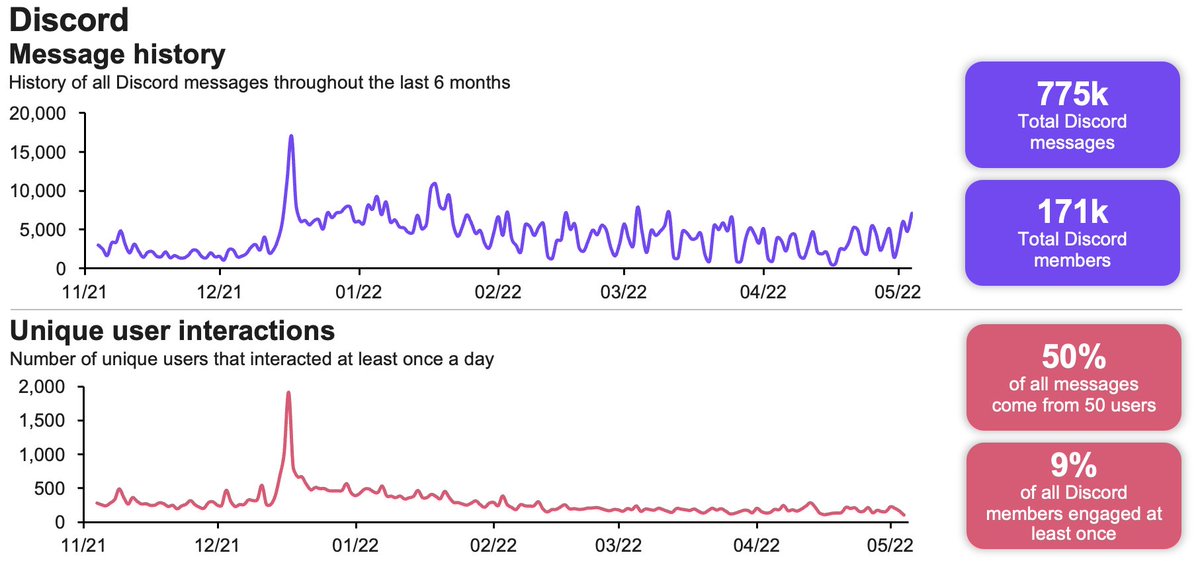
@staratlas is one of the largest blockchain games. What do you have to know about it and how does the community see it?
You can see how their Discord is developing in the picture below👀
Check out the latest piece from our contributors @0xMo11 and @danielpartidag introducing the #gmIndex
They analyzed around 2 Mio. Discord messages to determine which community has used #gm the most 🌞
Did you ever wonder which Discords have the best vibes?
@danielpartidag and I analyzed almost 2 Mio. Discord messages from the largest DAOs attempting to answer this question.
Introducing the #gmIndex 🌞
https://t.co/mBMit6UHGx
4/4
Many DAOs present all the information in simple text form within a multitude of Discord channels.
There's a huge opportunity in building holistic onboarding flows that leverage different forms of visualization of information to help smoothen the onboarding process.
3/4
Putting those two statistics into context, we believe that the actual problem lies within how users are onboarded and how information is structured and presented.
Many DAO operators say that in order to fully capitalise on new joiners who are eager to contribute, DAOs must build human touchpoints into the onboarding journey, preferably through onboarding calls.
While half of all new joiners manage to work themselves through different discord channels and long text messages, the other half feels left out and is confused about what to do next – ultimately giving up all together.
Even though no clear majority thinks that this is a substantial problem they've encountered, almost all agree on much better onboarding experiences and more organisational clarity being needed.
This implies that the other 66% of members, consider themselves "members" of a DAO, but say that they are not actively contributing in any capacity. Many feel strong emotions of "imposters syndrome".
Note that what determines an "active contribution" lies within the perspective of the DAO member who responds to that question. A contribution can take many shapes and forms.