The first auto brand to make a pickup with ZERO TECH will sell out so fast it'll make their head spin. No brain, no GPS...just engine, transmission, rear end, and get the hell outta my way:)
REPORT: A remarkable experiment in Finland is challenging one of modern parenting’s biggest assumptions: that cleaner is always healthier.
Researchers transformed sterile daycare yards into miniature forests filled with soil, moss, plants, and natural ground cover. Within weeks, children’s immune systems were already showing measurable improvements.
A year later, they had healthier skin and gut microbiomes, fewer potentially harmful bacteria, and stronger immune defenses than children playing on asphalt, gravel, and rubber surfaces.
The lesson is surprisingly simple: the microbes children encounter in nature may be helping protect their health, not threatening it.
Turns out, our ancestors were right all along.
Watch @zeeemedia's report and see why this simple experiment is making people rethink what a healthy childhood should look like.
@DisrespectedThe@realannapaulina Then start building infrastructure to support it and regulate the power companies. Everyday Americans should not be footing their electric bill. Everyday Americans can’t afford the continuous rate hikes.
@ihtesham2005 I write a sermon/speech every week. Typically I type out what comes to mind because it’s faster to type thoughts as opposed to writing. I just can’t write fast enough sometimes. Then I go back and physically write what I want to say.
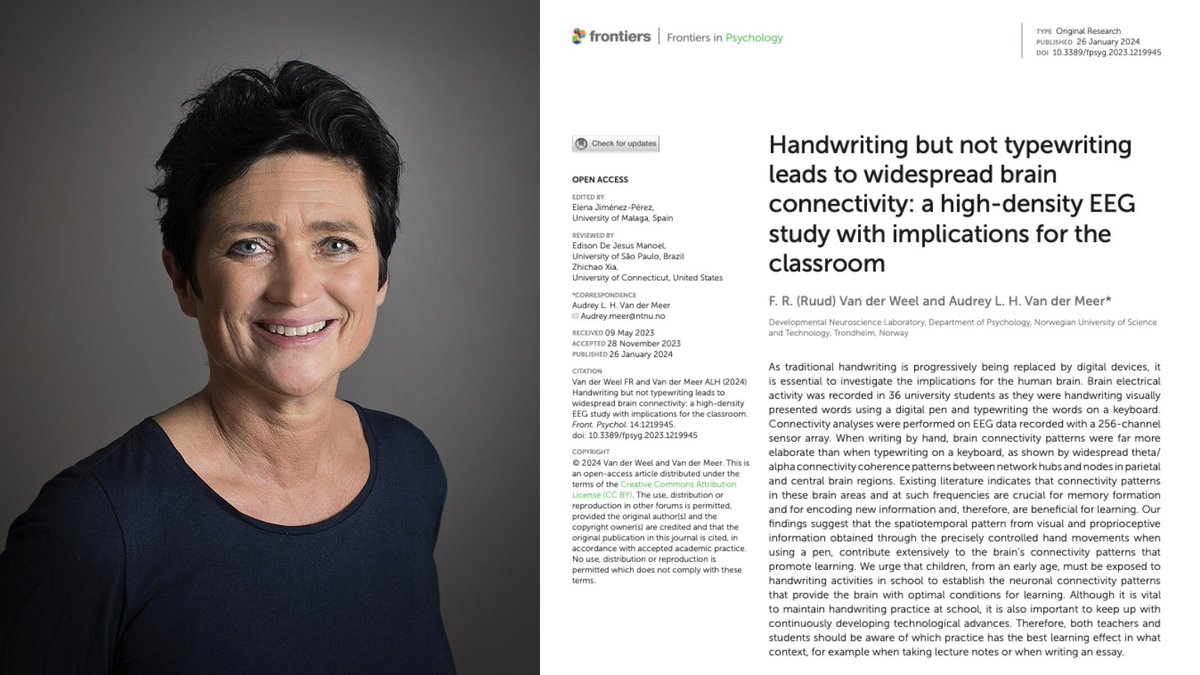
A Norwegian neuroscientist spent 20 years proving that the act of writing by hand changes the human brain in ways typing physically cannot, and almost nobody outside her field has read the paper.
Her name is Audrey van der Meer.
She runs a brain research lab in Trondheim, and the paper that closed the argument was published in 2024 in a journal called Frontiers in Psychology. The finding is brutal enough that it should have changed every classroom on Earth.
The experiment was simple. She recruited 36 university students and put each one in a cap with 256 sensors pressed against their scalp to record brain activity. Words flashed on a screen one at a time.
Sometimes the students wrote the word by hand on a touchscreen using a digital pen, and sometimes they typed the same word on a keyboard. Every neural response was recorded for the full five seconds the word stayed on screen.
Then her team looked at the part of the data most researchers had ignored for years, which is how different parts of the brain were communicating with each other during the task.
When the students wrote by hand, the brain lit up everywhere at once.
The regions responsible for memory, sensory integration, and the encoding of new information were all firing together in a coordinated pattern that spread across the entire cortex. The whole network was awake and connected.
When the same students typed the same word, that pattern collapsed almost completely.
Most of the brain went quiet, and the connections between regions that had been alive seconds earlier were nowhere to be found on the EEG.
Same word, same brain, same person, and two completely different neurological events.
The reason turned out to be something nobody had really paid attention to before her work. Writing by hand is not one motion but a sequence of thousands of tiny micro-movements coordinated with your eyes in real time, where each letter is a different shape that requires the brain to solve a slightly different spatial problem.
Your fingers, wrist, vision, and the parts of your brain that track position in space are all working together to produce one letter, then the next, then the next.
Typing throws all of that away. Every key on a keyboard requires the exact same finger motion regardless of which letter you are pressing, which means the brain has almost nothing to integrate and almost no problem to solve.
Van der Meer said it plainly in her interviews.
Pressing the same key with the same finger over and over does not stimulate the brain in any meaningful way, and she pointed out something that should scare every parent who handed their kid an iPad.
Children who learn to read and write on tablets often cannot tell letters like b and d apart, because they have never physically felt with their bodies what it takes to actually produce those letters on a page.
A decade before her, two researchers at Princeton ran the same fight using a completely different method and ended up at the same answer. Pam Mueller and Daniel Oppenheimer tested 327 students across three experiments, where half took notes on laptops with the internet disabled and half took notes by hand, before testing everyone on what they actually understood from the lectures they had watched.
The handwriting group won by a wide margin on every question that required real understanding rather than surface recall.
The reason was hiding in the transcripts of what the two groups had actually written down.
The laptop students typed almost word for word, capturing more total content but processing almost none of it as they went, while the handwriting students physically could not write fast enough to transcribe a lecture in real time, which forced them to listen carefully, decide what actually mattered, and put it in their own words on the page.
That single act of choosing what to keep was the learning itself, and the keyboard had quietly skipped the choosing and skipped the learning along with it.
Two studies. Two countries. Same answer.
Handwriting makes the brain work. Typing lets it coast.
Every note you have ever typed instead of written went into your brain through a thinner pipe. Every meeting, every book highlight, every idea you captured on your phone instead of on paper was processed at half depth.
You did not forget those things because your memory is bad. You forgot them because typing never woke the part of the brain that would have made them stick.
The fix is the thing your grandmother already knew.
Pick up a pen. Write the thing down. The slower road is the faster one.
@THPGolf@acaseofthegolf1 Empty course, we play two or three groups of 3, 18 hole round average time 2hrs 45mins. Everyone plays ready golf, everyone still does pre shot routine. The slowest area is putting. Average index 10.5.
@NJDevils856 @TRHLofficial Neighboring Troop just upset when they realized “too selling troop” was in the bag for those girls and they didn’t have a chance of catching them.
@IrvingNick33 I just told someone little over a week ago they’d drop Alien stuff soon because it’s the only thing they can come up with to try and move attention away from Epstein files.
For nine months, my wife Brooklyn carried our baby boy knowing he was dying. Three months in, they told us he had severe hydrocephalus. Too much fluid crushing his brain. "Off the charts bad," the specialists at Cincinnati Children's said. So extreme they stopped measuring because it didn't matter anymore.
The MRIs were sickening to look at. They said over 90% chance he'd either die right after birth or survive with such severe brain damage that any quality of life was impossible. We had meetings about breathing tubes. About when to remove life support. About letting our son "pass peacefully."
Brooklyn moved to Cincinnati, lived in a hotel near the hospital in case she went into labor. I drove back and forth, working, trying to hold our family together while planning our baby's funeral. On July 8th, fifteen minutes before her C-section, we had another meeting about the breathing tube. About when we'd need to remove it and let him go to Heaven.
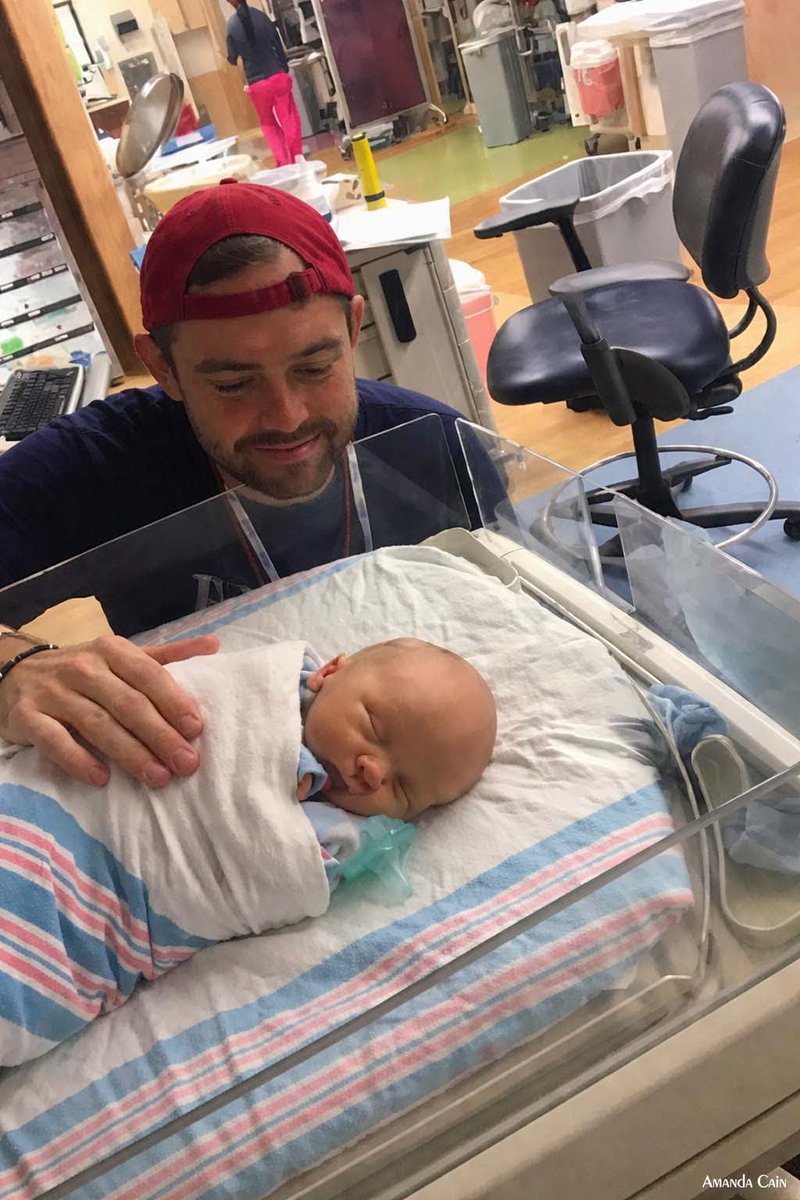
Then Charlie came out crying. The sweetest sound I've ever heard.
He stayed in intensive care until yesterday. Now he's home, doing everything babies do. Normal. Beautiful. The doctors have no medical explanation. His brain somehow cleared the blockage on its own, something they've never seen in a case this severe. Nurses with decades of experience kept saying "miracle" and "divine intervention."
Thousands of people were praying for us. Friends, family, strangers, people we'd never met. I'm practical, I believe in science, but I know God was involved in this. I give Him all the credit.
During those endless nights in Cincinnati, I started woodworking in the hotel parking lot just to keep my hands busy, to stop my mind from breaking. Made small toys hoping one day Charlie might hold them. Listed a few things on the Tedooo app where I'd been selling my work, and strangers started buying pieces they didn't need, sending messages saying they were praying for our son. That community held me when I couldn't stand.
Charlie's here. He's alive. Prayer is real, and miracles still happen.
By Amanda Cain