REALTOR® (Burlington | Oakville | Toronto); Hockey Goalie for Hire; Golf Fanatic; Macroeconomic Disciple; Student of Persuasion; Travel Junkie; Dad to Alyssa
@ScottAdamsSays Question for fans of Scott? What episode of Real Coffee would be most impactful / enlightening to share with those who have missed out …
@ScottAdamsSays@joelpollak Useful is an understatement. I don’t think I’ve ever experienced anyone that was more impactful on my thought processes. God Bless You Scott ❤️
Roger Federer broke the internet with one statistic that will change how you see every setback in your life.
1,526 singles matches.
Won almost 80% of them.
20 Grand Slams. 103 titles.
Now answer honestly:
What percentage of total points do you think he won across his entire career?
70%? 65%? 60%?
Try … 54%.
He lost literally almost EVERY SECOND POINT he ever played for 24 years.
And still became one of the greatest of all time.
Watch him explain it himself (2:07 of pure life-changing wisdom):
“In tennis, perfection is impossible… When you lose every second point on average, you teach yourself to say:
‘Okay, I double-faulted — it’s only one point.’
‘Okay I got passed at the net — it’s only one point.’
Even a screaming overhead smash that ends up on SportsCenter Top 10… still just one point.
So when you’re playing your point, it has to be the most important thing in the world.
The moment it’s over — it’s behind you.
That mindset frees you to attack the next point, and the next, and the next with absolute intensity and clarity.”
Then he looked at the crowd and said the line that hit a billion people in the soul:
“The real sign of a champion is not that they win every point.
It’s that they lose again and again and again… and have learned how to deal with it.
Negative energy is wasted energy.
Cry it out if you have to. Then force a smile.
Move on. Be relentless. Adapt. Grow.
Work harder — and work smarter.”
Save this post.
The next time you lose a deal, bomb a presentation, get ghosted, miss a deadline, or just have “one of those days” — come back here and read it again.
You’re not falling behind.
You’re just in the 46%.
And the 46% is exactly where every single legend has spent most of their career.
Keep playing the next point.
(full 2:07 clip — sound on)
Brampton House Prices Down 31% From Peak: Will It Go Lower? Why Did It Happen?
The TRREB system says Brampton house prices have fallen 31% from Feb 2022 to October 2025
$1.346M to $934K
That's a shit ton of losses, likely another 10% to 15% more to go
WTF Happened?
2/
This is the most jaw-dropping 4 minutes and 21 seconds you will watch this year.
Nicole Shanahan — ex-wife of Google co-founder Sergey Brin, former running mate of RFK Jr., and someone who personally signed nine-figure philanthropy checks — just went full whistleblower on the entire Silicon Valley “tech wife mafia” and how they were used.
Her exact words (full clip attached):
“I don’t think many of the tech mafia wives realize… they were used to set the groundwork for what Klaus Schwab calls The Great Reset.
Their money especially was being conscripted through a network of NGO advisors, Hollywood, Davos, and their own companies.
A really small group of people… completely blind to how their groundwork is being used to enable these Great Reset policies.”
Then she turns the knife inward:
“These women find their meaning through philanthropic work. I really believed I was helping Black communities and indigenous communities rise up.
But now the problems have gotten worse. Crime worse. Mental health worse. The whole model is broken.
At the end of the day they always go: ‘But climate change.’
Social justice + climate change — it gets progressive women 100% of the time.”
She even says many now believe the biggest “climate change issues” are actually geoengineering issues.
This isn’t some random podcast bro.
This is a woman who lived in the mansions, sat on the boards, flew private to Davos parties… and is now saying:
“We were the useful idiots.”
Watch the full unedited 4:21 below. Sound on.
The Big Misunderstanding: What Causes Economic Winter?
Important to those living in the GTA!
First, we need to clear up a common myth.
Most people think deflation is just "falling prices" (like gas or milk getting cheaper).
However, falling prices are actually the result, not the cause.
The Real Definition:
Think of the economy like a giant balloon. The air inside the balloon represents money and credit (loans).
Inflation: The balloon expands because there is too much air (money/credit).
Deflation: The balloon shrinks because air (money/credit) is being let out.
So, to understand what causes deflation, we have to know why money and loans suddenly disappear from the economy.
The Two Main Causes of Deflation
According to economic experts and history, deflation happens due to a combination of two things:
A massive pile-up of debt.
A change in "Social Mood" (how people feel about the future).
1. The Pre-Condition: Too Much Debt
You cannot have a crash unless you have a boom first.
Deflation is essentially a "financial hangover."
For deflation to occur, there must first be a period in which banks lend money too easily, and people borrow too much.
This creates a bubble.
"Good Debt" vs. "Bad Debt"
History shows that the type of debt matters.
Productive Debt (Self-Liquidating): A factory borrows money to buy a machine. The machine makes products, the products are sold, and the profits repay the loan.
This adds value.
Unproductive Debt (Non-Self-Liquidating): (Real Estate Loans)
When an economy is built on unproductive debt, the crash (deflation) is much worse because no new value is created to repay those loans.
2. The Trigger: A Negative Social Mood, Toronto!
The second cause is psychological.
Economics isn't just numbers; it's feelings.
The Party Phase (Positive Mood): When people feel optimistic, they borrow and spend.
They think the good times will last forever.
This inflates the bubble.
The Fear Phase (Negative Mood): Eventually, the mood shifts. It doesn't require a specific event (like a war or a law change); people just naturally become fearful or cautious.
How Fear Shrinks the Economy:
When the "Social Mood" turns negative, the following happens:
Lenders stop making loans because they are afraid they won't be repaid.
Borrowers stop asking for loans because they are scared of debt.
Shoppers stop spending money.
Hamilton Bolton’s Golden Rule: A study of major depressions since 1830 found that every single one was caused by the deflation (popping) of an excess credit bubble.
The Deflationary Spiral
Once the mood turns negative and credit dries up, a chain reaction occurs:
Cash Hoarding: People get scared of the future, so they hold onto their cash rather than spending it.
Prices Fall: Because no one is buying, businesses lower prices to try to tempt customers.
Delaying Purchases: Customers see prices falling and think, "I'll wait until next month, it will be even cheaper." Toronto, can we talk!
Money Disappears: As loans are paid off (or defaulted on) and not replaced by new loans, the total amount of money in the economy actually shrinks.
A Real-World Example: Japan in the 1980s
Japan provides a perfect example of this cycle.
The Boom: In the 1980s, Japan was incredibly optimistic.
They borrowed massive amounts of money. Private debt rose to over 200% of the country's GDP.
The Shift: Around 1989, the mood shifted. The stock market crashed.
The Deflation: Even though the government tried to help, the negative social mood took over. People stopped borrowing and started saving. It took nearly two decades to work through that excess debt.
Summary
Deflation isn't just about cheap goods. It is an economic contraction caused by too much debt colliding with a fearful population.
When people are scared to borrow and spend, the "air" leaves the economic balloon.
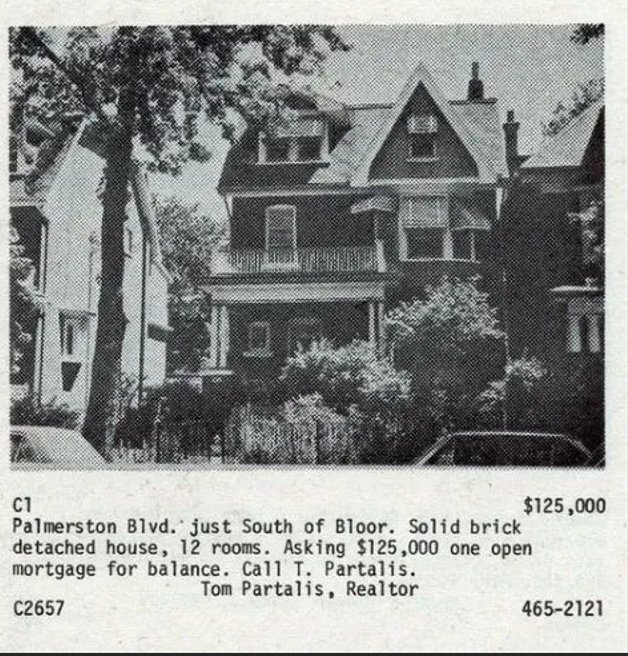
📌 Toronto’s Palmerston Blvd: The Most Devastating Real-World Example of Financialization in Canada
1973 vs 2025
In 1973, a solid-brick, 12-room detached home on Palmerston Blvd, just south of Bloor, was asking $125,000.
Adjusted only for CPI inflation, that same home should cost ~$857,000 in 2025.
But today?
A comparable Palmerston home sells for $2.7M–$3.5M.
Some push past $4M depending on renovations.
That’s not normal appreciation.
That’s credit-driven distortion.
Here’s the uncomfortable math:
1973:
• Home price: $125,000
• Toronto median income: ~$19,000
• Price-to-income: 6.6×
2025:
• Home price: ~$3,000,000
• Toronto median income: ~$84,000
• Price-to-income: 35.7×
📉 Homes on Palmerston became 5½× more expensive relative to income—even after adjusting for inflation.
This is what happens when an economy shifts from productive growth → financialized asset inflation.
It’s the signature of a system deep into Kondratieff Autumn:
• Credit replacing income
• Capital flows replacing savings
• Leverage replacing productivity
• Housing becoming a financial asset, not shelter
The result is a market where valuations diverge violently from wages, and a city becomes accessible only through debt, not earnings.
The Palmerston example proves a simple truth:
🔹 Toronto doesn’t have a “housing shortage.”
🔹 It has an affordability crisis caused by 40+ years of credit expansion.
And as every historical LongWave shows, these imbalances don’t unwind gently.
When Winter arrives, they reset.
This is why I’m warning people now.
Not to scare—but to give them the historical context to make informed decisions before the cycle turns.
If you live in the GTA and want to understand what comes next…
This is the moment to pay attention.
Most of the households losing their homes now aren’t missing one payment.
They’ve been carrying layers of debt for years, masked by the ability to refinance.
Power of sale is often the end of a long pattern, not a sudden failure./
@govt_corrupt Stupidity. Playing the role of tough guy when you are clearly NOT the tough guy is negotiation suicide. Trudeau / Carney / Ford FAFO. They Fucked Around and They Found Out. Now we ( 🇨🇦 citizens) are paying the price
And with all due respect to my Canadian friends, whose politics focus obsessively on the United States: your stagnating living standards have nothing to do with Donald Trump or whatever bogeyman the CBC tells you to blame.
The fault lies with your leadership, elected by you.