1/ 🧵
I was teaching some students some time ago that beans isn't just a protein like they've been taught from their primary classes.
It's actually richer in carbohydrate than protein.
And as expected, they looked at me like:
"Kini uncle yin so? What's this uncle saying?" 🙄😂😂
1/ 🧵
I was teaching some students some time ago that beans isn't just a protein like they've been taught from their primary classes.
It's actually richer in carbohydrate than protein.
And as expected, they looked at me like:
"Kini uncle yin so? What's this uncle saying?" 🙄😂😂
1/ 🧵
I was teaching some students some time ago that beans isn't just a protein like they've been taught from their primary classes.
It's actually richer in carbohydrate than protein.
And as expected, they looked at me like:
"Kini uncle yin so? What's this uncle saying?" 🙄😂😂
8/
And back to my students, I had to tell them:
"For your level now, beans is protein. Just write protein in your exam. When you advance in your studies, they'll teach you why beans is also considered a carbohydrate." 😀😀
7/
If we're talking about the nutrient beans is popularly known for and contributes significantly to the diet, we can call it a protein food.
But if we're asking:
"Which macronutrient is present in the largest amount?"
Then carbohydrate takes the lead.
😀
6/
But when you're looking strictly at its nutritional composition, that same food can contain more carbohydrate than protein.
So beans didn't suddenly stop containing protein. 😂
It is still a good source of protein.
The difference is simply in how we're classifying it.
5/
50–65g of carbohydrate
and around:
20–25g of protein.
So technically, beans contains more carbohydrate than protein.
And this is where the classification can become confusing.
A food can be called a protein food because it is a significant source of protein in the diet.
4/
Dry beans also contain a large amount of carbohydrate, mostly in the form of starch.
In fact, if you look at the composition of many common dry beans, carbohydrate makes up a larger proportion than protein.
For example, 100g of dry beans may contain roughly:
3/
We often classify foods according to the nutrients they contain in the highest amount.
And yes, beans contains a good amount of protein.
That's why we commonly call it a protein food.
But protein isn't actually the only major nutrient in beans.
2/
And honestly, that was exactly the reaction I expected.
Because that's exactly how some of us reacted when we were told the same thing back then in uni. 😂
But what actually makes beans more carbohydrate than protein?
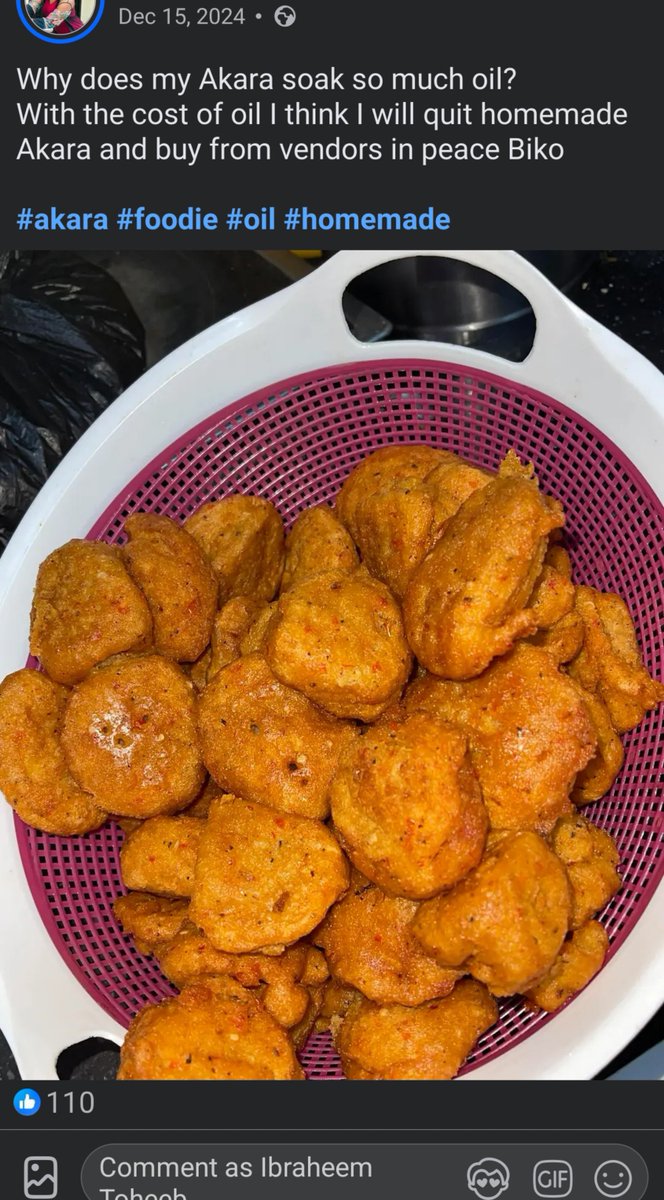
This akara doesn't look particularly oily.
But have you ever wondered why some akara comes out almost dripping with oil while another batch doesn't?
It's not simply because you used “too much oil.”
Here are a few reasons why 👇
#nigerianfoods#HealthyEats
7/7
So if your akara is coming out too oily, look beyond the amount of oil you're using.
Pay attention to:
• Oil temperature
• Batter consistency
• How much you fry at once
• Frying time
Sometimes, better frying conditions (not less oil) are what give you less oily akara.
👌🏼
This akara doesn't look particularly oily.
But have you ever wondered why some akara comes out almost dripping with oil while another batch doesn't?
It's not simply because you used “too much oil.”
Here are a few reasons why 👇
#nigerianfoods#HealthyEats
6/7
3. Putting too much akara into the oil at once
Adding too much batter at once can cause the oil temperature to drop.
When this happens, the surface takes longer to set and the akara spends longer frying.
That combination can increase oil uptake.
5/7
2. How watery the batter is
During frying, water inside the akara turns to steam and escapes.
This process contributes to the development of pores and spaces within the akara.
Its moisture content and final structure can determine how much oil it takes up.
4/7
But higher temperature doesn't always mean better.
If the oil is excessively hot, the outside can brown too quickly while the inside remains undercooked.
So the goal isn't the highest temperature.
It's maintaining an appropriate frying temperature
3/7
When the oil is hot enough and the temperature is maintained, the surface of the akara dries and sets faster.
Water also evaporates rapidly, while browning reactions contribute to its colour and flavour.
A firmer outer structure can help limit oil uptake.
2/7
1. The temperature of the oil
When the oil temperature is too low, your akara takes longer to cook.
The surface also takes longer to dry and form a firm crust.
This can increase the amount of oil absorbed.