@Grey90126677 I consider “google” search and particularly, publication by a certain “legacy media” too weak to allege someone of something as grevious as murder.
The pragmatic realist in me will never subscribe to the ‘now-fashionable’ campaign for the decriminalization of defamation and allied conducts.
One of the essence of law is to ensure deterrence and humans are hardly deterred by mild consequences. A civil action in Torts for defamation of action will only fetch a claimant monetary compensation by way of damages and perhaps, injunctive reliefs. However, where your defamer is impecunious like the many of them on social media these days, you end up getting an empty judgment, as there will be nothing to enforce against; nothing to attach. At best, he is declared bankrupt, without any soothing benefit or remedy for your battered reputation.
Even the acclaimed “activists” and celebrated proponents of decriminalization of defamation are beginning to come to terms with this truth. How do you just wake up, spew anything that comes to your head about me, without facts or empirical evidence to support your claim, then, you also seek to suggest to me, how to deal with you? I support @adeyanjudeji’s resolve to go the whole mile against this netizen.
A private security officer, who barely holds a school certificate, is seen assaulting a barrister and solicitor of the Supreme Court of Nigeria at the Federal High Court, Abuja and in the presence of a police officer.
The culture of impunity runs deep and lawyers are becoming easy targets.
Lawyers are not allowed to access courtrooms because of high-profile cases. How dare a security officer stop a lawyer from going inside the courtroom?
This country breaks my heart everyday.
You do not withdraw processes filed on behalf of a client, against his will or in order to prejudice his case. In fact, it is not a valid excuse that you were debriefed or are withdrawing your representation. At best, you are entitled to a recovery of your professional fees to the extent of work done.
THE COMPANY v. THE RECEIVER
For us, approaching the Supreme Court of Nigeria in SC/CV/48/2026 – Neconde Energy Limited v. FBNQuest Limited & Ors., was beyond a desire to challenge the decision of the Court of Appeal disqualifying us as counsel for Neconde. It afforded us an opportunity to engage an area of law with the potential of enriching the jurisprudence. While we have never been in doubt that it was never the intendment of the drafters of section 556 of the Companies and Allied Matters Act (CAMA), 2020 and the Eleventh Schedule to the Act, to confer on the receiver, the power to appoint counsel for a company in an action where the receiver’s appointment is in issue, the auspicious responsibility to chart the course in this ostensibly uncharted terrain, fell on our corporate shoulders. In concurring with our submission before it, the apex court in its leading judgment delivered by the Honourable Justice M. B. Idris, held that in such circumstance where the rights of the receiver’s appointor is directly in issue, “to insist that the receiver alone must determine the legal representation of the appellant will create an obvious conflict of interest.” According to the court, proceedings of this nature cannot be regarded as falling under the general authority of the receiver under section 556(3) of the Companies and Allied Matters Act, and Eleventh Schedule of Act.
Not only is the decision of the Supreme Court in Neconde v. FBNQuest a watershed in the annals of the Nigerian law, it is also a firm definition of the course in the areas of the law on secured credit transaction and insolvency practice. The practical utility of the decision to the courts, practitioners, and academics further underscores its enduring relevance as a guiding authority in the coherent development and application of the law. It was an exceptional privilege to have been aligned with the eminent team at Wole Olanipekun & Co. in the execution of this assignment.
@HighChiefOkoro@doysol_ You have not added the part where we also contract mutuals to appreciate you. Ẹ bami dupẹ lọwọ Mr. Lagbaja. (Meaning, kindly help me appreciate Mr. Lagbaja).
My argument is simple:
1. Anyone who is not qualified to contest should be prevented before the election is held.
2. Qualification issue is an entirely a pre-election issue. I am not aware there’s any known electoral jurisprudence that makes it an election or post election issue.
3. I am never in support of anyone who forged certificate to lead anybody or contest an election, I am saying you cannot standby knowing the person forged a certificate and because you lost an election and the forger wins and now it’s when you realise you want to challenge. If you had won, would you still raise the issue or let it go?
4. The time you have to raise or challenge the issue is longer enough before the election than the time you have to raise it after the election is concluded and result announced. So at what point do you investigate? How long do you have to do that as a petitioner?
5. A better outcome: courts should not limit the challenge to qualification to only those who participated in the election or primaries but public interest litigation and a constitutional right open to anyone who has the evidence to support the claim of forgery and anyone found wanting be prosecuted accordingly.
6. There are so many issues surrounding qualification and forgery of educational certificates is just one. Non-citizenship, criminal conviction, age barrier, lunacy among other things.
7. Challenge against an election should be limited to only things that transpired during the election and after the declaration of results. Nothing should disrupt the election if it’s outside of this.
Thank you.
I think appointing your critics into office is a way of punishing them for all they have said against you. This time, in discharge of their duties, they have the daily thankless obligation of eating their own words. More like, you created the mess, come clean it yourself.
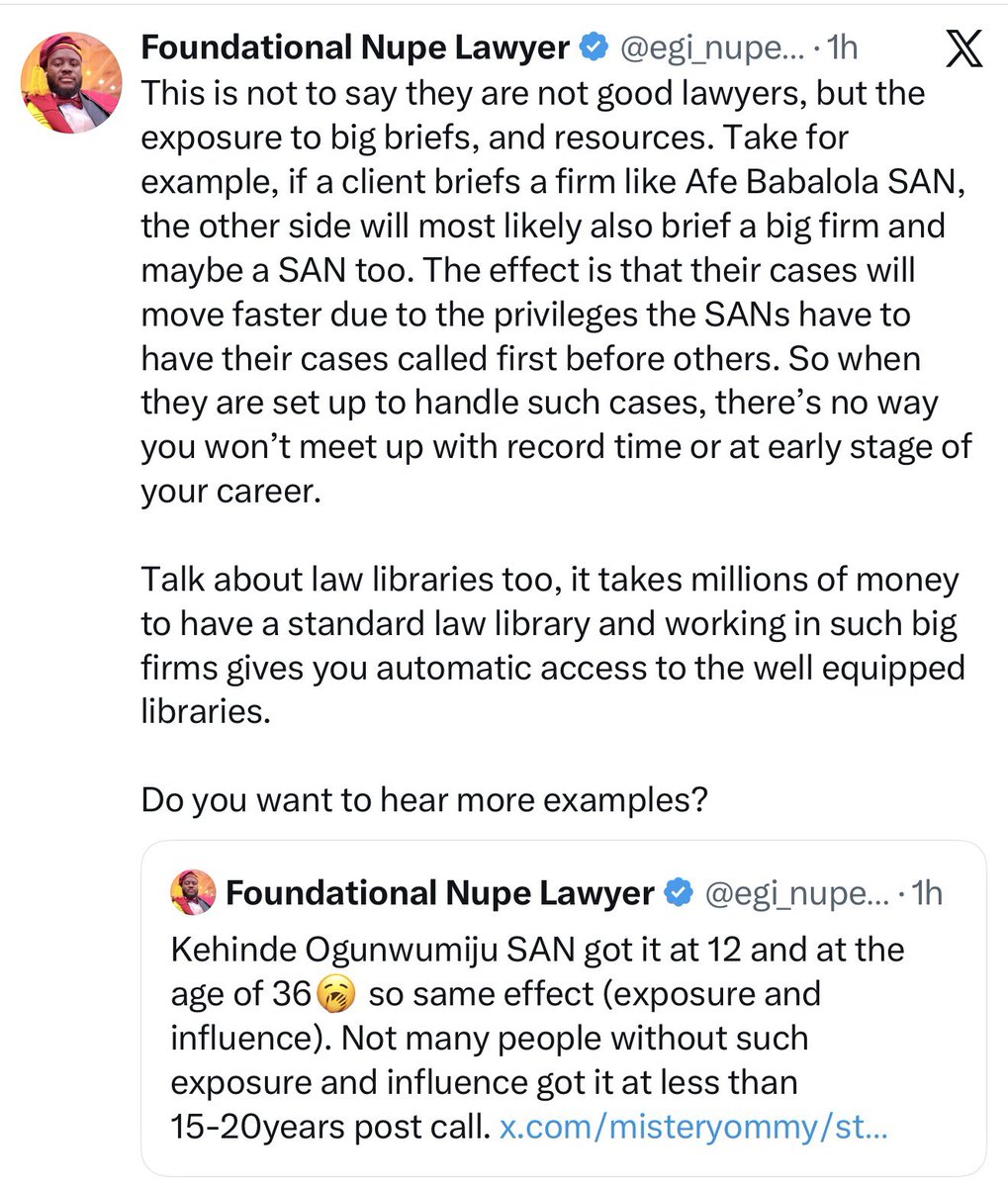
I think I agree that being in a top tier firm affords you the necessary exposure, which forms the core of the requirements for elevation to the silk. Does this mean that they are not good lawyers? Of course, chances are high that you won’t even be there if you do not possess the requisite capacity.
Though the following may not be a perfect example, but should convey my thoughts a little - It is easier for a lawyer who practices in Abuja to have an appearance at the Supreme Court at the early stage of his career than it is for his peers who practice in Otukpo. However, it is not all lawyers who practice in Abuja that have had the privilege of an appearance at the Supreme Court.
No bro, here’s the context of my position at the risk of being misunderstood.
1. Brilliant lawyers
2. Early exposure to bigger briefs and opportunities
3. Influence of big firms and principals
Nothing suggests they are not brilliant or good lawyers.
Fair point. However, if the context is in relation to the extent of ease that being from the firm afforded him, he couldn’t have been the only counsel-in-chambers at Afe Babalola & Co. at the time. And this does not in any way, make light of the achievements of those who couldn’t achieve the feat. Point is, Prince is by all standards, an exceptional character, with or without a political office.
Please let’s be putting context too. He was working with one of the most influential and successful senior lawyers at the time and till now, Chief Afe Babalola SAN.
There are some people you can threaten with taking their political “jobs.” Certainly, not one of the most successful lawyers that has graced the surface of this earth. Man became an SAN on the dot of 10, at a time when it was by far more competitive than you currently have it.
To be entitled to copyright protection, fixation is necessary. That you had an unfixed inspiration in 1973 does not give you copyright protection over someone who had a similar inspiration and proceeded to fix it into a tangible form.
@Beautiful_Nubia BBO Amin was said to be a song he had the inspiration as far back as when he was in Service (NYSC) coming out to say he copied your song 🤔
I have also been involved in cases where despite the pendency of a full defence on the merit, the court was minded to strike out the discontinued suit, as opposed to a dismissal. On each occasion, there were strong authorities at the disposal of both parties.
Regrettably, the fluidity of our jurisprudence makes both positions correct. I’ve gotten dismissed, an action sought to be discontinued, on the mere basis that I had a P.O,, activating the concept of litis contestatio.