‼️‼️🛢️🇺🇸 According to former CENTCOM Commander Gen. Frank McKenzie, the U.S. should explore seizing Kharg Island—a strategic location that accounts for 90% of Iran's oil shipments.
McKenzie argue that seizing the island—rather than obliterating it—provides the U.S. with "irrevocable" leverage. By holding the terminal intact, the U.S. could theoretically shut down Iranian oil revenue without permanently scarring the global energy market or triggering the catastrophic economic collapse that might follow a total refinery strike.
See the latest updates with us: @visionergeo
‼️‼️🇮🇷 BIG | Iranian authorities have declared the "Aq-Teke-Khan" bridge in Aqqala back in service.
Tehran is desperate to keep its "land-bridge" to Central Asia open, especially now that its maritime ports are being strangled by a U.S.-led blockade.
See the latest updates with us: @visionergeo
Jatkojuttujen ja täällä käydyn keskustelun perusteella tajusin sit ton yksityisen sektorin rajauksen. Samalla ihmettelen (toistuvasti) sitä, miten ”keskeltä” ja ilman mitään taustoituksia nää @hsfi jututkin nykyisin tehdään. Se harmittaa välillä, koska en itsekään kaikkea tiedä.
Je suis dans un train "climatisé" où il fait 26 degrés. Le wifi ne marche pas. Personne ne bronche.
Et c'est ça qui me fascine le plus : pas la panne, mais l'acceptation collective.
L'État socialiste a réussi un tour de force psychologique. Il nous a fait intérioriser qu'un service médiocre, payé une fortune, c'est normal. Que c'est même ça, le "service public".
Le même service dans un marché libre coûterait une fraction du prix. Et si la clim tombait en panne, vous seriez remboursé dans l'heure, parce qu'un concurrent attend juste à côté que vous changiez de crémerie.
Faites la liste de tout ce que l'État touche :
L'école : effondrement du niveau, profs en burnout, classement PISA en chute libre. L'hôpital : des mois d'attente, des couloirs pleins de brancards, des soignants qui fuient. Le transport : retards, pannes, grèves, prix qui explosent. La justice : des années pour un jugement. La police : débordée, démoralisée.
Budgets colossaux. Prélèvements records d'Europe. Résultat : tout est pourri.
Pourquoi ?
Parce qu'il manque deux choses que seul le marché fournit : le skin in the game et les prix.
Le skin in the game d'abord. Un entrepreneur qui livre un service pourri fait faillite. Il perd SON argent, SA réputation, SES années de travail. Un bureaucrate qui gère mal un service public ne perd rien. Il sera promu, muté, ou au pire il attendra sa retraite. L'échec n'a aucune conséquence personnelle. Donc l'échec se répète, indéfiniment.
Les prix ensuite. Hayek l'a montré : les prix de marché sont un système d'information. Chaque prix agrège des millions de décisions individuelles et signale où allouer les ressources. Quand l'État fixe les prix ou subventionne à perte, il détruit ce signal. Plus personne ne sait ce qui vaut quoi. On arrose au hasard, on gaspille, et on appelle ça de "l'investissement public".
C'est pour ça que le bureaucrate est le pire locataire possible de vos impôts : il dépense l'argent des autres, pour les autres. Ni incitation à économiser, ni incitation à bien servir. Milton Friedman avait résumé ça en une phrase : c'est la pire des quatre façons de dépenser de l'argent.
Le problème n'est pas tel ministre, tel gouvernement, telle réforme. Le problème est structurel. Un monopole sans concurrence, sans prix, sans skin in the game, produira TOUJOURS de la médiocrité. Peu importe qui le dirige. Peu importe le budget.
Si vous avez compris ça, vous avez compris 90% de l'économie politique.
Alors faites une chose simple : expliquez-le à vos proches. Au prochain train en retard, à la prochaine attente aux urgences, posez la question : "qui perd de l'argent quand ce service est mauvais ?" Réponse : personne. Voilà le problème.
L'information finira par se propager. Et un jour, collectivement, on arrêtera de gober.
Le problème, c'est l'État. Toujours.
U.S. Central Command (CENTCOM) has released video of what it describes as the first operational use of the Corsair one-way attack surface drone, employed during yesterday's strikes against a ship and submarine maintenance facility at Bandar Abbas, Iran.
According to CENTCOM, the strike was intended to further degrade Iran's naval capabilities and its ability to threaten commercial shipping transiting the Strait of Hormuz.
While the Corsair's capabilities have been known within defense circles for some time, they did not become widely publicized until last month's rescue of the crew of a downed U.S. Army AH-64 Apache near the Strait of Hormuz. In that operation, a Corsair autonomously reached the survivors after they had spent approximately two hours in the water, recovered them, and ferried them to a rendezvous point where U.S. forces completed the rescue.
The latest operation demonstrates the platform's versatility, showing that the same unmanned surface vessel can be configured for both precision strike missions and personnel recovery, depending on operational requirements.
‼️‼️🇺🇲🇮🇷 BIG | Direct military clashes have flared up once again between the United States and Iran, plunging the Persian Gulf into a fresh wave of heavy kinetic violence.
Just minutes ago, Iranian forces launched a barrage of anti-ship cruise missiles and explosive drone swarms directly targeting commercial vessels and maritime traffic transiting through the critical shipping lanes of the Persian Gulf.
In immediate retaliation, U.S. combat aircraft and long-range naval assets launched an extensive aerial bombardment campaign against the Iranian mainland, striking key military infrastructure, coastal radar installations, and missile launch sites across southern Iran.
See the latest updates with us: @visionergeo
U.S. Central Command (CENTCOM) has announced that at the direction of the Commander-in-Chief, President Donald J. Trump, forces have began launching additional strikes against Iran to continue degrading their ability to attack civilian mariners and commercial ships freely transiting the Strait of Hormuz.
‼️‼️🇺🇸🇮🇷 BIG | U.S. has ramped up its presence, positioning aircraft carriers deep within the Gulf of Oman—well within striking distance of the Iranian coast.
Iran is desperately trying to project strength through sporadic drone hits on regional infrastructure, but the U.S. Navy is systematically stripping away the regime’s ability to defend itself.
July 11, 1943. Day two on the beaches of Sicily, and it nearly ends in catastrophe twice, once from the Germans and once from the Americans themselves.
In the morning the enemy threw its hardest punch. The Hermann Goring Division, tanks and all, came rolling down toward the beach at Gela to shove Patton's men back into the sea while the beachhead was still thin and half stocked. Some of those panzers got within a couple thousand yards of the water. Men on the sand could see them coming. For a few hours the whole invasion hung by a thread.
What broke the attack was the navy. Cruisers and destroyers sitting offshore dropped their gun sights onto the tanks and fired point blank over their own troops, tearing the German armor apart in the open. The counterattack died on the coastal plain. The beachhead held. Patton, typically, went ashore and started shoving men forward personally.
Then came the night, and the part almost nobody wants to remember. Patton had ordered a reinforcement drop, more than 2,000 paratroopers of the 504th flying in from Tunisia to land behind his own lines. But that same evening German bombers had come in low and hammered the fleet, and one supply ship had blown up. Every gunner on every ship and every beach was wound tight, finger on the trigger, waiting for the next raider.
Two minutes after the last German bombers left, 144 slow American transport planes droned in over the fleet, same direction, same low altitude the raiders had used. One nervous gunner opened up. Then all of them did. Thousands of guns firing at once, tracers filling the sky, hitting planes full of their own men.
By the time it stopped, 23 transports had been shot out of the sky by their own side. Two hundred twenty nine paratroopers and aircrew were dead, hundreds more wounded, some cut down in their harnesses before they ever hit the ground. It remains the worst friendly fire disaster in American military history. The Germans did not do it. We did it to ourselves, in the dark, out of fear.
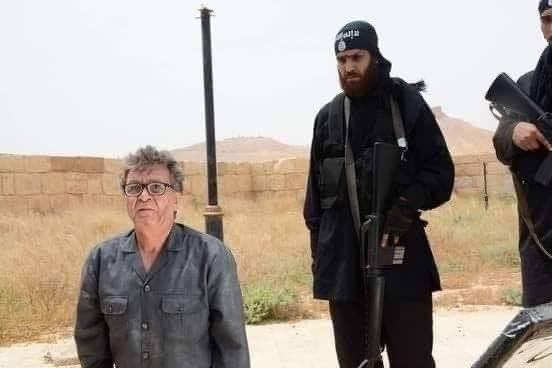
In 2015, ISIS captured Palmyra and demanded its head of antiquities reveal where the treasures were hidden.
He was 81 years old. He refused.
Khaled al-Asaad had spent over 50 years excavating and protecting Palmyra, the caravan city that once rivalled Rome in the Syrian desert.
He learned Aramaic to read its inscriptions. He raised his children among its ruins and named his daughter Zenobia, after its rebel queen.
Before the city fell, he helped evacuate hundreds of artefacts to safety. ISIS interrogated him for weeks to find them. But he gave them nothing.
They executed him in the square and left his body among the columns he had spent his life defending.
Archaeology is not a soft profession. Sometimes the people who guard the past die for it.
‼️‼️🇺🇸🇮🇷 The U.S. Air Force has surgically dismantled the Aq Tekeh Khan railway bridge in Iran’s Golestan province, effectively severing a critical land-based artery that linked Tehran to Russia and China.
This wasn't just a random target; it was the bypass valve for the "North-South" transport corridor, which Tehran has been desperately relying on to move goods while its maritime ports remain under U.S. blockade. By vaporizing this rail link, Washington has signaled that it’s not just squeezing Iran’s navy in the Strait of Hormuz—it’s systematically strangling the regime’s entire land-based logistical network.
This strike is a masterclass in American strategic dominance. For months, the regime in Tehran has tried to use land routes through Turkmenistan and Kazakhstan to circumvent the U.S. naval pressure, hoping to keep its economy on life support despite the blockade.
TRUMP: Putin said, "I'd love to meet in Moscow." I don’t know if Zelenskyy would go to Moscow. Maybe he would. Would you go to Moscow?
ZELENSKYY: It’s difficult. There are lot of Ukrainian drones there. (Audience laughs) It’s dangerous.
TRUMP: Yeah, it’s hard to go to Moscow.
@Petri2020 Hänkään ei jäänyt Kaliforniaan..
Kuukausiliite | Juuso Myllyrinne on nyt perheenisä Nashvillestä, ja näin hän näkee Yhdysvallat
https://t.co/4bYPUHrTxJ
@Uutistoimittaja Kansallisteatteri teki asiasta hyväksyttävää taiteen nimissä...'katsojan tyhmyyttä ' ....
Suomen sankarit teloitetaan Tuntemattomassa
https://t.co/cLKGIOYMR4
Karua katsottavaa. Nämä Leclercit on valmistettu 90-luvun alun - puolivälin tienoilla ja poistettu käytöstä, ollen uudempia ja moderminpia kun Leopard2A4:t ympäri maailman! n. 250kpl on vain jätetty ulos ja osin kannibalisoitu varaosiksi. Ranskalla on käytössä vain 200 Leclerciä.