"Take this sinking boat and point it home / We've still got time..." — Glen Hansard
Before the Academy Awards and arena tours, the song existed as a quiet refuge of vulnerability. Hansard’s acoustic delivery turns the act of "sinking" into an intentional, dignified surrender.
True resonance does not depend on massive production. A voice and raw wood are enough to anchor a soul in the dark.
Er is iets fundamenteels dat veel mensen niet lijken te begrijpen.
Continu worden er maatregelen ‘verkocht’ onder een nobel doel: kinderen beschermen, criminaliteit bestrijden, terrorisme voorkomen…
Maar men ‘vergeet’ wat daarvoor nodig is.
—> Als je online de leeftijd van minderjarigen wil controleren, dan moet iedereen zijn leeftijd bewijzen.
En dus moet iedereen zich -rechtstreeks of onrechtstreeks- identificeren om online te kunnen gaan.
—> Als je kindermisbruikbeelden in privéberichten wil opsporen, dan moet je álle foto’s en álle berichten van iedereen controleren.
En juist dat is het fundamentele probleem.
—> Om een kleine minderheid te kunnen controleren en hopelijk arresteren wordt de hele bevolking gemonitord, gecontroleerd.
In diezelfde logica kan je ook zeggen dat huishoudelijk geweld een verschrikkelijk probleem is -wat ook zo is natuurlijk.
Maar dat betekent niet dat de oplossing is dat de overheid verplicht in elke woonkamer een camera mag hangen -waarvan de beelden dan door algoritmes en ambtenaren worden gecontroleerd en geanalyseerd.
Daar begrijpen we intuïtief (tenminste voorlopig nog) dat zo’n maatregel totaal disproportioneel zou zijn.
—> Een hele bevolking permanent onder toezicht zetten om een minderheid van daders te vatten, “dat zouden we er totaal over vinden”.
Maar nochtans is dat exact dezelfde redenering die vandaag digitaal wordt toegepast. Compleet disproportioneel.
—> In een vrije samenleving is niet alleen het doel belangrijk, maar ook de methode.
En juist daarom zijn er grondrechten zoals het briefgeheim.
Want onze voorouders hebben de harde les geleerd dat een overheid die preventief iedereen controleert, vroeg of laat een overheid wordt die alleen maar meer wil controleren.
De vraag is dus niet of kindermisbruik of huishoudelijk geweld bestreden moeten worden. Uiteraard moet dat.
De échte vraag is of we bereid zijn daarvoor basisprincipes op te geven die al eeuwen de kern vormen van een vrije democratie:
Namelijk dat de overheid eerst een concrete verdenking moet hebben vóór ze in uw privéleven mag binnendringen, en niet andersom.
Want op het moment dat we dat principe loslaten, verandert de uitzondering snel in de regel.
En exact dát zou ons veel meer zorgen moeten baren dan men vandaag lijkt te beseffen.
Twenty-five years ago, the Massachusetts Institute of Technology made a bold move that most universities would never dare.
Instead of locking its world-class course materials behind campus walls, MIT decided to put nearly its entire curriculum online, completely free for anyone with an internet connection.
That decision gave birth to MIT OpenCourseWare (OCW).
What began as a bold experiment in 2001 has become one of the most significant educational initiatives in history.
Today, OCW provides materials from more than 2,500 undergraduate and graduate courses across virtually every discipline: physics, engineering, artificial intelligence, economics, biology, mathematics, computer science, and many more.
Anyone can access lecture notes, problem sets, exams, syllabi, and a growing library of video lectures, with no tuition, no application, and no account required.
According to MIT, more than 500 million people worldwide have used these resources over the past 25 years.
The impact has been profound. Students use it to ace exams, explore new fields, and launch careers. Educators around the globe integrate the materials into their own teaching. Many learners credit OCW with helping them pass professional certifications and unlock new opportunities.
Beyond its direct benefits, OpenCourseWare helped spark the global open education movement, inspiring dozens of other universities to share their knowledge freely online.
Even more impressive: the project was originally planned as a 10-year initiative. A quarter-century later, it's still expanding.
MIT now aims to reach 1 billion learners in the coming decade, while enhancing the experience with powerful new AI-powered learning tools.
A French engineer who lives quietly in Paris has spent 30 years writing software that the entire internet now runs on without knowing his name.
He wrote the code that streams every YouTube video, every Netflix show, every TikTok clip. He wrote the code that runs the virtual servers underneath AWS, Google Cloud, and Microsoft Azure. He calculated more digits of pi than anyone in history. He has no Twitter. He has no marketing. He just keeps shipping.
His name is Fabrice Bellard.
Here is the story, because almost nobody outside the systems programming world knows what one man has built.
Fabrice was born in 1972 in Grenoble, France. He studied at École Polytechnique, the top French engineering school. He never went to Silicon Valley. He never built a startup empire. He just wrote code.
In 2000 he started a project called FFmpeg, an open-source multimedia framework for encoding, decoding, and streaming video. He was 28. The project did one thing nobody else had done well. It handled every video and audio format that existed, in one library, on every operating system. He led it himself for years.
Today FFmpeg is the invisible engine of the internet. YouTube uses it. Netflix uses it. VLC uses it. Chrome and Firefox use parts of it. Every Android phone, every iPhone, every smart TV, every video editing tool you have ever touched runs FFmpeg somewhere underneath. If you have watched a video on a screen in the last 20 years, Fabrice's code processed it.
He was not done.
In 2003 he started QEMU, a machine emulator and virtualizer. He wrote it solo until version 0.7.1 in 2005. QEMU lets you run any operating system on any other operating system. It became the foundation of modern virtualization. KVM, the Linux kernel hypervisor, runs on top of QEMU. Every major cloud provider, AWS, Google Cloud, Microsoft Azure, IBM Cloud, runs virtual machines on infrastructure built around it. The Quick Emulator is the most cited piece of cloud infrastructure code on Earth.
He kept going.
In 2001 he won the International Obfuscated C Code Contest with a small C compiler that grew into TCC, the Tiny C Compiler. TCC can compile and boot a Linux kernel from source in under 15 seconds. In 2004 he calculated the most digits of pi ever computed at the time, using a personal desktop computer and an algorithm he derived himself called Bellard's formula. In 2011 he wrote a complete PC emulator in pure JavaScript that runs Linux in your browser, a project called JSLinux that engineers still cannot believe is real.
In 2019 he released QuickJS, a small but complete JavaScript engine that fits where V8 cannot. In 2021 he released NNCP, a neural network based lossless data compressor that immediately took the lead on the Large Text Compression Benchmark.
Then he turned his attention to large language models. He built TextSynth Server, a web server with a REST API for running LLMs locally. He released ts_zip and ts_sms, compression utilities that use language models to compress text and short messages at ratios traditional algorithms cannot reach. He released TSAC, a very low bitrate audio compression system. In December 2025 he released Micro QuickJS, a new JavaScript engine for microcontrollers, separate from QuickJS, designed for environments with almost no memory.
Fabrice co-founded a telecom company called Amarisoft in 2012, where he serves as CTO. Amarisoft builds 4G and 5G base station software used by carriers and labs around the world. He has been running it for over a decade while continuing to ship personal projects from his own home page at bellard dot org
He has no Twitter. He has no Instagram. He gives almost no interviews. His personal website is a flat list of projects with no styling, no fonts, no marketing copy. Just titles and links.
A quiet French engineer who never moved to Silicon Valley wrote the code that quietly runs the internet.
He is still shipping.
Its safe to say software developer jobs are fine despite AI
I have 15 years experience in software development, and I know what to prompt, but still it takes hundreds of prompts to create an app with AI
If you have 0 experience, you dont even know what to ask it.
then what do you do when the app breaks ?
non-devs have no chance to vibecode a production app
devs on the other hand seem to get superpowers
Added a message queue. Removed it 8 months later.
The addition:
- "We need to decouple these services"
- Added RabbitMQ between API and processor
- Async all the things
- Felt very architectural
The reality:
- 99% of messages processed in under 1 second
- Queue depth never exceeded 10
- Added failure mode: queue itself
- Added complexity: retry logic, dead letters
- Added latency: async overhead
The problems:
- Debugging required checking two systems
- Message ordering issues emerged
- New engineers confused by the indirection
- Sync would've been simpler and sufficient
The removal:
- Direct HTTP calls between services
- Circuit breaker for resilience
- Timeout for latency control
- Retry at caller level
Result: Simpler, faster, easier to debug.
Queues solve real problems. But "decoupling" isn't automatically a problem.
Add infrastructure for reasons, not resume.
As a Backend Engineer in 2026 aiming for Staff, please learn:
1. One language deeply (Go/Rust/Java)
Not “I can write APIs”, but runtime model, memory, concurrency, profiling, GC behavior (if any), and how to read stack traces like a native.
2. Data modeling and storage fundamentals
Relational modeling, constraints, isolation levels, indexes, query plans, locks, deadlocks, migrations, backup/restore, partitioning. Most “scaling” problems are schema + query shape problems.
3. Distributed systems basics that actually show up in prod
Consistency vs availability, timeouts, retries, idempotency, backpressure, message ordering, leader election, clock skew, eventual consistency, and what happens during partial failures.
4. API design and contracts
Versioning, pagination, filtering, error models, idempotency keys, rate limits, backwards compatibility, and how to avoid breaking mobile clients for months.
5. Performance and capacity engineering
Latency budgets (p50/p95/p99), tail latency causes, load testing, queueing theory intuition, connection pools, CPU vs IO bound, and capacity planning with real numbers.
6. Reliability engineering
SLOs/SLIs, incident response, postmortems, alerting that does not spam, error budgets, graceful degradation, feature flags, circuit breakers, bulkheads.
7. Observability like a pro
Structured logs, metrics, tracing, correlation ids, RED/USE metrics, sampling strategies, and how to debug “it is slow sometimes” without just guessing.
8. Security fundamentals
AuthN/AuthZ, least privilege, secrets management, token expiry, OWASP basics, SSRF, injection, secure defaults, audit logs, threat modeling for your own services.
9. Messaging and async systems
Kafka/Rabbit/SQS semantics, at-least-once vs exactly-once (and why “exactly once” is mostly a marketing term), consumer groups, retries, DLQs, replay, dedupe.
10. Caching with correctness
Cache invalidation strategies, TTLs, stampede protection, read-through/write-through, negative caching, and when caching makes bugs harder than latency.
11. Infrastructure literacy
Linux basics, networking (DNS, TCP, TLS), containers, k8s concepts, autoscaling, deployment strategies (blue/green, canary), and what your cloud bill is really paying for.
12. System design, but with tradeoffs
Designing is picking pain. Learn to write down constraints, failure modes, data growth, and operational cost. Staff is judged on tradeoffs, not diagrams.
13. Codebase leadership
Design docs, RFCs, review quality, mentorship, aligning teams, reducing complexity, owning a subsystem end-to-end, making boring systems that do not wake people at 2am.
14. Pick ONE domain to go deep
Payments, search, streaming, identity, infra, data platform, etc. Staff engineers are “the person for a hard area”, not generic API writers.
Stop hopping stacks every month. Pick a lane, build proof of reliability, and become the person people call when prod is on fire. That is Staff.
Kubernetes killed more startups than server crashes ever did
You don't have Spotify's scale. You have 8 engineers and a single server that's running fine
But you watched a KubeCon talk, and now you've got 23 YAML files, a Helm chart nobody fully understands, and engineers debugging pod evictions instead of buildinga product
Your "cloud-native infrastructure" is just a cloud bill with extra complexity
A $50/month VM can handle millions of requests. Your startup will run out of money debugging networking issues long before you need horizontal pod autoscaling
The best infrastructure decision is often the simplest one
I'm trying something new with my blog, making it interactive
first article is about something I care deeply about: logs
logging sucks so much
https://t.co/mdFhxEvpjB
AI has dramatically accelerated how software is written. But speed was never the real bottleneck.
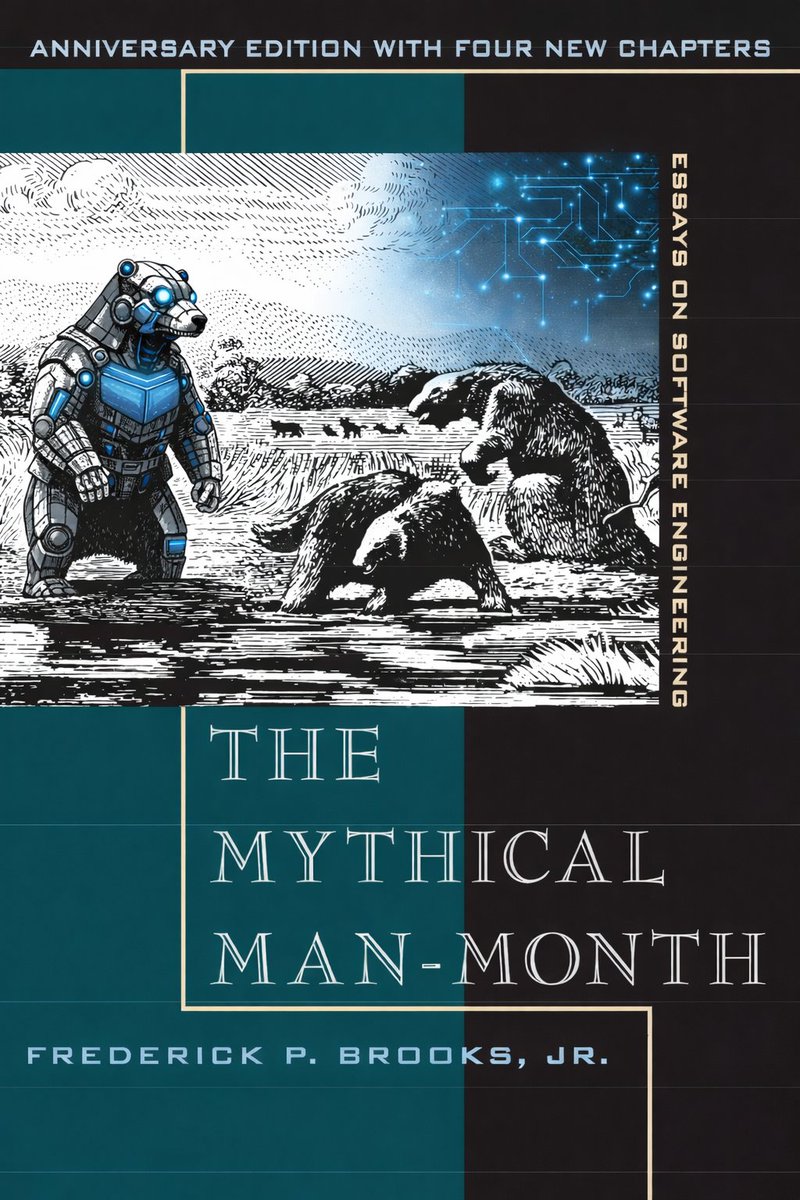
Despite LLMs, The Mythical Man-Month is still surprisingly relevant. Not because of how code is produced, but because of what actually slows software down: coordination, shared understanding, and conceptual integrity.
AI makes code cheap. It does not make software design, architecture, integration, or alignment free.
In fact, faster code generation can amplify old problems:
* Incoherent abstractions appear sooner
* Integration costs surface later
* “We’re almost done” illusions become stronger
What matters more than ever is strong architecture, clear intent, and technical leadership. The modern leverage point is not the fastest coder, but the person who can frame problems well, guide AI output, and preserve system coherence.
A modern version of Brooks’ Law might be: "Adding more AI to a late or poorly defined project makes it confusing faster."
AI changes the tools. It doesn’t repeal the laws of software engineering.
Fun fact.
Italian singer Adriano Celentano released a song in the 1970s with nonsensical lyrics meant to sound like American English—to prove that Italians would just love any American song.
And it was a hit.
AI tools, like all productivity tools, amplify the skills of those who wield them.
If you don't know how to play guitar, a Stratocaster isn't going to make you Jimi Hendrix.
If you don't know how to code, Cursor is not going to make you a dev.