@felangelov How do you go about arguing that though? How do you convince the market there’s still value in software engineers, and that they are necessary for building scalable solutions?
Thanks to @tomaSasovsky for bringing "finalizers" to my attention for the first time in 2022; See 👇
https://t.co/ebC70NTuEy
https://t.co/x6w2rDRnOa
At that time, finalizers were vaguely described and lacked good examples, so I've been exploring them ever since.
(2/n) 👇
@francescovll@SpaceEngy Ah, I see. I'm used to not running into this issue due to my linter rules of choice, https://t.co/vrzhWDQsYZ. Thanks for the explanation!
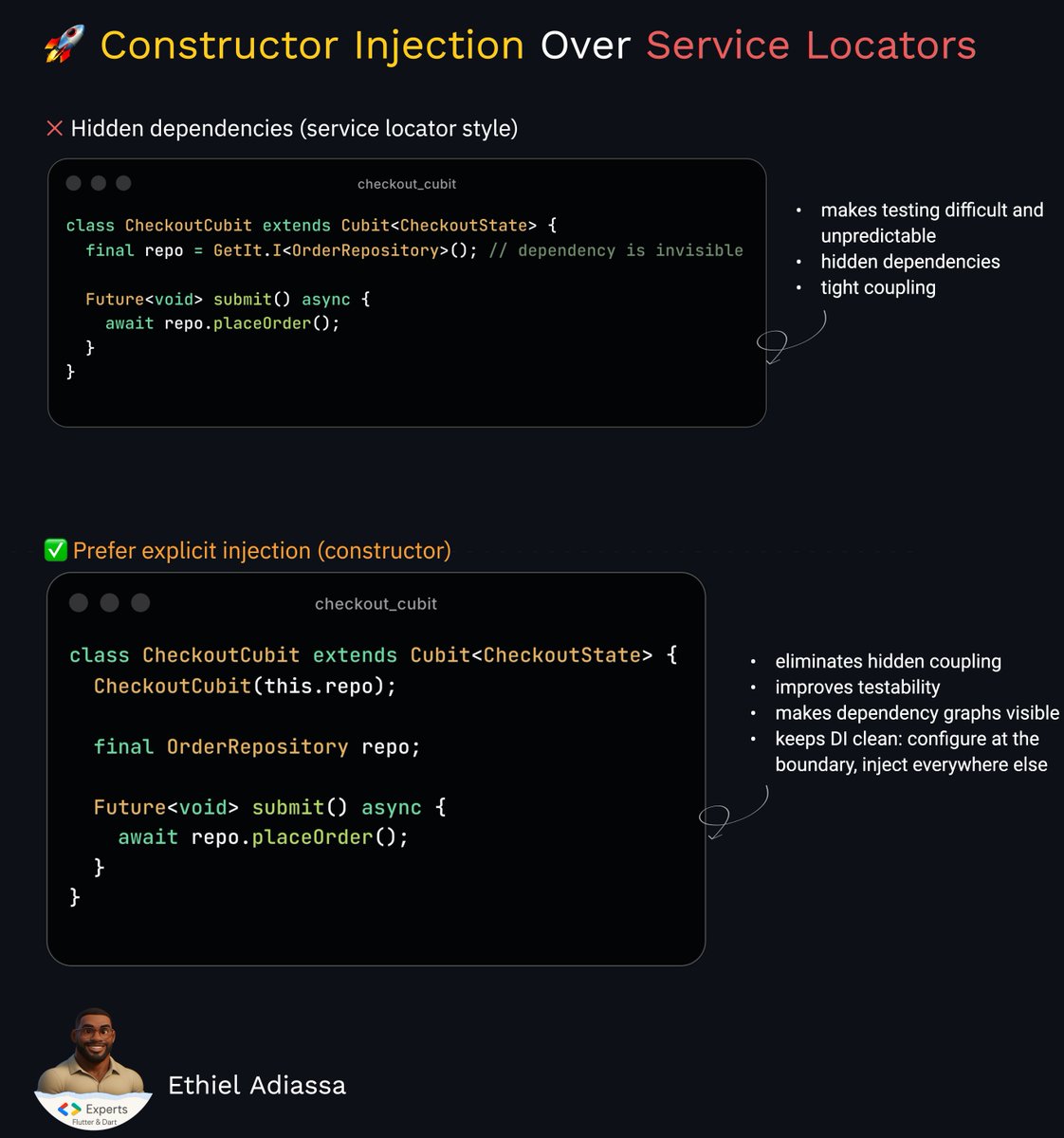
Dependency injection often starts clean… and then slowly turns into something else.
A GetIt.I<T>() here, another lookup there, and before you notice, the DI container is being used everywhere as a global service locator.
The issue isn’t the tool. It’s the loss of explicitness.
When dependencies are pulled from a container inside classes, they become invisible. Tests get harder to write, refactors get riskier, and understanding the real dependency graph takes more effort than it should.
A healthier pattern is to keep the container at the boundary of the app, and inject dependencies explicitly through constructors.
It makes dependencies obvious, keeps classes honest, and dramatically improves testability.
I added a small before/after example in the attached visual to show the difference.
It’s a simple discipline, but it keeps DI doing what it’s supposed to do, not quietly turning into global state. 🚀
PS: Follow @fluttergigs
I’m personally not a huge fan of Dart’s new dot shorthand syntax. It makes code harder to read, there’s no lint rule to standardize one way or the other, and it just adds more complexity to a language which I love for its simplicity.
World's first sperm race
It featured sperm samples from two college students, Tristan (USC) and Asher (UCLA), racing on a 20-centimeter microscopic track designed to mimic the female reproductive system.
https://t.co/1jxv85mqR4