Human Rights Watch has concluded that Israel's denial of water to Gaza amounts to an act of genocide.
In October 2023, Keir Starmer said "Israel does have that right" to cut off water and power from Gaza. This is what complicity in genocide looks like👇
In 1982, Israel bombed the Beirut airport.
The Lebanese were trapped as the IDF marched into Beirut, massacring thousands of civilians.
Hezbollah didn’t exist.
IDS warns welfare is heading for the rocks. He doesn't mention the crown costing you £1.5bn a year. Or Andrew's £150m security.
Same system. Different targets. They always blame the poor. 👑
'Utter disaster’: Alan Bates attacks schemes compensating post office scandal victims.
7 schemes. £1.5bn paid from public purse, could hit £3.5bn.
Zero contribution by Fujitsu, PO execs, other perpetrators.
No one charged for false criminal convictions.
https://t.co/1pkj4Fx051
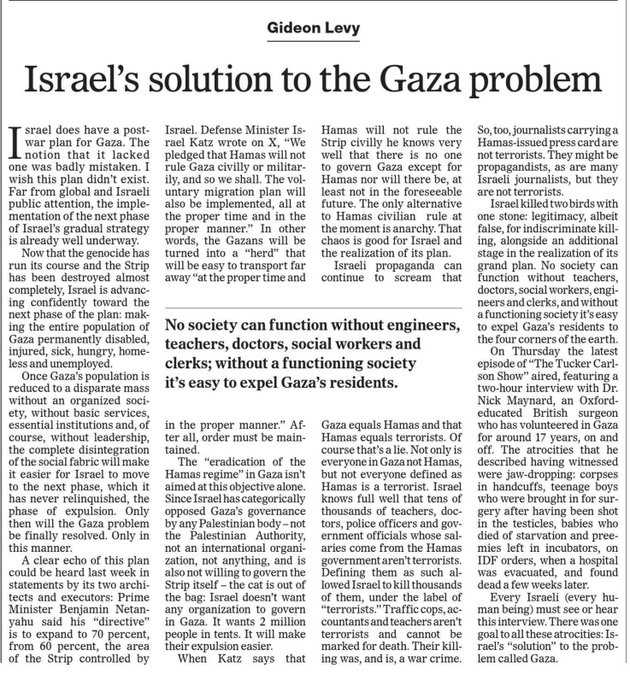
Now that Gaza lies in ruins—shattered, like a beloved face after a long brutality—Israel moves with a terrible confidence to the next act: The act of leaving every soul there not merely wounded, but permanently disabled. Injured, sick, hungry, homeless, without work, without hope. This is not war’s collateral damage. This is design.
As my friend Gideon Levy writes—and he knows, he knows—this is the prelude to expulsion. Think of it: a society without teachers, without doctors, without social workers, without engineers, without clerks. That is not a society. That is a holding pen. A slow erasure. And when nothing functions—no school, no hospital, no office, no heart—then it becomes ‘easy,’ they tell themselves, to scatter the people to the four corners of the earth. Like seeds from a broken pod, except no soil will take them.
We must name this. Not with rage alone, though rage is honest. But with the cold, clear tears of recognition: they are making life impossible so that departure becomes the only ‘choice.’ And the world watches, adjusts its spectacles, and calls for restraint. Restraint! There is no restraint in a slow drowning.
The Israelization of our societies is already happening: posturing democracies where human rights can be suspended for people that those in power consider a disturbance.
Wake up Brits. Italians. Germans. French. North Americans. Dutch.
Two months ago, a "well-placed" contact told me that the US was relaunching the long-debunked Uyghur genocide hoax. I didn't believe him, but he was right. FT and others are backing it, vaporising the final shreds of credibility
Of course the British working class got a great deal from Empire.
This is Jonty Lambert, a miner from Stanley, in Co Durham, just along the road from Consett where I was brought up. This was 1909, the same year his 17-yr old son James died in the Burns Pit Disaster. The bow legs are a symptom of rickets, by the way. Very common amongst the miners.
Only nationalisation improved their conditions. My grandad, miner Joe Hall, took part in one of the Hunger Marches. He was hauled before Mr Scott, the owner, and told the only reason he's keeping his job is that he has a shot-firing certificate. Firing shots pumped a lot of dust into his lungs. Pit lung - pneumoconiosis - meant he had to pack in playing football at the age of 30 and coughed up gunge for the rest of his life.
In July 2025, Labour govt gave ‘special mission’ immunity to head of Israeli Air Force force—and key architect of Gaza genocide—so he could visit UK
Same govt just banned journos Hasan Piker and Cenk Uygur from UK for criticising same genocide
Labour is a genocidal institution
It always astonishes me how there is virtually ZERO public debate - or even public awareness - in Europe about the decisions that will most shape ordinary people's lives.
These days, the EU is drafting a new anti-China legal framework where - quite literally - the more affordable and competitive Chinese products are, the more illegal they'd become.
You'd think EU citizens would want to be informed about such things - as it couldn't be more consequential for their prosperity.
Yet I bet virtually no EU citizen is even aware of it, beyond a vague sense that there is some sort of trade dispute going on.
So what's going on exactly? It all centers around a new legal instrument the EU is drafting called the "overcapacity instrument" (https://t.co/mNpCMudYyS).
First of all, the very notion of "overcapacity" is pretty ridiculous to begin with, especially the way it's being defined by the EU, as it basically means being competitive enough to export.
By this definition of "overcapacity," pretty much every European industry that's ever run a trade surplus - German cars, French wine, Italian fashion - has been guilty of "overcapacity."
I'm not even exaggerating: if you read this study by the EU Parliament on "Industrial overcapacities, with a focus on China" (https://t.co/TcwEBoL8mD), they define "overcapacity" as building more capacity than your domestic market can absorb. So the moment you build capacity to export abroad, you're in "overcapacity."
Utterly ridiculous.
And what this "overcapacity instrument" is about is creating a permanent legal mechanism for the EU to block Chinese competition across whole sectors of the economy, if they happen to be in "overcapacity."
In effect, this means that if China is competitive globally in a given sector in such a way that it exports a lot, that's proof of overcapacity, and legally it'd mean that the entire sector can be restricted from the EU market.
Which means it really, factually, is a legal framework where the more affordable and competitive your products are, the more illegal they become.
Which is a CRAZY economic concept! 🤦♂️
Please note that it's different from the anti-subsidy legal instrument, which the EU has already put in place in 2023 (the "Foreign Subsidies Regulation": https://t.co/SvPKFyN0zo).
This "overcapacity instrument" would be above and beyond this: it wouldn't even matter if a particular sector was subsidized by the Chinese government or not, the mere fact of its competitiveness in exports would be grounds for restrictions in the EU.
It doesn't take a genius to understand how badly this could impact everyday people: this is European consumers being forced to pay more for worse products by law, so that uncompetitive European firms don't have to improve.
Politicians frame it as avoiding a "China shock 2.0" but really this is choosing an even steeper self-inflicted decline than is already the case, where EU citizens would subsidize mediocre EU companies that would have even less pressure to catch up. It's a hidden tax: subsidies for uncompetitive firms paid by consumers instead of governments, which in turn makes them less incentivized to become competitive.
The first "China shock" did de-industrialize Europe somewhat, but at least it made things cheaper for European consumers. If this becomes Europe's response to a second "China shock" not only it'd make everything more expensive but it'd do nothing for EU industry: you don't become competitive by banning the competition...
Look at China itself: the way it industrialized was NOT by banning Western firms but on the contrary by welcoming them strategically and learning from them. You learn to compete by... competing, duh!
What I find most shocking in all of this isn't even the policy itself - you can make arguments for and against protectionism, and reasonable people can disagree.
What's shocking is that virtually no European media outlet is explaining any of this to the public. This is unarguably one of the single most consequential economic decisions the EU will make this decade, affecting the price of everything, and it's being drafted in near-total silence.
No newspaper is running the headline "EU plans to make Chinese goods illegal if they're too affordable" - even though that's essentially what's happening.
But that's what you call a "democracy" with "freedom of expression" these days apparently...
Great article, but too many words for me: Summary of the Jadaliyya article “Raffi Berg: In His Own Words” (by Martin Asser)
This is a detailed, highly critical personal and professional assessment of Raffi Berg, the BBC’s Digital Middle East editor, written by former BBC colleague Martin Asser (who worked with him from 2001–2009 on the Middle East online desk). Asser portrays Berg as a journalist with a pronounced pro-Israel/Zionist bias whose work consistently humanizes Israelis while downplaying or negatively framing Palestinian perspectives, contributing to broader criticisms of BBC impartiality on Israel-Palestine.
Key Points:
•Background and Context: Asser describes Berg as a likable colleague whose strong attachment to Israel (e.g., planning to wave a large Israeli flag at a pro-Israel rally during the Second Intifada) was viewed internally as an asset for balance. Berg later became a focal point of criticism after Owen Jones’ 2024 Drop Site News article highlighted alleged BBC bias on Gaza, leading to Berg facing social media scrutiny (e.g., memes about him being “on holiday” when coverage is less favorable to Israel) and a defamation lawsuit against Jones.1
•Public Statements:
The article highlights Berg’s 2020 comments expressing pride in Mossad operations (giving him “goosebumps”) and framing stories about Israel as positive, non-political “humanitarian” narratives to appeal to non-Jewish audiences. Asser questions how such open partisanship would be tolerated from a Muslim or pro-Palestinian journalist.
•Analysis of Berg’s Reporting (2002–2008):
Asser examines dozens of Berg’s BBC articles, arguing they show systematic patterns:
◦Humanization: Israelis (soldiers, settlers, mothers, victims of attacks) are given rich personal stories, emotions, and sympathetic backstories. Palestinians appear more as collectives, threats, celebrators of violence, or shallow victims.
◦Settlers: Portrayed warmly as ordinary, wholesome people building communities (often glossing over the illegality of settlements under international law).
◦Framing of Conflict: Israelis are reluctant peace-lovers forced to fight by implacable Palestinian/Arab enemies. Emphasis on Israeli suffering (suicide bombings, etc.) with limited context on occupation or Palestinian grievances.
◦Specific Examples: Articles on IDF conscripts, settlers in places like Migron, the 2006 Lebanon war (including animal stories and sympathetic Israeli families), and pieces that Asser sees as distortions (e.g., on the USS Liberty incident or Gaza patients).1
•Broader Critique: Asser contrasts the lax editorial scrutiny Berg allegedly received with the heavy oversight applied to his own more critical pieces. He argues this reflects institutional bias at the BBC favoring Israel-friendly framing. The article ends by suggesting Berg’s worldview treats Palestinian issues through an Israeli lens, with rare sympathetic Palestinian portrayals tied to narratives of rejecting violence or “brainwashing.”
The piece is partisan and polemical, drawing on Asser’s direct experience and close readings of Berg’s archived articles. It distances itself from antisemitism while accusing Berg (and by extension the BBC) of consistent partiality. The BBC has rejected the criticisms as an attack on an individual staff member, maintaining adherence to editorial guidelines. The article is quite long and includes extensive quotes and links to specific BBC pieces.
•Murphy outlines three steps: guarantee everyone sufficient income through better wages and social security to eliminate poverty; increase taxes on high incomes and wealth gains to rebalance spending power; and redirect ISA and pension savings into productive UK investments for jobs and climate projects.
•The approach rejects decades of neoliberal policies in favor of using money, taxation, and savings more effectively to drive growth, reduce inequality, and strengthen society.
En Albania, el yerno sionista de Trump, Jared Kushner, quiere destruir una reserva natural protegida para construir un resort de lujo para turistas, destruyendo el ecosistema marino y amenazando a especies en peligro de extinción.
Los albaneses locales lucharon contra la seguridad privada de los oligarcas capitalistas para evitar la construcción del complejo y la destrucción del paraiso natural.
La zona es una área protegida que contiene hogar a especies en peligro de extinción como la foca monje mediterránea además de otras 70 especies amenazadas y 200 especies de aves que tienen corredores en la zona, como los flamencos rosas.
El sionismo y la avaricia capitalista sigue destruyendo tierras por allá por donde asoma.