The lesson I take from the SpaceX IPO is that the only thing stopping us from solving arbitrarily difficult problems is extreme creativity in business models.
No amount of tax and spend programs got us reusable rockets and great electric cars. Customer delight is a necessary precondition for success.
There seems to be some discussion around whether successful entrepreneurs should give up control of their companies so they can subsidize some philanthropic venture that otherwise has no value prop sufficient to run it as a business where customers voluntarily exchange money for goods and services at a competitive and reasonable price.
This misses the point. Transformational products deliver tangible value at 1000x the rate of charities whose value cannot be tested in the market place. Think about the undeniable value of the smart phone, satellite Internet, electric consumer devices, etc etc.
I think the transformational moment for SpaceX was when Elon stepped away from the philanthropic Mars greenhouse concept and fixed his resolve on unlocking radically better rockets for humanity. The greenhouse would have been, at best, a neat trick. Falcon and Starship give humanity a durable economic engine to maintain and improve access to space, forever.
Please God! Trillions are being spent on data centres and AI chips, but the investment in design and UX seems to be zero.
Soon, someone will come along with a B-plus model and an A-plus interface and VHS the whole thing.
The Blackberry was objectively much better than the first Iphone.
You can work 5 days a week and succeed as a startup.
Mercury has done that from day 0 and we are valued @ $5.2bn 7 years after launch.
I have been an entrepreneur for 20 years and raised 3 kids while doing it.
The point of success is to have a great life not just a startup 😊
I’ve been thinking about this a lot recently. How our imagination and ingenuity is becoming so compressed to meet commercial KPIs and create scalable businesses.
Creativity and craft is a muscle and if we don’t use it, we lose it.
I’m making a TV show!
Here’s why: When I was moving to New York, I told my leasing agent that I wanted a place with charm and character. She told me that if that’s what I want, I need to look for apartments built before World War II.
“So you’re saying we’ve basically built nothing with charm and character in the past 80 years?”
“That’s right.”
This is happening all over the world. The same boring and generic style has spread to the entire world. 150 years ago, new buildings in Shanghai looked nothing like the ones in Rome or Tokyo or San Francisco or Buenos Aires. The architecture of each place was as varied as the landscape itself.
And it’s not just the sameness of the modern world that has me scratching my head, but also the carelessness behind so much of what’s built these days. We boast about the triumphs of technology and how advanced we are as a civilization, but why has our built environment regressed so much? Shouldn’t we use our wealth to make our streets more charming and delightful?
There’s lots of talk about how we’ve polluted the natural world, but what about how we’ve polluted the man-made world? We’ve filled our streets with ugly railings, benches, lampposts, and clutter.
We assume these things have to be boring, but they don’t. Good design can make everything, even bins and bus stops, charming. New things can be prettier than old things. The first step is believing it’s possible.
Something has changed. We’ve taken a dramatic turn, and the majority of people prefer what we used to build to what we build today. Just look at where people take photos. In New York it’s the steps of brownstones in the West Village; in San Francisco it’s the old Victorian homes; in London there’s tourists galore in front of those iconic red phone booths which remain on the streets, even though they don’t work anymore, because they’re so nicely designed that people like having them there.
All this is what inspired me to make a TV show.
First: a pilot episode which now has 5.4 million views, 23,000 comments, and 379,000 likes. It also has 241,000 YouTube subscribers from that one video, which is just about unheard of for a new channel.
And now: a full-on, six-episode series.
But when I pitched Hollywood on the idea, they said cultural series of this sort don’t work: “The only kinds of documentaries that get funded are about sports, music, nature, or true crime.” Huh? How can that be?
People are interested in culture. The problem is most culture documentaries are terrible. They fail in one of two ways: (1) people dumb down the ideas in patronizing ways, or (2) people use so much jargon and high-falutin language that it becomes boring and inaccessible.
This is why I’m producing this work. It’ll be called The Modern World, and it’ll be a tour of art & architecture through the eyes of Sheehan Quirke, who goes by @culturaltutor.
It’s our ambition to do for the man-made world what Planet Earth did for the natural world. To use cinematic imagery and simple language in a way that everybody can understand. And to be rigorous, but not in a way that feels like school or your know-it-all friend who never stops talking.
The potential here is huge. Architecture impacts literally every person on earth. What we build shapes the moods of people and the spirit of our culture.
We’ll film in six countries (the United Kingdom, Belgium, France, Germany, Italy, and the United States) to produce six 30-minute episodes which we hope to publish on a major streaming service. We’re currently in the fundraising stage, and production begins once we’ve raised the money.
It’s our mission to help people see the world more clearly, and in turn, make the world a more charming and delightful place to live in.
I’m making a show about buildings.
The concept is simple: do for the man-made world what Planet Earth did for the natural world.
But, when I pitched the idea, the answer was that nobody would watch it.
So I released a pilot episode on YouTube. It’s got 5.4 million views, 379k likes, and 23k comments.
People are interested, and now it’s time to make the full show.
Six episodes, filming in the UK, France, Belgium, Germany, Italy, and the USA, and releasing on a streaming service like HBO, Netflix, or Prime.
Why does this show matter?
First: we’re surrounded by buildings all the time. Look around yourself, right now… what do you see? Buildings are the logical conclusion of everything a society believes in. That’s the real focus of this show: not the buildings themselves, but what they say about us.
Second: there’s global dissatisfaction with modern architecture. This feeling gets written about online, but nobody’s given a voice to it on film or TV. That’s what this show will be. But this isn’t just about criticising modernity. That’s easy. This is about learning from the past in order to understand and improve the present, for everybody.
Third: there’s a drought of high-quality culture shows. When I spoke to film executives they said that only documentaries about sports, music, or true crime get funded. That’s a colossal missed opportunity. Galleries are always full, content about architecture goes viral online all the time, and people spend their precious holidays visiting beautiful cities.
Why no shows about architecture, then?
Tourists flock in their millions to see (for example) the buildings of Antoni Gaudí in Barcelona. But, if you asked those same people if they’re interested in “architecture”, they’d probably say no.
To put that another way: not many people want to watch “a show about architecture”, but lots of people want to watch a show that illuminates the real world they’re living in, each and every day.
What will the show be like?
Six episodes, going chronologically through history and arriving at the present, each focussing on the architecture and design of a specific period:
1. Middle Ages
2. Renaissance
3. Enlightenment
4. The Nineteenth Century
5. Art Nouveau & Art Deco
6. Present Day
But, in each case, the point isn’t just to learn about that era; the point is to learn about our modern world through those eras and what they’ve left behind. If you watch the pilot episode (included below) you’ll see what I mean.
So the show’s not really “about” the past; it’s about the twenty-first century.
That’s why it’s called The Modern World.
When you think of a typical history show there are loads of interviews, stock footage, archive photos, historical recreations, and graphics. We’re doing none of that. Everything will be filmed on location, because we’re telling our story only through the real world that exists right now. And, rather than going to the most obvious places, we’ll focus on buildings that aren’t well-known but should be more famous.
But that’s all big picture; what will it be like on screen?
Buildings used to look different in every country, and now they look the same. Why? Because the weather is different everywhere, and buildings were always a way of dealing with that weather, using local materials. Now we have air conditioning and we ship concrete around the world, so we don’t need to design our buildings with regard to local weather or rely on local materials.
Look at really old clocks and you’ll notice something: they don’t have a second hand… because it was only invented 300 years ago! Then you look at the present and you realise we’re surrounded by timers, by seconds ticking down and ticking up relentlessly. If we’re looking for a cause of our anxiety-inducing culture, that might be it.
When you spend time with the sun-softened bricks and time-warped timbers of old cities you notice that synthetic materials like plastic have taken over. When we’re surrounded by things that feel temporary, how do you think it makes us feel?
It’s only by seeing 19th century train stations, designed like cathedrals, that you realise tradition and technology aren’t enemies. New things don’t have to look boring: if the Victorians had designed AI data centres, they’d look like Medieval castles.
In the 1920s, at the zenith of Art Deco, people believed technology would uplift humanity. That’s why they decorated their buildings with statues inspired by electricity. Only by seeing their enthusiasm can we realise our own cynicism, and perhaps begin to fix it.
All of that… and much, much more.
But, above all else, this show is about a way of seeing. If you want to understand any society then you need to look at what it creates, not what it says about itself.
There’s a worldview in every single object; our skyscrapers are designed the same way as our phones. Learn to look at this world, to notice its details, and everything else starts to make sense.
What now?
I’ve been quiet online recently because I’ve been researching and working on scripts for six full-length episodes. Production begins when we’ve raised the funding.
The Modern World is coming.
Something to think about : what does life look like 25 years from now if AI continues to improve.
I don’t think any AI community ( broad tech industry , academia , various timelines predictions) have done a great job articulating a positive long term future for humanity and what it means for the institutions and traditions that a lot of the world holds dear.
@tomfgoodwin Could be simply that what you say resonates with them, and spending an hour together without a specific agenda could spark ideas for something bigger.
@tomfgoodwin Consulting is the biggest culprit. They feed the hype cycles, Gartner publishes the content, consultants sell their framework, deliver nothing of impact, and the loop starts again.
AGI has been achieved in Ireland.
Artificial Guinness Intelligence.
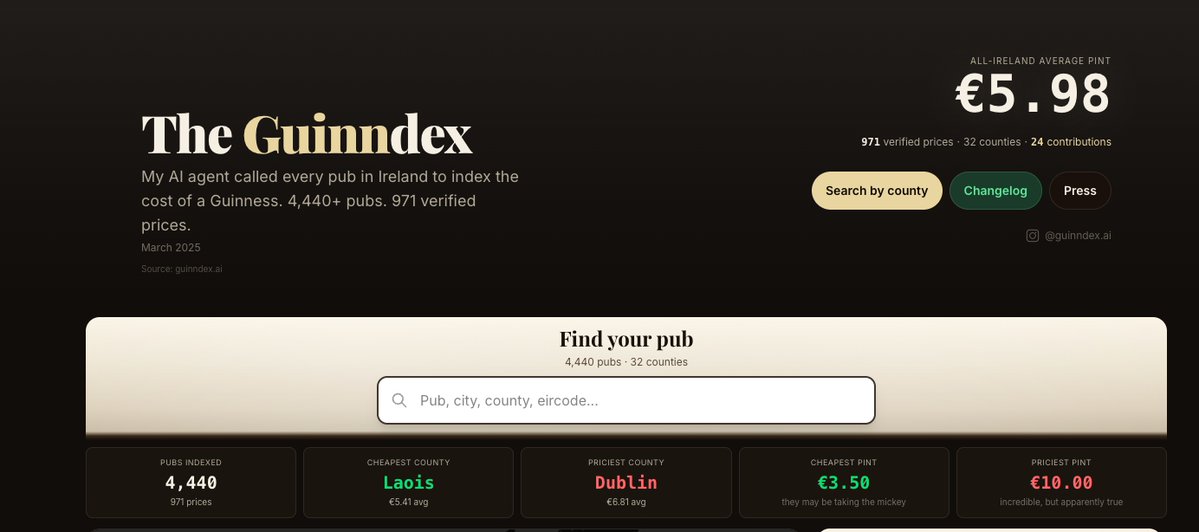
Engineer Matt Cortland built an AI voice agent named Rachel, gave her a Northern Irish accent, and pointed her at every pub in the country.
Over St. Paddy's weekend, she rang 3,000+ of them to ask one question: how much for a pint of Guinness?
How he built it: ElevenLabs for the voice, Twilio and an old Irish SIM to place the calls, Google Places API to map 5,200+ pubs across all 32 counties, and Claude to parse the transcripts for prices.
2,052 picked up. Barely any even realized she was AI. The whole operation ran him about €200.
The result is a live price index he's calling the Guinndex.
Ireland's statistics office used to track pint prices, but stopped in 2011.
An engineer with a weekend and a voice agent just picked up where they left off.
🚨 Do you understand what happened today.. a single Monday..
> Zuckerberg announced he's building AI to do his own CEO job.. after firing 31,000 people to "protect" it..
> someone bought $1.5 billion in S&P futures FIVE MINUTES before Trump announced halting attacks on Iran.. the biggest insider trade in broad daylight..
> then the Pentagon started deploying airtroops to Iran anyway.. the "peace" lasted 12 hours..
> then Iran launched missiles at Israel tonight.. so the peace someone made $1.5 billion off of was never real..
> OpenAI started guaranteeing Wall Street 17.5% minimum returns AND early access to unreleased models.. nonprofit to "we'll pay you to invest in us"..
> Jensen Huang told Lex Fridman "I think we've achieved AGI".. then walked it back in the same sentence.. the man selling the shovels just said the gold rush is over and expects you to keep buying..
> Claude launched an AI that sits at your desk and does your entire job while you're not in the room.. shipped it as a Monday night feature update..
> Goldman Sachs raised US recession probability to 30%..
> the owner of OnlyFans died at 43 with $3 billion.. couldn't buy more time..
> Larry Fink called tokenization "the next internet" after calling Bitcoin money laundering for years..
all of this.. one Monday.. if you're not following me you're finding out about this 48 hours late from someone who read my post..
it's only getting crazier from here.
Apart from the school thing (teaching the same old curriculum in the same old way is dumb), Hugh Grant is so right here. Without more play, kids will naturally become consumers instead of creators, and real imagination and creativity will be lost.
Hugh Grant: "It's been very, very depressing watching Big Tech kidnap their lives, and to see children really finding it very, very difficult to get properly interested in anything that isn't a screen."
@tomfgoodwin The heavy thing is a very real change. Everything so serious, joy is suffocated a bit. It’s not just about getting old, I notice it in my kids. Less carefreeness, more anxiety and pressure