@andrzejkrzywda As in - for most accounts, which are naturally less popular, the posts were fanned out straight to cache. It was the big accounts that needed the heavy joins, and were mixed in.
@andrzejkrzywda It blew my mind that in the original implementation of Twitter, following a celebrity effectively made your timeline generation slower (due to these joins).
@john_my07 I haven't played with vid-gen yet but was curious what I'd get if I'd paste this prompt 1:1.
Needed to compromise on output params (4s only, lower res, Seedance 2.0 Fast) but here's what $2.00 got me:
Dear Diary.
I've just optimized feeding GitHub PRs to an LLM by ~33x. Here's how I did it:
While reading @nateberkopec's Four Line Friday's post on his recent OSS contrib, I wanted to check up on something mentioned in one of his PR descriptions.
9/
Caveats:
- I've assumed basic tokenization of `chars / 4` (even if a real tokenizer shifts both numbers up or down, it would need to shift the token counts considerably to erase a 30x+ gap)
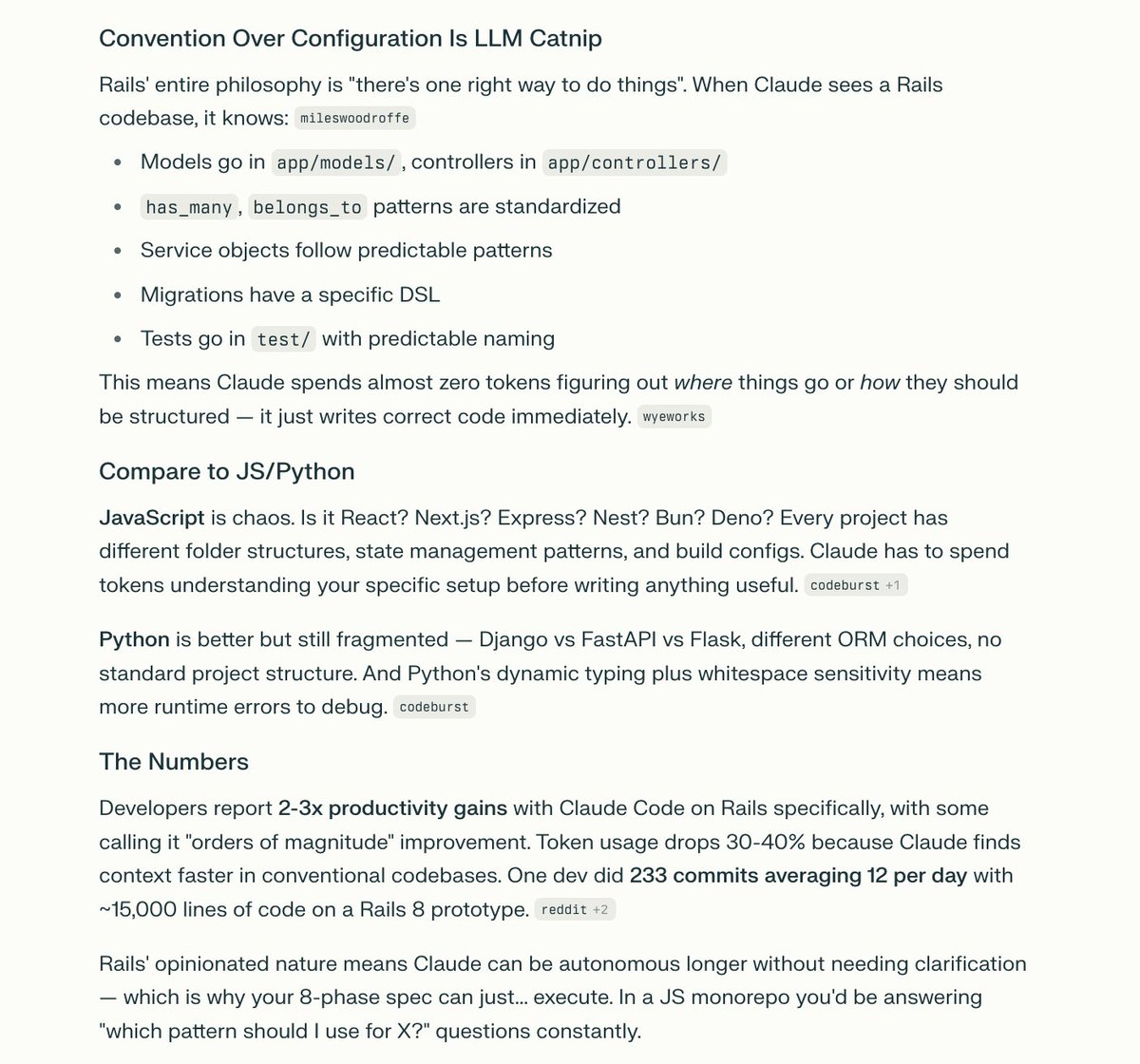
I think people are sleeping a bit on how much Ruby on Rails + Claude Code is a *crazy unlock* - I mean Rails was designed for people who love syntactic sugar, and LLMs are sugar fiends.
@andrzejkrzywda@rockatanescu Haven't seen this gem of an article in a while. It goes without saying embracing alternate approaches helps one to think about software. Thanks :)
Had some time over the holidays, so I made a few PRs to Ruby💎
⚡ Float#to_s → 4x faster
⚡ String#to_f → 3.2x faster
⚡ String#pack('H*') → 5x faster
⚡ String#reverse → 3x faster
I may not have deep YJIT or internals knowledge, but I'm doing my best 🙂
#ruby#performance