Quantitative Psychologist. Systematic Trader blending behavioral science and statistics. All entries fully automated. USIC 2026. Nothing for sale. Go Dores!
I've kept a low profile here, so an introduction is probably overdue.
I started with a PhD in clinical and quantitative psychology, then twenty-five years of research and executive work in healthcare. I spent most of those years working with messy, real-world data and always wondered whether I could apply those skills to the market. Turns out it works. I left Vanderbilt earlier this year to trade full time through Arcadia Analytics.
My trading is fully systematic. I design the strategies and the parameters, and every entry is placed by the system, not by me. I spend my time exploring data and testing ideas.
I trade only my own capital. This year I created a dedicated account for USIC because it's the premier trading competition in the world. One interesting fact: no June leader in this division has ever won the year. 0 for 7 since 2019. Five months left to find out!
Happy to talk research design and methodology with anyone interested.
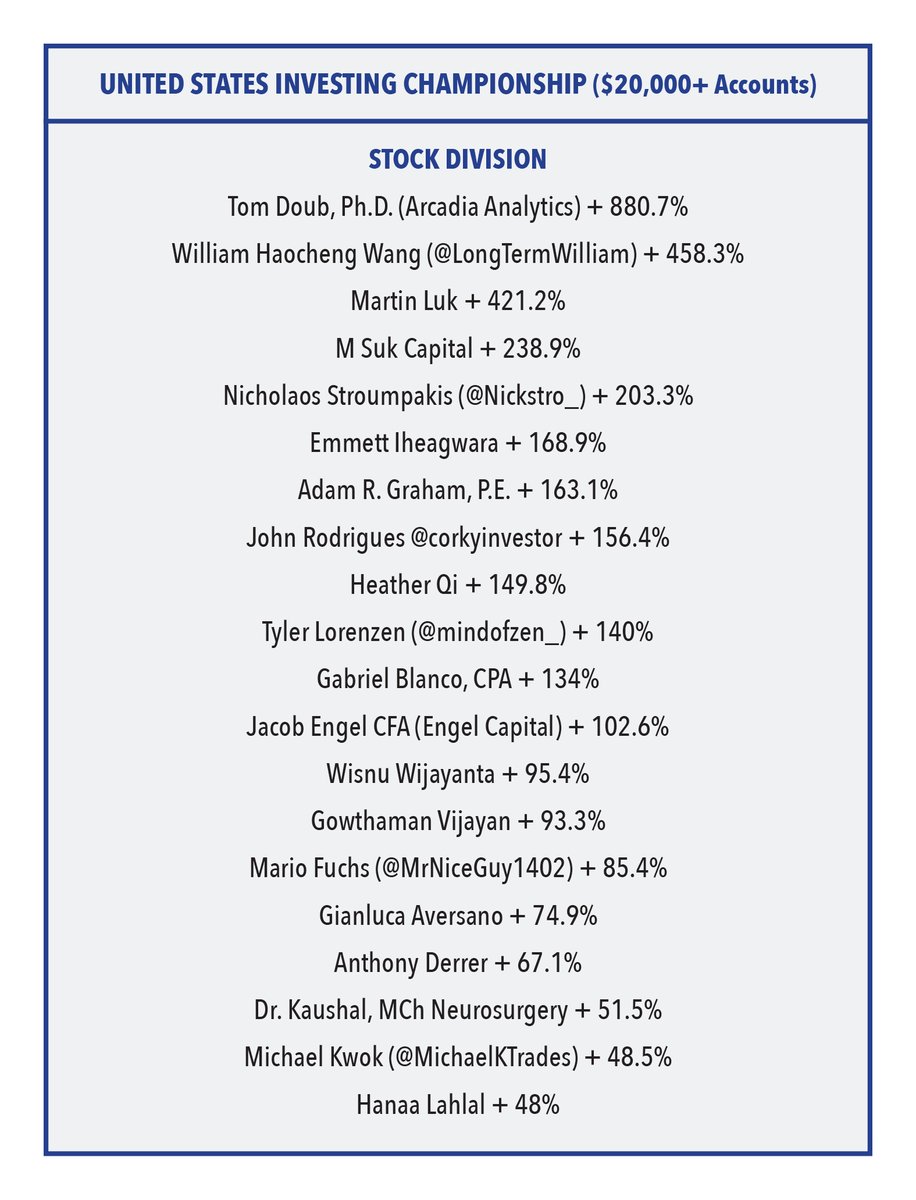
Leaders after six months in the stock division. Late entrants for the 2026 competition are welcome and are tracked from the close on the day they enter. https://t.co/iSk7ihf9tN
There's a lot to be learned from Martin's screenshot, and it's not about the P&L, it's about risk. It's been a challenging environment to trade, and you can see his tight-risk, big-payoff approach in the shape of the curve: gentle pullbacks when he's wrong, sharp jumps when he's right. Small losses, big wins. Doing that in a market this choppy is extremely impressive. My algo has been sitting on the sidelines through much of it.
Let me be the first to congratulate Martin on a very likely back-to-back USIC title!
Today ended the note on a high, with both the largest single-day gain and the largest monthly gain. It’s extremely unlikely that I'll be able to replicate this in the future, and I know I was really lucky to have the market cooperate.
Good night.
Thanks for putting this out there. Nice to see ideas that aren’t pure AI slop. Two things that stand out are the limited number of trades for a multiyear strategy so it’s hard to trust the stats and the R is too small. I’d look to find ways to increase the number of qualifying trades and tighten risk. Not easy in large caps that’s for sure. Also the max drawdown versus your PNL in the holdout is too big. It’s noteworthy that the holdout drawdowns look a lot worse than your development samples.
Too many to list. I'm constantly into podcasts/videos/books and trying to expose myself to new ideas. I can usually find something that sparks an idea to explore and add to my arsenal.
A few have probably had an outsized influence:
Mark Douglas and his emphasis on thinking in probabilities (aligns with my statistical background - he has great lectures on youtube)
The Market Wizards series of course (what do they all have in common? A focus on risk, just like Martin)
Van Tharp (his Definitive Guide to Position Sizing really helped me internalize R, risk of ruin, etc - it's an expensive book unfortunately $130 - you can can learn the same concepts by digging into @BrianLeeTrades). Haha now this looks like one of those AI spam posts, but Brian has a great way of thinking about and explaining risk/reward. Recommend checking out his interviews.
Not sure where you're at in your journey but I made a lot of progress when I quit trying to be clever and come up with entirely new trading ideas. This is why I study top traders and take pieces of what they do into my own work. Get a foundation and then build on it.
When you're learning it's hard to figure out where to focus because there are so many markets and opportunities out there, so you have to find something that makes sense to you and focus like a laser on getting the most out of it.
That exploration is what I enjoy most, the trading is just evidence about whether my ideas work or not.
I've kept a low profile here, so an introduction is probably overdue.
I started with a PhD in clinical and quantitative psychology, then twenty-five years of research and executive work in healthcare. I spent most of those years working with messy, real-world data and always wondered whether I could apply those skills to the market. Turns out it works. I left Vanderbilt earlier this year to trade full time through Arcadia Analytics.
My trading is fully systematic. I design the strategies and the parameters, and every entry is placed by the system, not by me. I spend my time exploring data and testing ideas.
I trade only my own capital. This year I created a dedicated account for USIC because it's the premier trading competition in the world. One interesting fact: no June leader in this division has ever won the year. 0 for 7 since 2019. Five months left to find out!
Happy to talk research design and methodology with anyone interested.
Leaders after six months in the stock division. Late entrants for the 2026 competition are welcome and are tracked from the close on the day they enter. https://t.co/iSk7ihf9tN
Honestly, probably not this level of return. Automation has strengths that go beyond what most of us can do by hand, but the adaptability Martin showed in all this volatility really set him apart, while my algo mostly sat on the sidelines (and I was pretty happy with that lol).
This is why I'm fascinated with trying to model the best of human judgment, not just building pure mathematical models.
Finally, I think we all have to find an approach that fits our own psychology and lifestyle, or we'll burn out.
@JoachimMo1985@JohannMarkov Yes, fully systematic. I may share more after USIC, but risk management is a big part of my approach. The strategy matters less than the process.
I am. Everything's fine, I just didn't post results for Sept. I'm pretty engaged in some new ideas I'm working on so decided to take some time off posting/twitter to focus on deep work. Good luck to everyone entering the home stretch for 2026!
Great process question. That's a lot to answer in a tweet, but at a very high level...
Take a discretionary idea that you have or find a promising one to test and try to define it as mechanically as possible.
Then backtest it as far back as you can - I usually go 6-10 years at least. Take a discretionary idea that you have or find a promising one to test and try to define it as mechanically as possible.
If you use AI to code, don't let it write custom backtests - make it use an event-driven backtesting platform like Nautilus Trader or Backtrader (both free).
Use a short window of the data to explore and refine. I use a lot of visual tools to understand data (box & whisker plots etc), and I'm also looking at performance in quintile or decile buckets to find weak spots. Then test on the data you held back (using walk forward and other methods). If it falls apart there, it was probably never real.
If something shows promise I'll spend a lot of time tracing through the actual trade logic on charts (agents can build charts and show entries/exits). Lots of trade logic issues get obscured when looking at summary data and I don't trust a backtest until I've traced through lots of trades (agents now help there too).
Vendor data quality is a big issue - it will matter more with some strategies than others.
Once you have a consistent trading edge, you can then look at how to get more out of it (i.e., how can you find more trade opportunities and retain the edge, how can you improve R:R, improve trade management, etc).
In my opinion, once you have something decent, there is a lot of benefit in going super deep and really squeezing every drop of value from it. I'll spend weeks or months digging into a single promising idea, many of which I'll eventually discard.
@tomdoub I’m early in going from discretionary ideas to a mechanical process. If someone is starting from scratch, what’s the first research loop you’d use to test whether an idea is a real edge versus just curve fitting to charts you’ve already seen?
Our brain processes visual patterns more efficiently than we can interpret tables of numbers. This is why great traders can develop intuition after reviewing thousands of charts and not be able to fully explain everything they are picking up. Very hard to model. Visual plots can help reveal patterns that wouldn’t be apparent otherwise. Edward Tufte has some great references with beautiful data viz.
@manifoldbt Not yet, though I did review the docs and github. Looks interesting for fast testing. I'm in the midst of another project right now but will get to it.
Thanks James. I'd rather not get into strategy details while still competing in USIC (still lots of the year left), but I think most of the value is in process anyway. One of the great things about the market is there are virtually infinite ways to win (& lose lol).
That said, in order to compound rapidly, I'd want strategies that:
1) start with edge
2) generate plenty of opportunities
3) turn over reasonably often (capital efficiency)
I think that's true for most USIC high performers from what I can tell.
Once you have that, you can design a portfolio approach to manage drawdowns and maximize growth.