Three people read Dark Decisions before it was a book. An engineer, a product manager, a management consultant.
"The most relevant book on AI governance I've ever read."
Olabayo Balogun, Software Engineer, CISA
"Dark Decisions gives leaders a structured method for building control into AI from the start. It does not limit what AI can do; it makes sure the boundaries are in place."
Paul Burgener, P.Eng. FCMC
"Tom looks at AI as a product and systems problem: how to design, govern, and build reliable AI products that people can actually trust."
Nilakshi Kundu, Product Manager
If you've read it, a few honest sentences of review, wherever you found it, help the next reader find it.
https://t.co/rAHKTcTfdU
"Air Canada was accountable for the product, not the model."
Three things people blur when they talk about AI.
The model is the engine: GPT-4, Claude, Gemini. You've probably never configured one.
The product is what somebody builds on top: the interface, the rules, and everything that decides what happens to the engine's answer before a person acts on it. The airline chatbot that gave a grieving passenger wrong bereavement information was a product.
The method is how you design the product so it works when you're not watching.
When AI fails, everyone looks at the model. But the model only generated words. The product decided which sources it read, whether anyone checked the answer, and how it reached the customer. That's where the failure lived, and the responsibility.
Ask the product question: who decided what happens to the answer before a person acts on it?
Chapter 2 of Dark Decisions: https://t.co/rAHKTcTfdU
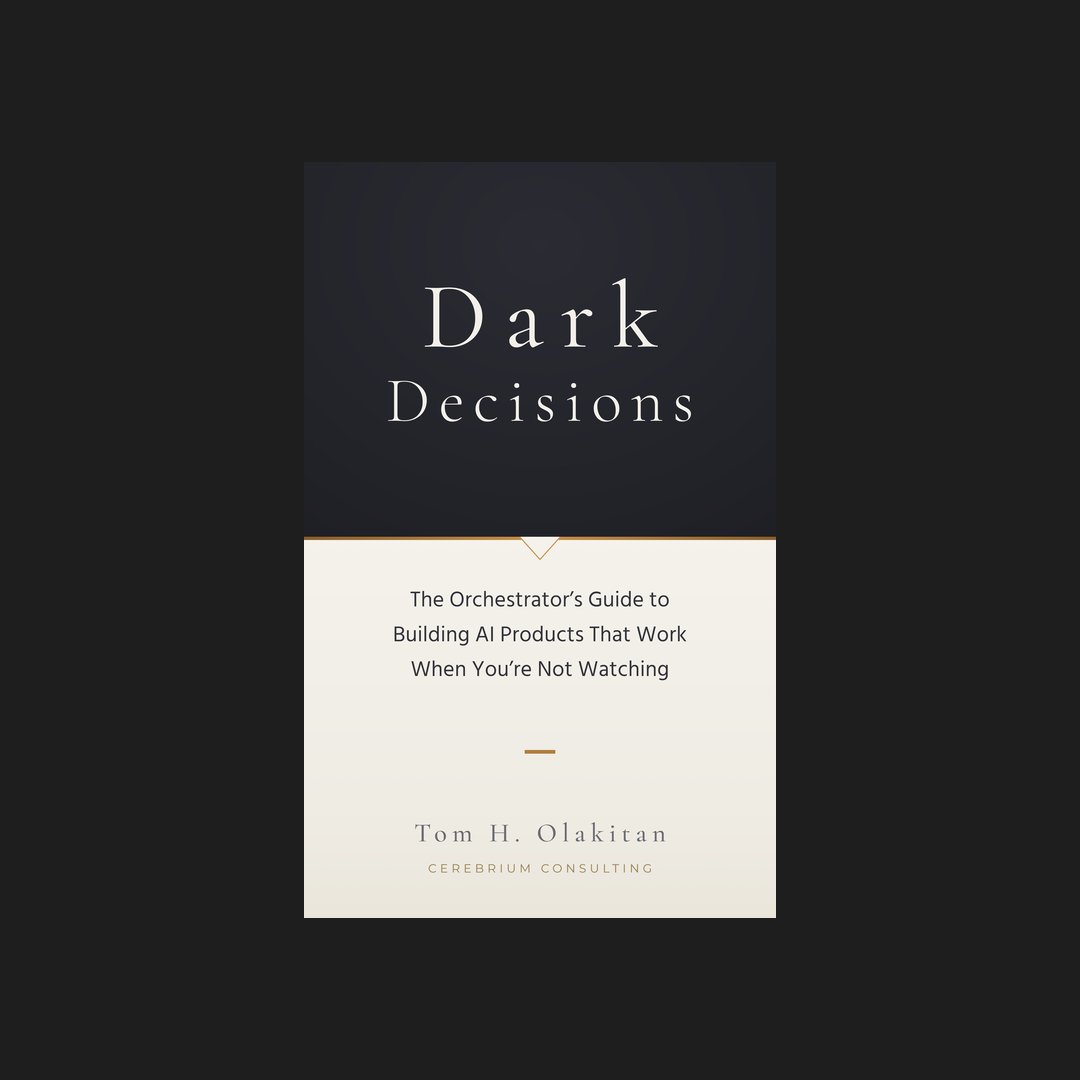
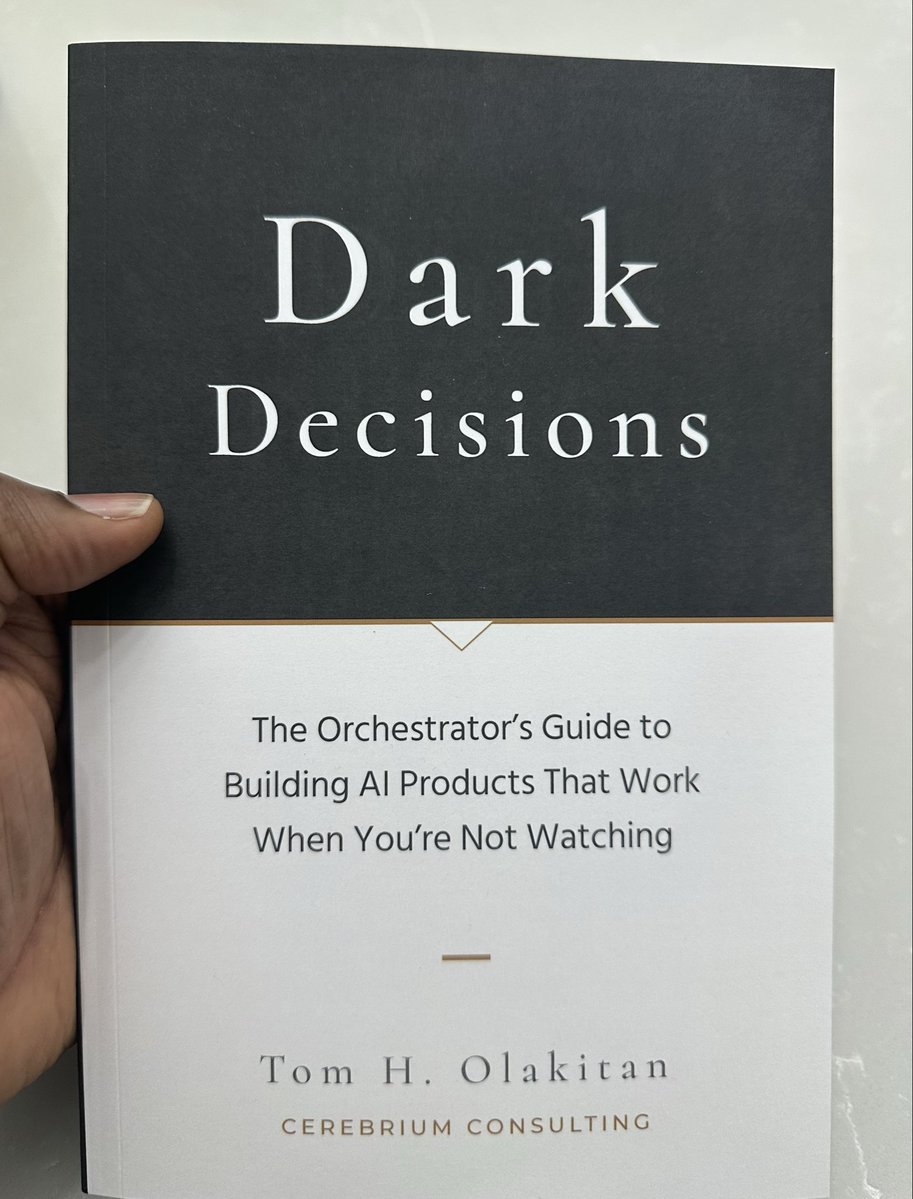
Dark Decisions is out today.
I kept seeing AI products that were impressive in a demo and unreliable with real users. Not because the technology failed. Because nobody designed what sits around it.
The book is for the people who build AI and the people who answer for it: the engineer, the product manager, the CIO, the owner, the person who signs, and the person building a product alone with AI tools, who is all of those at once.
Twelve chapters. Four parts. One argument. Part One names the problem: the decisions an AI makes that no person saw, checked or owned. Part Two: stop thinking in prompts, think in the whole sequence from question to answer. Part Three: the eight checks every reliable AI product needs, written principles that are enforced rather than declared, and the review rhythm that keeps it honest. Part Four: the business built on top.
Nine documented cases. Seven went wrong. Two went right.
Paperback and Kindle, from today: https://t.co/rAHKTcTfdU
If you're not the one who answers for it, send this to the person who is.
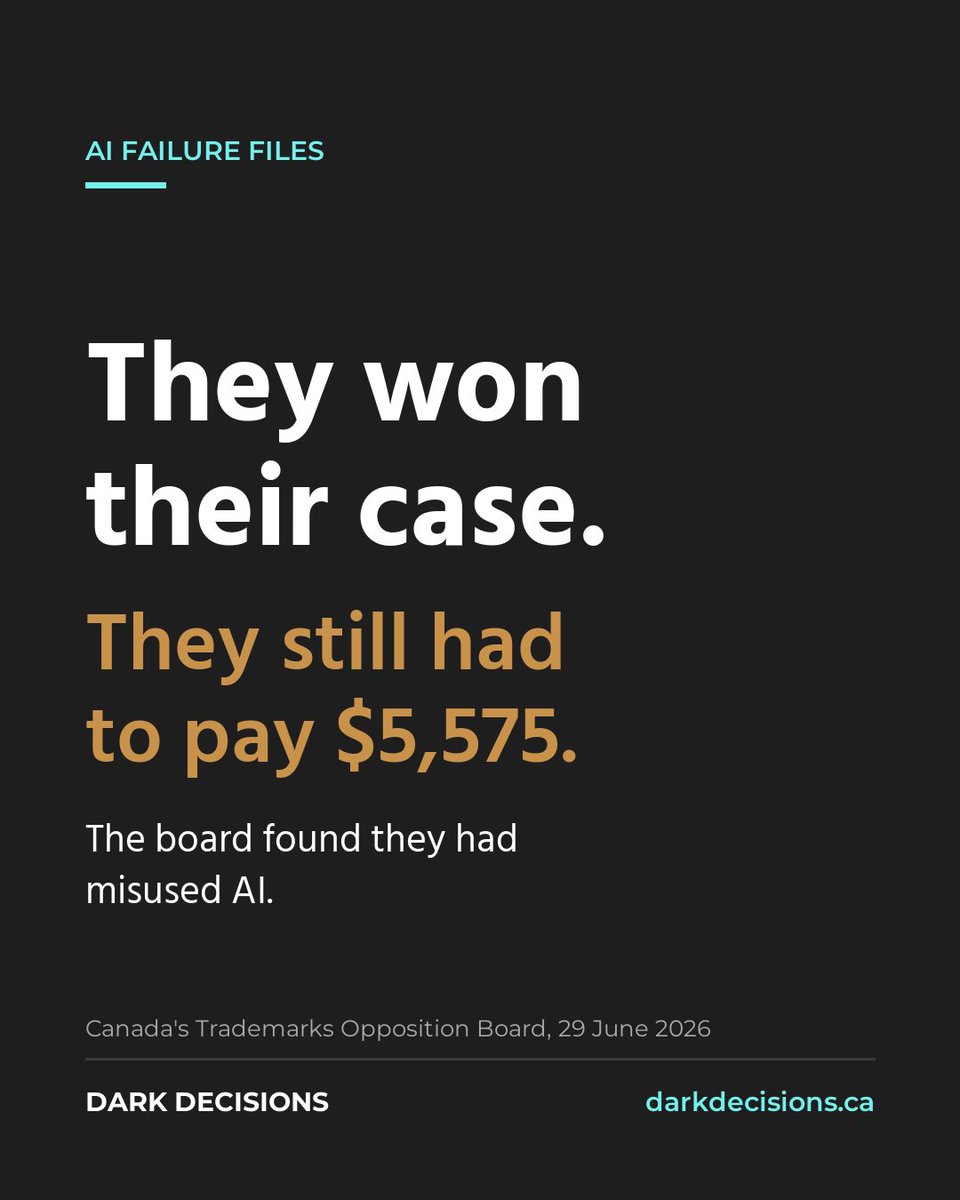
They won their case. They still had to pay $5,575.
A Canadian company wanted to trademark its brand, Chilly Moose. Moosehead Breweries tried to block it. The dispute went to Canada's Trademarks Opposition Board, which settles trademark fights.
On 29 June 2026, the board decided in favour of Chilly Moose. Then it ordered Chilly Moose to pay $5,575 toward Moosehead's costs.
Why? In September 2025, the board had warned Chilly Moose that its papers looked AI-written: a rule that does not exist and two made-up court cases. Chilly Moose's next papers still got the law wrong. Asked directly if it used AI, Chilly Moose said no, then said AI was part of its daily work and its staff "may have" used it. The board found that answer untrue in places, and that Chilly Moose had misused AI.
Nobody checked what AI put into its papers. Nobody could say who had used it.
What should they have done? Check every rule and case in the original source before sending. Treat the warning as a stop sign. Know who used AI on the work, and say so plainly.
Two questions before anything leaves your business: Who here is using AI, and for what? Who checks it before it goes out?
Dark Decisions is out 17 November: https://t.co/YPGnJVoJ4L
#DarkDecisions #AIGovernance #SmallBusiness #AIRisk
On 8 August 2025, an arbitrator in Quebec, a private judge the two sides had chosen, threw out a $1.2 million claim from a care provider that said a Montreal public health centre left it unpaid for 23 months.
The ruling leaned on five legal sources: a law article, three court decisions and an earlier ruling.
On 22 April 2026, Quebec's Superior Court went looking for them. The article can't be found. The court decisions don't exist. The earlier ruling was never made. They were the only legal support in the decision, and the court said they had been made up.
Its finding: the decision-maker handed off the work and never checked what came back. Decision cancelled. New arbitrator. A dispute that began in 2021 is back at the start, because of one unchecked ruling in 2025.
Using AI wasn't the problem, the court said. Not checking it was.
That's a dark decision. The first check in my book is one question to ask before you sign anything AI helped write: are these sources real, and has a person actually checked them?
If you sign what AI helped write, that question is yours. If it isn't you, send this to the person whose name goes on the decision.
Dark Decisions is out 17 November: https://t.co/YPGnJVoJ4L
#DarkDecisions #AIGovernance #AIRisk
#OrchestratorFramework #Orchestrator
The first version of my AI compliance platform was impressive in the demo.
In production, it was unreliable.
That gap is why I wrote a book.
It had to tell BC healthcare professionals what their regulations require. Not approximately. Accurately. When it wasn't sure, it had to say so and pass the question to a person.
A smarter model didn't fix that. What fixed it was what I built around the AI:
→ checks on what goes in
→ checks on what comes out
→ a visible signal of how sure it is
→ a route to a person when it isn't
Most AI books are written for executives or for engineers. Few cover the gap between a good demo and a product you can trust with real people.
Dark Decisions does. Out Tuesday 17 November.
What's the gap between your AI's demo and how it behaves with real users?
https://t.co/YPGnJVoJ4L
#DarkDecisions #AIGovernance #newbook #AI
Your AI made a decision this morning that nobody saw, checked or signed
If it's wrong, someone still answers for it
Dark Decisions shows you where those decisions hide, and which need a person first
Out 17 Nov. Pre-order: https://t.co/7z7iprDQvG
#DarkDecisions#AIGovernance
The fix isn't a smarter chatbot. It's a check between the answer and the customer.
Chatbot, AI assistant or agent, it speaks for you. Every reply is your answer, and your responsibility.
Know a team that uses one? Tag them.
What checks your AI's answers?
#DarkDecisions
In 2024, a BC tribunal ruled on a chatbot.
A grieving passenger asked an airline's chatbot about bereavement fares. It told him he could claim the discount after travelling.
He booked, flew and applied. The airline said no. Its real policy didn't allow it.
#AIGovernance
#3
The chatbot didn't crash. It gave a fluent, confident, wrong answer, and linked to the policy page that contradicted it. Nothing checked one against the other.
I call that a dark decision: a decision your business made that no person saw, checked or owned.