💡 Integrating RWAs on TON comes with a subtle yet critical pitfall:
on-chain raw balances do not equal the holdings users should actually see.
Take xStocks, which implements the TEP-526 (Scaled UI Jettons) standard on TON. When corporate actions like dividends or stock splits occur, the on-chain Jetton raw balance remains unchanged. Instead, the user-facing balance must be recalculated using a multiplier:
Displayed Balance = Raw Balance × Multiplier
While the mechanism itself is sound, the real risk lies in whether downstream applications handle both values properly.
If wallets or exchanges fail to update the multiplier in time, they risk displaying outdated balances. Worse, if a transaction is constructed using the displayed balance directly as the on-chain raw balance, the actual transferred amount will deviate from user expectations.
State synchronization during multiplier updates requires extra caution. xStocks announces new multipliers and activation timestamps in advance, advising exchanges and protocols to pause interactions for ~15 minutes before and after activation to prevent unexpected settlement outcomes during the transition window.
👾 For TON developers, integrating these assets requires verifying more than just standard Jetton transfer logic:
▪️Multiplier Syncing: Are multipliers fetched and updated accurately?
▪️Indexer Monitoring: Do indexers listen for display_multiplier_changed messages to refresh local state promptly?
▪️Unit Conversion: Are user-inputted displayed amounts properly converted into actual on-chain transfer amounts?
▪️DeFi Accounting: Do protocols accurately map raw balances to adjusted equity to prevent collateral valuation discrepancies?
Secure RWA integration isn't just about ensuring tokens transfer cleanly—it's about guaranteeing that wallets, exchanges, and DeFi protocols share a consistent, accurate view of the underlying asset.
This is a key technical detail TonBit focuses on when auditing emerging financial applications on TON.✨
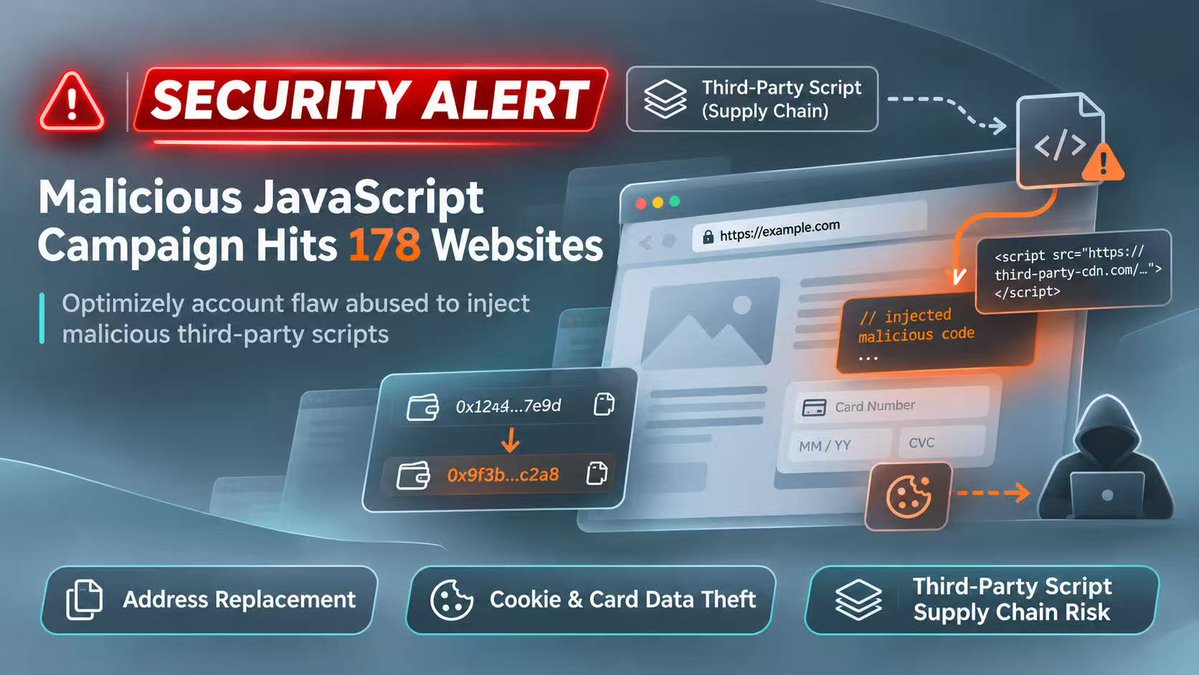
【🚨Security Alert】Malicious JavaScript Injected Across 178 Organizations: Optimizely Third-Party Script Supply Chain Attack
📅 On Nov 17, attackers exploited a registration flaw in Optimizely to inject malicious JS (track.js) into 178 major sites—including Ledger, Zoom, BBC, CNN, Salesforce, GitLab, IKEA, and HSBC.
🕹️ Attack Vector:
Threat actors abused an Optimizely Experimentation sign-up flaw to hijack customer Project JavaScript fields. Because affected sites natively load Optimizely scripts, the payload bypassed server defenses and executed directly in users' browsers.
🧰 Payload Capabilities:
1. Crypto Clipper: Swaps BTC, ETH, TRON, SOL, and TON wallet addresses on pages, in forms, and in the clipboard.
2. Data Theft: Steals credit card info, non-HttpOnly cookies, URLs, and screenshots.
3. iOS Exploits: Delivers Coruna/DarkSword exploits based on iOS version (full compromise unconfirmed).
🧲 Impact & Status:
188 of 1,611 analyzed scripts were compromised. Attacker addresses received ~$7,040 in crypto as of Nov 16 (full impact unconfirmed). Optimizely has patched the flaw, purged the code, and revoked compromised sessions.
💡 Security Takeaway:
Audited smart contracts ≠ a secure dApp.
If third-party JS gets execution rights, it can hijack front-end transactions and drain users. Teams must enforce SRI (Subresource Integrity), strict CSP, and monitor outbound requests. Security must cover off-chain scripts and SDKs—a core focus of BitsLab's application-layer research.
🧲 Sui Devnet Fixes Two Cryptographic Issues
On November 9, Mysten Labs released Sui Devnet v1.84.0, bumping the protocol version to 142. Two changes merit close attention: a fix for an integer overflow during ECDSA public key recovery, and stricter validation for Groth16 zero-knowledge proof verification keys.
Why should builders care about low-level protocol updates?
Because the security of the Move ecosystem isn't solely defined by smart contract code. When utilizing features like signature verification and ZK-proofs, developers inherently rely on the chain's underlying cryptographic primitives. If these primitives mishandle malformed inputs, those risks can propagate straight into upper-layer applications.
🔋 1. ECDSA Public Key Recovery: Overflow Cannot Be Ignored
The bug resided in the secp256r1_ecrecover function. During the calculation of r + n, if the result exceeded the bounds of a 256-bit integer, the legacy logic would suffer a numerical wrap-around, ultimately outputting an incorrect public key.
The fix is straightforward: the protocol now halts execution immediately upon detecting an overflow, abandoning the flawed result rather than proceeding with it.
🔋 2. Groth16: Verifying Keys Need Strict Length Checks
Groth16 is a widely used ZK-proof verification scheme. During verification, the number of elements in the key's vk_gamma_abc must precisely match the count of public inputs.
Previously, this logic lacked rigorous length checks. This update introduces strict validation: if the counts mismatch, the protocol throws an EInvalidVerifyingKey error, explicitly rejecting invalid keys upfront.
What Does This Mean for Move Developers?
Neither issue is structurally complex—one is an integer overflow, the other an array length mismatch. Yet, they serve as a reminder that security flaws don't always stem from sophisticated attack vectors; sometimes, they're simply the result of poor edge-case input handling.
For Move developers and security auditors, looking beyond contract permissions, state changes, and business logic is no longer enough. You must also scrutinize input validation, boundary handling, and error propagation in underlying crypto primitives.
This is why MoveBit continuously tracks core infrastructure shifts across Move-based ecosystems like Sui and Aptos : a genuinely comprehensive security audit evaluates not just what your contract writes, but whether the underlying capabilities it relies on are bulletproof.
Note: These updates pertain strictly to Sui Devnet v1.84.0. They do not constitute a Sui Mainnet upgrade, nor do they indicate any actively exploited vulnerabilities.
🚨 Security Alert
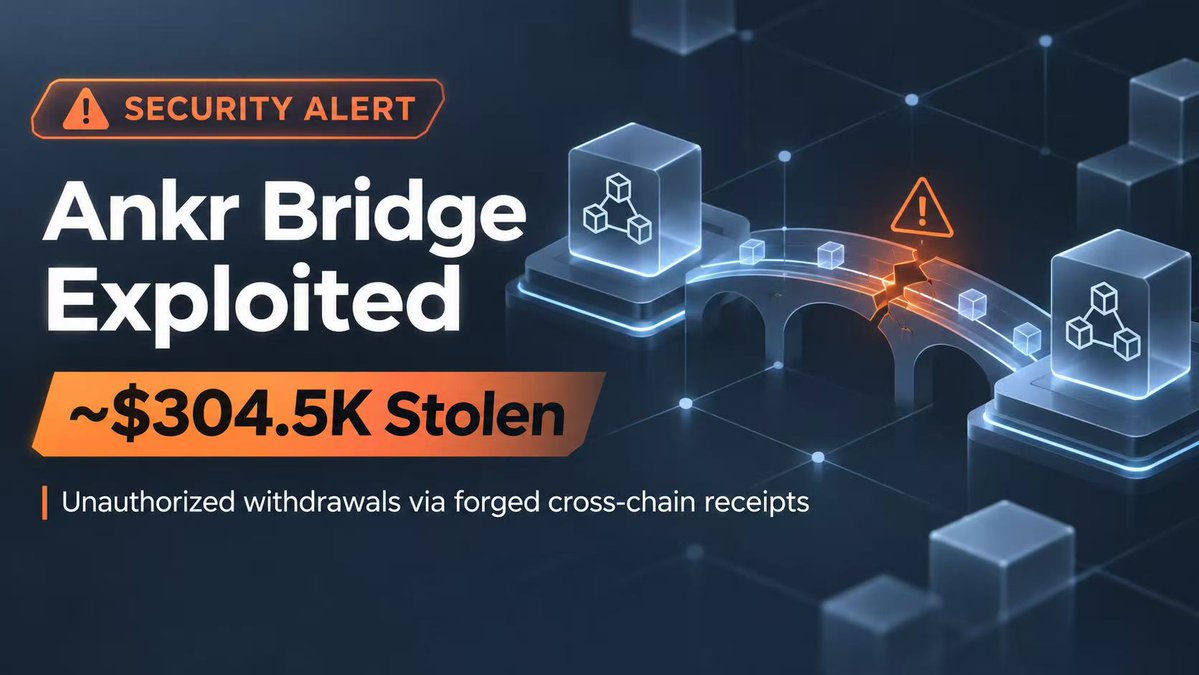
On Nov 9, Ankr’s Ethereum bridge was exploited for 💸 ~$304,500.
An attacker reused a past Optimism deposit to forge 5 withdrawal proofs, calling withdraw() to drain:
🔺 82.91 ankrETH
🔺 515,206 ankrPOL
🔺 ~7.98M ANKR
🔺 5,372 aPOLb
🔺 0.8196 aETHb
【🚨Security Alert】Keplr Social Login Key Leak & Web3Auth Incident
An infrastructure vulnerability at Web3Auth led to private key exposure for certain Keplr embedded wallets created via Google/Apple social logins. On Nov 7, Keplr suspended social login functionality.
💸 Impact: ~44k Cosmos and 7.6k Injective addresses affected.~$6.01M in on-chain asset migration observed. ~1.96M staked ATOM were converted via the Liquid Staking Module (LSM) to bypass the 21-day unbonding period.
🧲 Status: On Nov 8, Web3Auth confirmed that part of the migrated funds belong to white-hat recovery wallets; exact theft amount is still pending.
⛵️ Root Cause: Issue originated in Web3Auth's third-party key management infrastructure, not Keplr smart contracts. Exact exploit vector remains under investigation.
🧰 Action Required: If you use social logins on Keplr, check your account, avoid further deposits, and migrate remaining assets to a new mnemonic or hardware wallet. Seed-phrase and hardware wallets are not affected. Watch out for phishing recovery links.
BitsLab Security Takeaway:
Wallet security extends beyond smart-contract audits. Third-party auth, key management, and signing infrastructure are critical attack surfaces. BitsLab recommends auditing the entire wallet security stack.
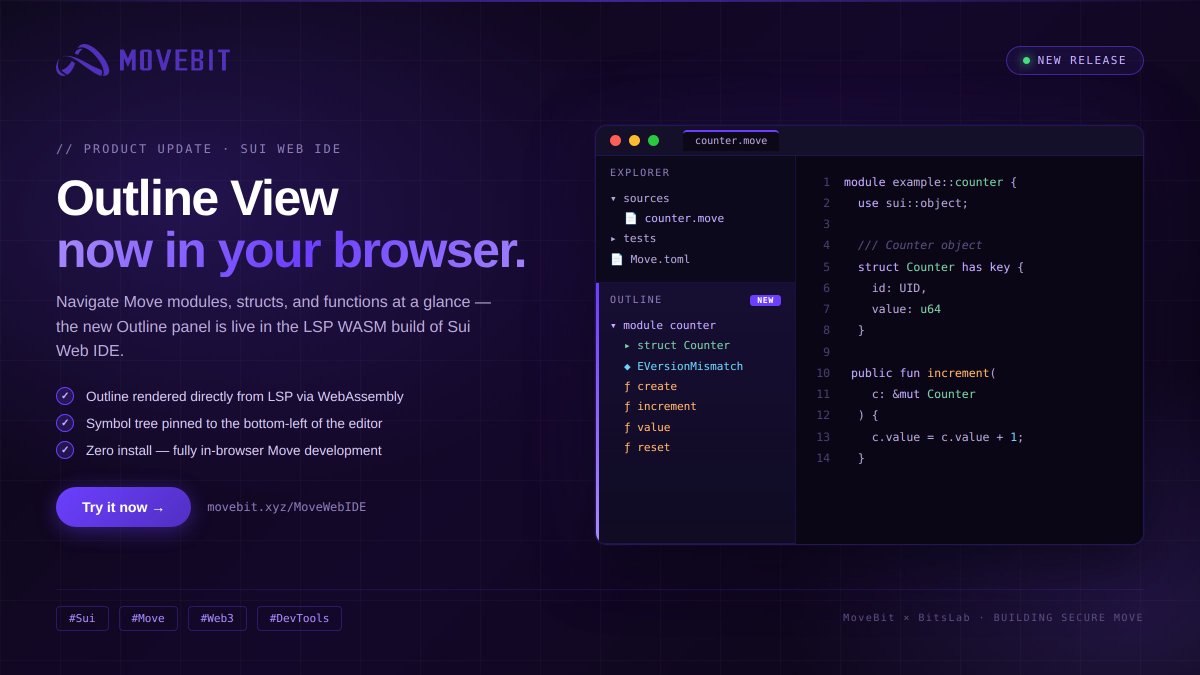
🚀 Move Web IDE — new release
Outline View is now live in the LSP WASM build. Browse Move modules, structs, and functions from a single panel — pinned to the bottom-left of the editor.
No install. No setup. Open and code.
🔗 https://t.co/xfyUkBM77o
#Sui#Move#Web3#DevTools
🚨 BitsLab Research: One forged email is enough to hijack a nanobot agent.
No clicks. No user interaction. No prior access.
We disclosed CVE-2026-33654 — a zero-click Indirect Prompt Injection chained with Authentication Bypass in the Email Channel.
Here's how it works 🧵👇
🚨 INCIDENT REPORT — Verus-Ethereum Bridge
$11.58M drained in a single transaction.
ETH 1,625.37 · tBTC 103.57 · USDC 147,658
Not a signature bug. Not a reentrancy.
It was a data-structure ambiguity that let the attacker walk through proof verification untouched.
BitsLab breakdown 👇
🚨 On-Chain Forensics | Ink Finance @inkfinance@0xPolygon
On May 11, 2026, an attacker drained $165,162 USDT0 from Ink Finance's Treasury — by impersonating a "legitimate" claimer and walking right through claimPayroll(3).
Net profit: ~$140K. Cost to attacker: a flash loan and a fake interface.
Full breakdown 🧵👇
🔬 New from BitsLab Research
Balancer V2 deployed ONE contract to hold every token across every pool.
Looks like a single point of failure. It's actually why:
→ Cross-pool arbitrage moves zero tokens
→ Flash loans tap the entire protocol's liquidity
→ A 2-token swap completes in just ONE SSTORE
We spent weeks dissecting the Vault contract line by line. Part 1 of our 3-part Balancer V2 deep dive is live — covering every gas trick, every safety check, and the trade-off no one talks about (the Aug 2023 Boosted Pool incident wasn't an accident of architecture).
If you're building a DeFi protocol, auditing one, or investing in one — this one's worth 15 minutes.
📖 Read Part 1 ↓
https://t.co/4ZHF2BoLUO
Part 2 (Pool math) and Part 3 (real vulnerability post-mortems) coming next.
It took one character to break it.
`|` — that's all an attacker needs to bypass nanobot's Channel allowlist and slip into the Agent Loop with full access to whatever tools the deployment exposes.
CVE-2026-31977. The first vuln BitsLab found in nanobot. Read on ↓
🎉 We’re excited to share that MoveBit will be presenting today at the Web3 Scholars Conference 2026 in Hong Kong.
https://t.co/rqfGE4mawh
Our presentation:
“Beyond Guesswork: LLM Driven Semantic Distillation to Fuzz and Exploit Smart Contracts”
🏆 Presenting on site today: Ziqiao Kong and Wanxu Xia
Authors:
Ziqiao Kong (Nanyang Technological University)
Wanxu Xia (Beihang University)
Borui Li (Jilin University)
Yi Lu (MoveBit)
Pan Li (BitsLab)
Yang Liu (Nanyang Technological University)
Proud to contribute to smart contract security research at the intersection of LLMs, fuzzing, DeFi semantics, and vulnerability discovery.
See you at #Web3Scholars2026 in Hong Kong.
@DRK_Lab
#MoveBit #BitsLab #SmartContractSecurity #BlockchainSecurity #DeFiSecurity #Web3
🚨 Incident Analysis: Volo Protocol (Sui) Vault Exploit
On 2026-04-21, Volo Protocol on Sui suffered a vault theft resulting in ~$3.27M in direct losses, plus ~$230K in LP share-ratio collapse — combined impact of ~$3.5M.
BitsLab's post-incident analysis below. 👇
$292M vanished in a single transaction.
Not from a complex zero-day. Not from a reentrancy bug.
From one number set wrong in a config file.
Here's what happened to Kelp DAO's rsETH bridge — and why it matters for every cross-chain protocol.