Researchers have directly observed extremely small plasma vortices at the boundaries of granules on the Sun’s visible surface.
The discovery was made using the four-metre Daniel K. Inouye Solar Telescope in Hawaii, whose high spatial resolution allowed scientists to distinguish structures only about 20 kilometres across. These features had remained invisible to previous solar telescopes.
The observations were compared with advanced magnetohydrodynamic simulations, and the close agreement between the real and simulated images supports the interpretation that the structures are produced by Kelvin–Helmholtz instabilities.
The solar photosphere is covered by granules between roughly 500 and 2,000 kilometres wide. They are created by convection: hot plasma rises from the Sun’s interior, cools near the surface and then sinks again. At the edges of these granules, neighbouring layers of plasma can move at different velocities.
This velocity difference creates shear, allowing small disturbances to grow and roll into narrow wave-like structures and vortices. This process is known as the Kelvin–Helmholtz instability and occurs in many fluid and plasma environments, including Earth’s atmosphere, planetary atmospheres and the interaction between the solar wind and planetary magnetic fields. Until now, however, it had not been directly resolved at such small scales on the solar surface.
The discovery is important because the vortices appear to interact strongly with small magnetic structures distributed throughout the photosphere. The simulations indicate that the swirling plasma bends and deforms the boundaries of magnetised regions, twisting the associated magnetic field lines.
This mechanical deformation can transfer kinetic energy from convective plasma motions into magnetic energy. When magnetic fields become sufficiently stressed and unstable, part of that stored energy can later be released through magnetic reconnection, a process involved in many forms of solar activity.
The results therefore identify a possible small-scale mechanism for continually injecting energy into the Sun’s magnetic field. These vortices could contribute to minor releases of energy such as nanoflares and may also form part of the longer chain of processes that eventually produces larger eruptions and solar flares. The observations do not demonstrate that an individual vortex directly triggers a major flare, but they reveal how energy may begin to accumulate at scales far smaller than those normally associated with visible solar eruptions.
The vortices also appear to mix magnetised and weakly magnetised plasma efficiently. This mixing could help magnetic flux move from the photosphere into the higher solar atmosphere more rapidly than existing models predict. Understanding this transport is relevant because the Sun reorganises its large-scale magnetic field over its approximately eleven-year activity cycle, and current models have difficulty explaining how magnetic flux can be dispersed and redistributed quickly enough.
Overall, the study shows that structures only tens of kilometres across may influence the transfer, storage and redistribution of energy throughout the solar atmosphere. By resolving these vortices and reproducing them in physics-based simulations, researchers have identified a previously unseen component of the connection between convection at the solar surface and magnetic activity above it.
Further observations will be required to determine how much energy the vortices supply, how they interact with the overlying atmosphere and how important they are in producing nanoflares, flares and other forms of solar activity.
👉 https://t.co/361oxtmtEJ
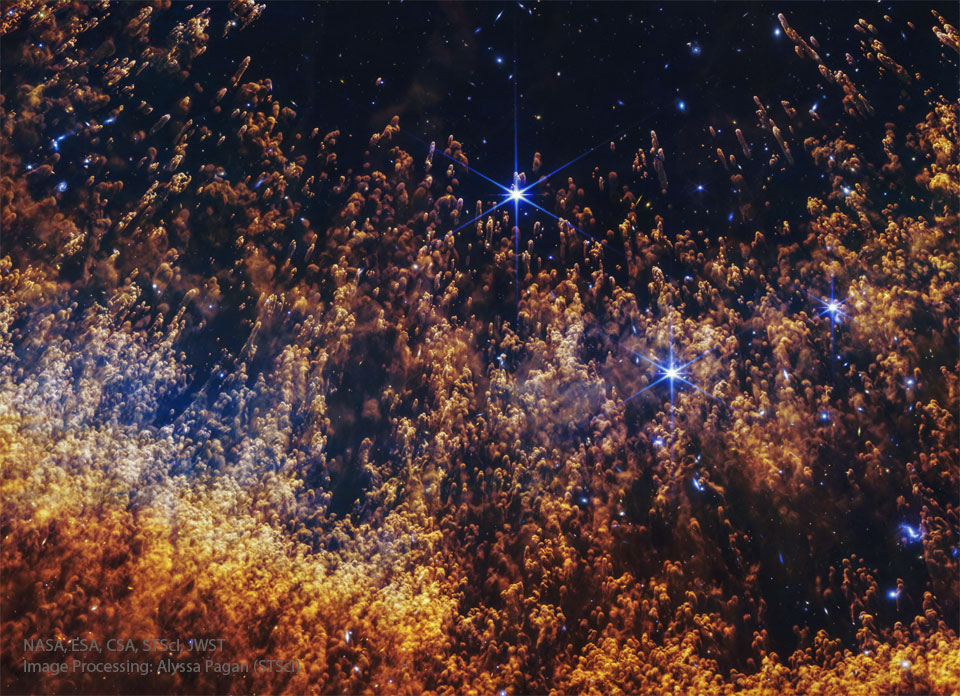
What causes unusual knots of gas and dust in planetary nebulas?
Seen also in the Ring Nebula, the Dumbbell Nebula and NGC 2392, the knots' existence was not initially predicted, and their origins are still not well understood.
Pictured here is a fascinating image of part of the Helix Nebula by the James Webb Space Telescope showing tremendous detail in infrared light.
The cometary knots have masses similar to the Earth but have sizes typically several times the orbit of Pluto.
One hypothesis for the fragmentation and evolution of the knots includes existing gas being driven out by a less dense but highly energetic stellar wind of the central evolving star.
The Helix Nebula is one of the closest examples of a planetary nebula created at the end of the life of a Sun-like star.
Given a technical designation of NGC 7293, the Helix Nebula lies about 650 light-years away towards the constellation of Water Carrier (Aquarius).
Image Credit: NASA, ESA, CSA, STScI, JWST; Processing: A. Pagan (STScI)
Dear Ethiopian Youth,
This summer presents an opportunity that should not be allowed to pass idly. The 5 Million Coders courses are available free, and the certification is internationally recognised.
5 million Ethiopians have already made their decision. Now, it is your turn!
🔗ENROLL NOW: https://t.co/2Oka9P7fde
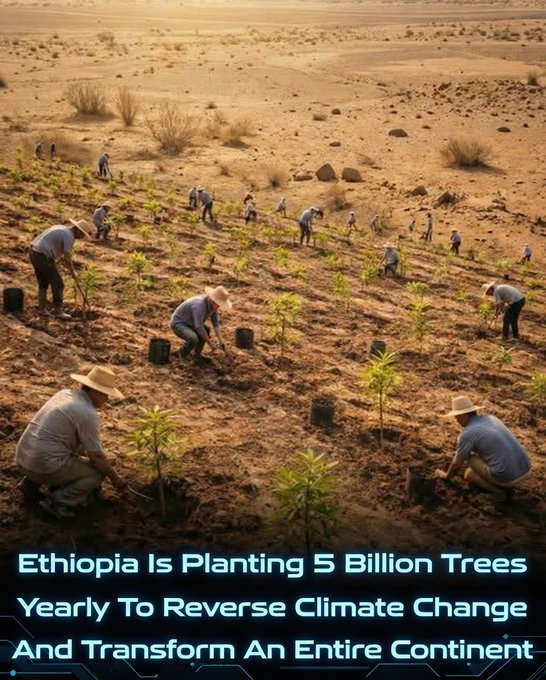
Ethiopia is actively reversing a century of severe deforestation through ambitious large-scale reforestation.
Under the Green Legacy Initiative, launched in 2019 by Prime Minister Abiy Ahmed, the country has mobilized millions of citizens each year to plant billions of seedlings nationwide. Since the program's start, more than 32–40 billion seedlings have been planted (with official sources varying slightly in cumulative figures), countering the dramatic loss of nearly all original forest cover—estimated at over 95–98% decline over recent decades due to agriculture, fuelwood needs, and other pressures.
The initiative has expanded forest and tree cover significantly, while also establishing dedicated funding mechanisms, such as the 2024 Green Legacy and Landscape Restoration Special Fund (allocating 0.5–1% of federal revenue annually). Annual targets remain high: for 2025, the goal was 7.5 billion seedlings, with ongoing efforts building toward even larger cumulative objectives in the coming years.
Beyond ecological restoration, the program drives socioeconomic benefits by creating hundreds of thousands of green jobs—particularly in nurseries, seedling production, and land management—many going to women and youth. It enhances biodiversity, boosts soil health and water retention, strengthens agricultural resilience against drought and climate impacts, and supports long-term food security.
This community-driven, government-backed effort has positioned Ethiopia as a standout example of bold climate action and landscape restoration in Africa and beyond, inspiring similar initiatives while demonstrating how national mobilization can deliver both environmental and human development gains.
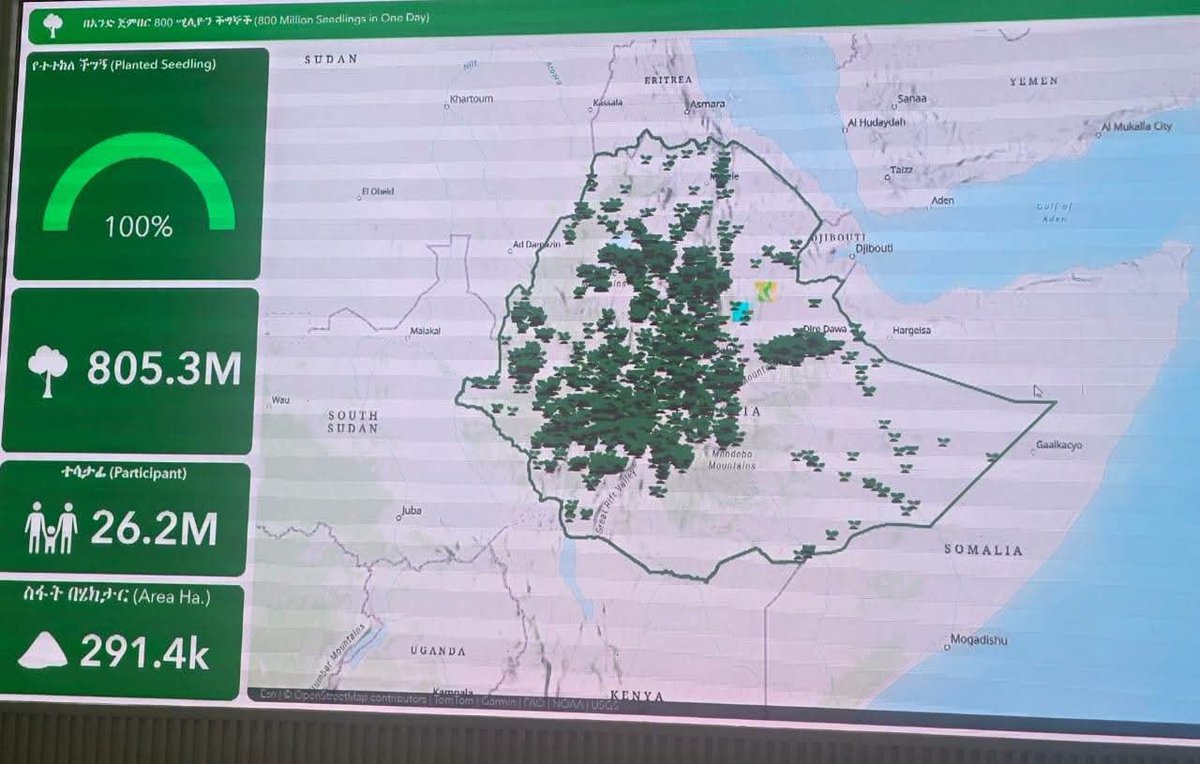
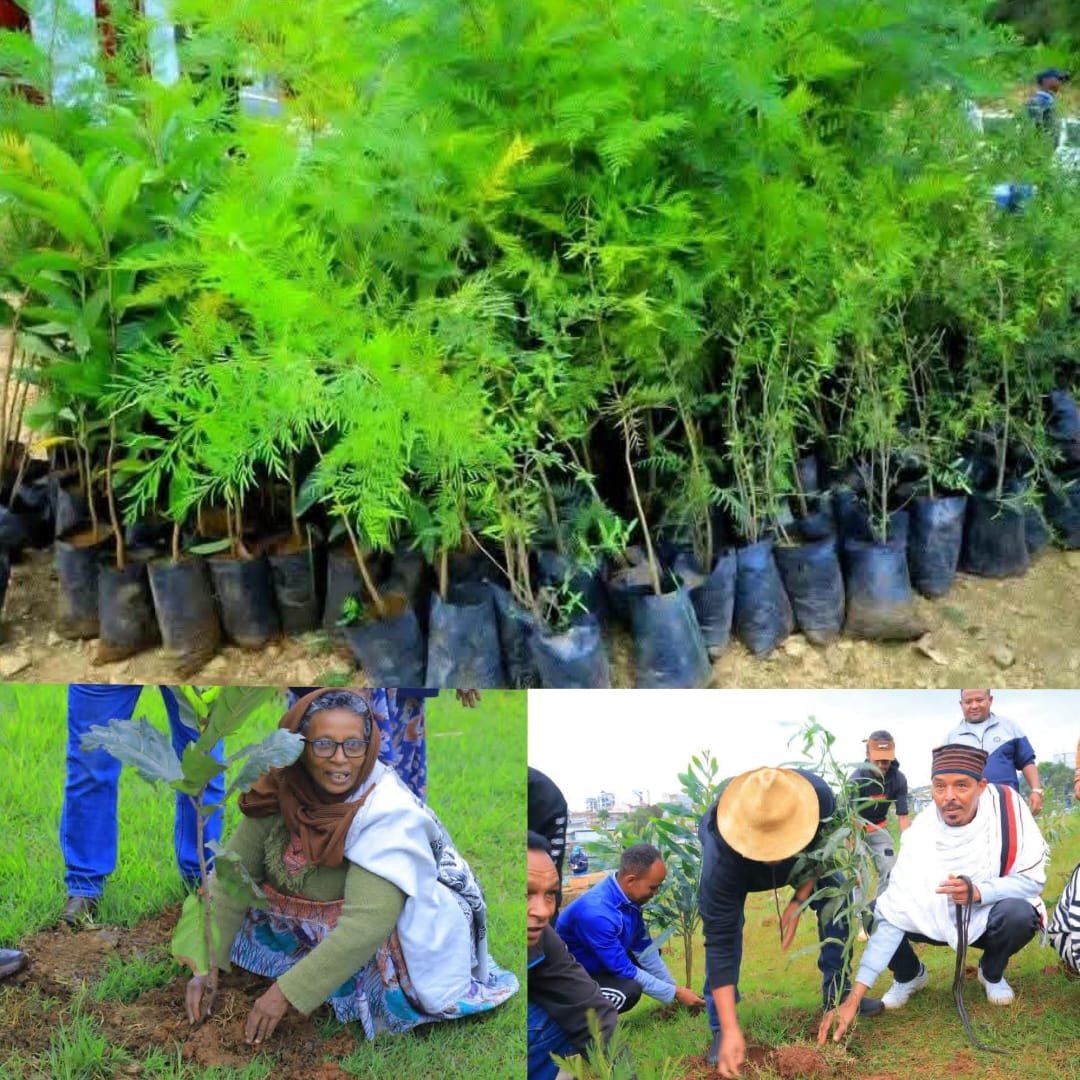
Eight years of consistent action. The Green Legacy Initiative continues to grow stronger, driven by public commitment and the shared belief that, together, Ethiopians can nurture a greener, more sustainable future. Today marks our annual nationwide one-day planting effort which is a moment when Ethiopians from all walks of life come together to create a lasting legacy for generations to come.
Alongside First Lady Zinash Tayachew and the COP32 National Steering Commitee, we have planted our contribution and added our mark to this collective journey. We call on all Ethiopians across the country to continue their efforts throughout the day as we work together to achieve our ambitious target of 800 million seedlings planted.
I declare Divine Alignment over your life. Right now. 🔥
When purpose gets into position — that's a Kairos. A divinely appointed moment. And I believe that moment is now for someone reading this.
Whatever has held you back. Whatever has limited you. Whatever has blocked you and made you want to quit — I declare it is being broken off you in the name of Jesus.
“Where can I go from your Spirit?
Where can I flee from your presence? If I go up to the heavens, you are there; if I make my bed in the depths, you are there.
If I rise on the wings of the dawn, if I settle on the far side of the sea, even there your hand will guide me, your right hand will hold me fast.”
Psalms 139:7-10 🕊️
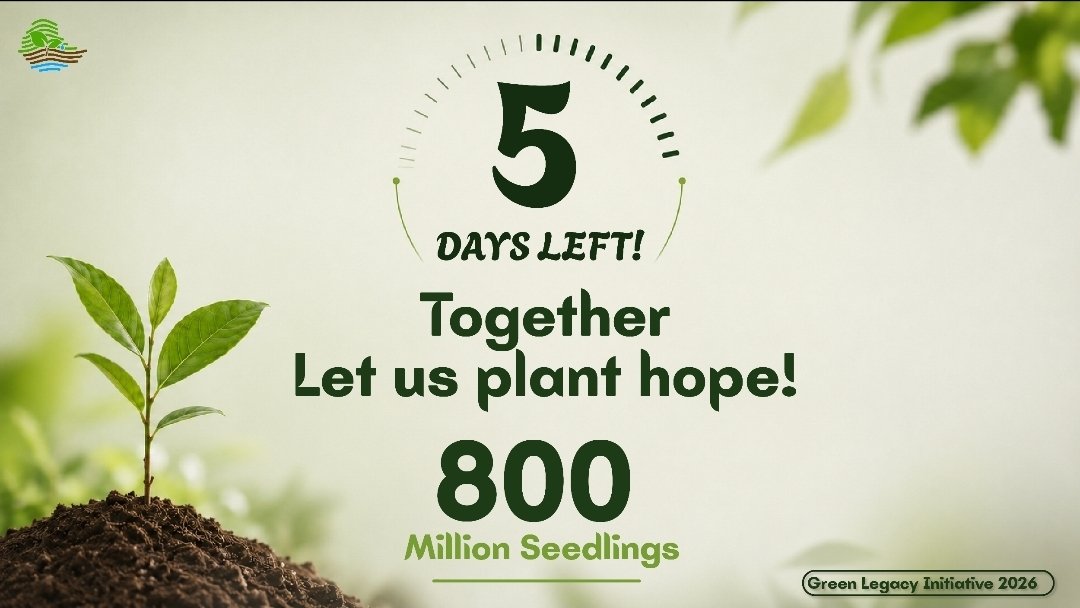
Only 5 days remain to make history through the united arm of all Ethiopians by planting 800 million seedlings in a single day! In these remaining days, I call upon my beloved fellow citizens to make the necessary preparations, rise with determination, and ensure the victory we will achieve in our unity.
Together, let us plant hope!
#GreenLegacy
JWST’s discovery of Little Red Dots has created an unexpected problem in early-Universe astronomy.
These objects are extremely compact and luminous, appear mainly during the first one and a half billion years of cosmic history, and show an unusual spectral shape: relatively blue emission in the rest-frame ultraviolet combined with a steep rise toward redder optical wavelengths. This produces the characteristic V-shaped spectrum from which much of their name and classification derives. The most common interpretation is that they contain rapidly growing supermassive black holes hidden inside dense gas, but their weak X-ray emission, unusual continua and apparently high abundance have made it difficult to construct a single model that explains every observation.
A new study proposes a very different possibility: some Little Red Dots may be globular clusters observed during the earliest and most violent stage of their formation. Globular clusters are dense, gravitationally bound systems containing hundreds of thousands or even millions of old stars. The Milky Way has roughly 150 known examples, but we normally observe them after more than ten billion years of evolution, when their original gas has disappeared, their most massive stars are long dead and dynamical interactions have substantially altered their structure. This makes their formation conditions extremely difficult to reconstruct. The proposed connection would therefore use the distant Little Red Dots as possible snapshots of globular clusters being assembled in real time.
In this model, the ultraviolet component of a Little Red Dot would be produced by an extremely young, compact stellar population. Its red optical emission would come primarily from a short-lived supermassive star at the centre of the cluster, with a mass exceeding about ten thousand solar masses and potentially reaching much higher values. Such an object would not form through ordinary stellar evolution. Instead, it could emerge through runaway collisions in an exceptionally dense young cluster. Massive stars would repeatedly interact and merge until they produced a single central object far more massive than any normal star.
The combination of the young cluster and its central supermassive star can reproduce the broad V-shaped spectral profile observed in Little Red Dots. The hot young stars dominate the ultraviolet light, while the cooler but extraordinarily luminous supermassive star dominates the optical continuum. The comparison is notable because the supermassive-star atmosphere models used by the researchers were developed independently rather than specifically adjusted to fit Little Red Dot observations. The same general scenario is also compatible with their limited mid-infrared and X-ray emission, since a relatively cool supermassive star would produce little hard radiation compared with an actively accreting black hole.
However, the fit isn’t complete. The observed Little Red Dots are generally hotter and more luminous than the available hydrostatic models of supermassive stars predict. The researchers suggest that this discrepancy might be explained by dense, optically thick stellar winds. Radiation from a supermassive star close to or above its Eddington limit could drive an enormous outflow that absorbs and reprocesses the original emission. The radiation we detect would then emerge from the extended wind rather than directly from the stellar surface. Current models don’t yet describe these extreme winds in sufficient detail, so this remains one of the central theoretical uncertainties.
The hypothesis also offers a possible explanation for one of the oldest puzzles associated with globular clusters: their unusual chemical composition. Although the stars within an individual cluster formed at approximately the same period, they don’t always share the simple chemical pattern expected from a single generation of stars. Many clusters contain populations enriched in helium, nitrogen, sodium and aluminium, while being relatively depleted in carbon, oxygen and magnesium. These abundance patterns require hydrogen burning at temperatures higher than those reached in the cores of ordinary massive stars.
A central supermassive star could provide the required environment. During its short life, it would process large quantities of material through extremely hot nuclear reactions. Powerful winds or mass-loss episodes could then return this altered gas to the surrounding cluster. New stars forming from a mixture of this material and the original gas would inherit the helium enhancement and the characteristic sodium-oxygen, aluminium-magnesium and nitrogen-carbon anti-correlations observed in many old globular clusters today. The supermassive star would therefore serve both as the source of the Little Red Dot’s red optical light and as the chemical polluter responsible for the cluster’s multiple stellar populations.
The numerical properties of the two populations also show an intriguing correspondence. The researchers converted the observed ultraviolet luminosity distribution of Little Red Dots into an estimated initial cluster-mass distribution and then modelled how those clusters would lose mass over billions of years through stellar evolution and dynamical processes. The evolved distribution develops a peak near a few hundred thousand solar masses and declines toward both lower and higher masses, broadly resembling the mass distribution of present-day globular clusters in the Milky Way and the Virgo Cluster.
Their estimated total number density is also of a similar order. After accounting for the short time during which a forming cluster would appear as a Little Red Dot, the authors estimate that the accumulated population could produce approximately 0.3 surviving objects per cubic megaparsec in the present Universe. This is reasonably close, within the considerable uncertainties, to independent estimates for the local density of globular clusters. The comparison doesn’t prove that the populations are directly related, but it shows that the proposal doesn’t obviously produce too many or too few descendants.
Their timing provides another clue. Little Red Dots are most common at redshifts around five to seven, corresponding to the period when the oldest, metal-poor globular clusters are believed to have formed. The model therefore appears more naturally connected to metal-poor clusters than to the younger and more metal-rich clusters commonly associated with galactic bulges. The absence of an obvious lower-redshift Little Red Dot population corresponding to metal-rich clusters could mean that such objects are difficult to detect inside bright, crowded galaxies. Alternatively, high metallicity or lower stellar density might prevent the runaway collisions needed to create a supermassive star, allowing clusters to form without passing through a recognisable Little Red Dot phase.
The hypothesis makes several observational predictions. Detailed spectroscopy should reveal unusually high helium and nitrogen abundances in at least some Little Red Dots, together with evidence for the same elemental anti-correlations seen in globular clusters. Tentative indications of strong helium, nitrogen and aluminium already exist, but the samples are small and the available spectra often lack the resolution required to separate the relevant lines. More sensitive JWST observations could determine whether these chemical signatures are systematic or merely coincidental.
The fate of the central supermassive star is another important test. It would probably collapse into a black hole, potentially leaving an intermediate-mass black hole inside the surviving globular cluster. Yet most nearby globular clusters don’t show secure evidence for sufficiently massive central black holes. The supermassive star would therefore need to lose a substantial fraction of its mass through winds before collapsing, or the remnant black hole would later have to be ejected, disrupted or otherwise reduced. Better models of supermassive-star winds and stronger observational constraints on black holes in local clusters will be necessary to determine whether this aspect of the scenario is physically consistent.
The study doesn’t claim that every Little Red Dot is a forming globular cluster, or that accreting black holes can be excluded. The observed population may contain several physically different types of object that appear similar because of their compactness and spectral colours. Some could be active galactic nuclei, others could involve black holes embedded inside dense stellar envelopes, and a subset could represent the cluster-formation phase proposed here.
In my view, the main strength of the idea isn’t that it already solves the Little Red Dot mystery, but that it connects several otherwise independent observations within a single testable framework. It links their spectra, abundance, redshift distribution and inferred masses to known properties of ancient globular clusters, while predicting specific chemical signatures and possible black-hole remnants. Its principal weakness is the dependence on poorly understood supermassive stars and optically thick winds that haven’t yet been modelled under the required conditions. For now, it remains a plausible and productive hypothesis rather than an established identification. If future spectroscopy confirms the predicted chemical patterns, Little Red Dots could provide the first direct view of how some of the Universe’s oldest surviving stellar systems were born.
👉 https://t.co/yfLn5Bvmvt
@ExploreCosmos_ Insanely intriguing, LRDs are hair scratchers, Crimson, always points to the Infinitely Precious, Living Holy & Eternal🩸of Jesus which was shed 4 the sin of a dying 🌎 ∴ LRDs are Harbingers of The Eternal Gospel of Jesus urging us to repent renounce our sin & believe in Jesus,