Another angle of the robot crashing straight into the wall, sparks flying everywhere.
To be honest, I think China’s robotics industry may be over-optimizing for speed right now.
Last year, running and dynamic motion control were meaningful because they proved a basic point: before a humanoid can do useful work, it first needs a capable body.
But once that foundation exists, simply making the robot run faster gives you diminishing returns.
If we put cognition on one axis and physical capability on the other, this year’s competition feels heavily skewed toward the physical side. Faster running, more aggressive motion, harder impacts, while some very basic capabilities are still missing.
Knowing when to slow down, when to stop, and how to stop safely matters just as much as how fast you can run. That kind of judgment is also part of what makes a robot actually intelligent.
A robot that can sprint incredibly fast but has no idea when to brake feels like a student who aced one subject and ignored the rest.
At the end of the day, our goal is to have a robot that can safely and reliably work around people and actually get things done.
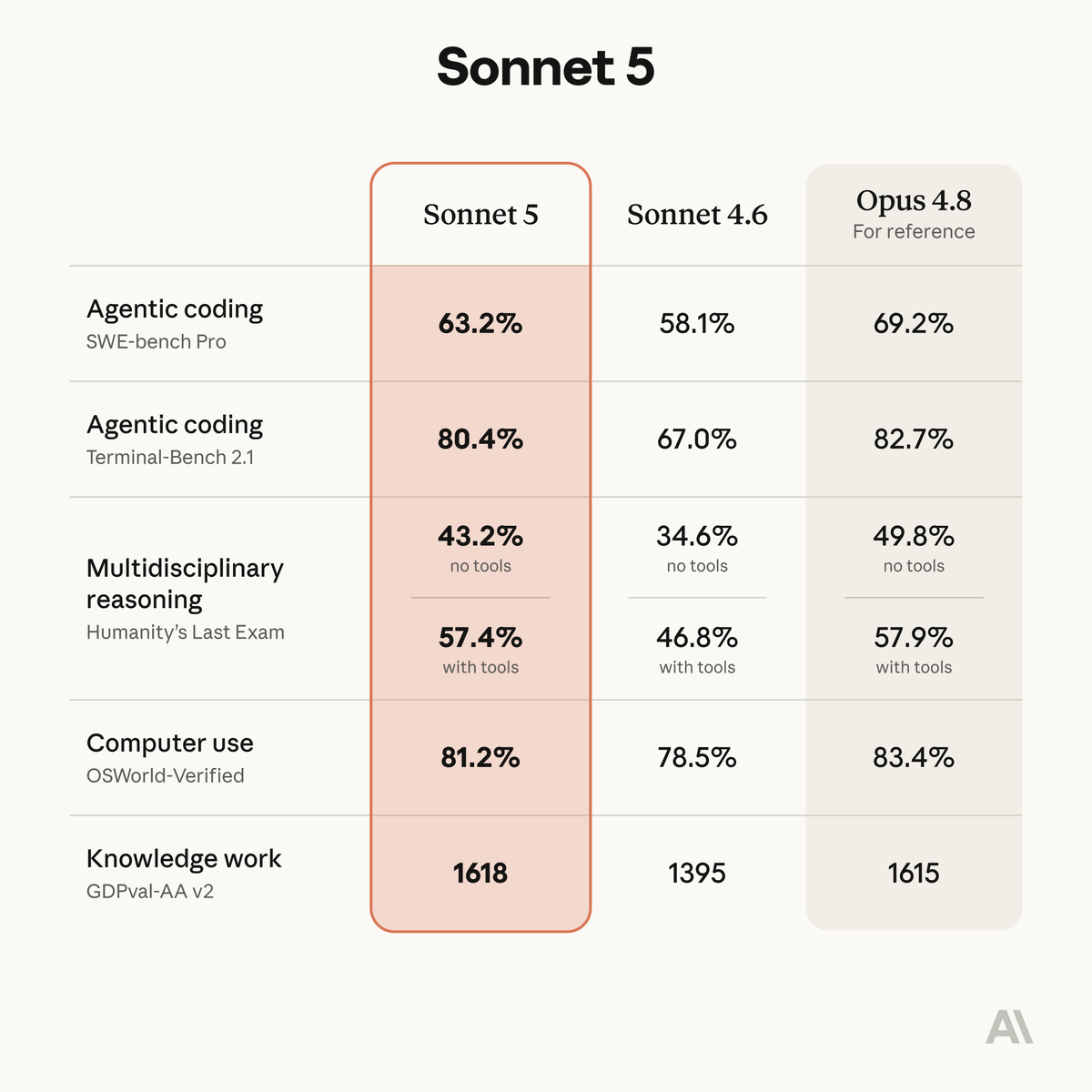
Sonnet 5 is a substantial improvement over Sonnet 4.6 on reasoning, tool use, coding, and knowledge work.
Its performance is close to Opus 4.8, at lower prices.
🚨 New Claude Sonnet 5 leak just surfaced
Anthropic appears to be prepping the next Sonnet model:
· Internal codename from earlier leaks: Fennec
· Expected as early as next week
· Expect strong coding performance, speed, and better price/performance than Opus/Fable
· 1M token context window
Are you looking forward to this model being released?
Watch a team of humanoid robots running a full 8-hr shift at human performance levels. This is fully autonomous running Helix-02 https://t.co/bIgpYuaYCj
HTML is the new markdown.
I've stopped writing markdown files for almost everything and switched to using Claude Code to generate HTML for me. This is why.