The problem is that tokens can’t be shareholders. The computers are the property of the individuals running the protocols, not the token holders. So token holders can’t enforce anything. Even if 100% of the token holders vote to do X, the people running the protocol can update their software to do the opposite of X.
This is a critical feature of decentralization.
Strategy founder Michael Saylor thinks Bitcoin will grind its way to $150,000 this year, despite the dip from its recent all-time high. https://t.co/mfbZ2KkoIi
what cobie said today hit hard.
“nearly everyone else I know from 2013 lost everything, or sold in 2017 and never came back.”
i’m from the class of 2016 and its the same story.
we were a small group chasing this thing. school friends, work colleagues… one by one, they left. i’m the only one still here.
crazy to think how it all turned out.
3 life lessons this year:
do work that inspires u, or u'll burn out fast
buy quality assets at fair prices and hold them for 10 years
ur loved ones can be gone in the blink of an eye - spend time with them today
i do think what happened yesterday will have profound implications on the future of the economic relationship among token holders, traders, and vault depositors
at hyperliquid tge, traders and token holders were basically the same group of people. in fact, not just the same - their ownership was even scaled based on volume and usage. that was almost perfect alignment. over time, this inevitably diverged - now you’ve got people who don’t trade at all but own $HYPE, and others who trade in huge size but own zero $HYPE
fundamentally, that’s why some traders were left with a sour taste when they saw $HYPE holders celebrating the largest buyback day and the biggest HLP vault win yesterday
had this happened before tge, alignment would’ve been easier - you’d just drop certain traders some points. post-tge, it’s much tougher, especially when the protocol doesn’t have a cash reserve (or an insurance fund)
personally, i think this likely triggers a rethink of the incentive model and possibly marks the end of the ~100% buyback era. the pendulum has likely swung too far to one side - risking the equilibrium
lighter’s approach here feels more balanced and likely more trader-friendly. LLP took the hit, and traders were protected by it
longer term though, for lighter, this does raise two questions:
- if LLP becomes a quasi-insurance fund, should there be a cap on network OI relative to LLP?
- how does it incentivize LLP to compensate for the higher risk so it stays competitive?
I think this is likely where revenue and incentive structure come in. instead of using 100% of revenue for buybacks (ie incentivizing ONLY token holders), it could perhaps be split among:
- an insurance fund to backstop system-level risks
- some incentives for the vault to compensate for higher risk while keeping a more trader-friendly risk mechanism
- cover development costs
- and finally, excess capital going back to token holders
no one knows where the future of perp dexes and the incentive model will be, but thanks to all the builders - we’ve come a long way vs a few years ago. the exciting part is, being a derivative product, it can scale to almost any asset in the world - the upside is huge for our industry if defi gets it right. i’m hopeful we get there one day. let’s all keep building!
as with the dotcom era, the biggest fortunes will be made *after* the current bubble pops, when everyone calls ai is a scam, right before a decade of real productivity gains begins.
@BTCBreadMan Bitcoin will die if it does not move on-chain. Block reward alone will not be enough to attract miners and after 2140 no more block reward.
public market - its far better to buy a wonderful company at a fair price than a fair company at a wonderful price
private market - its far better to invest in a wonderful founder with a fair idea than a fair founder with a wonderful idea
2 philosophies ive seen play out empirically again n again and have fully internalized this past year
South Korea stats are wild.
- 2nd most paid chatgpt subs behind only the US
- More Korean Won traded against crypto than USD
- # 1 YouTube video of all time, # 1 boyband, # 1 rated movie, # 1 most viral soundtrack, # 1 show on Netflix
From @storysylee opening presentation.
It would be great for crypto project to know which one is controlling which. Regulatory framework clarification is coming in many countries, US must follow.
Imo, bitcoin adoption has negligible meaning as people can not do much with Bitcoin rather than investment. On-chain Adoption is a much better metric to watch in the coming year.
To all those reply guys saying Wall Street want security. Perhaps learn about the technology first.
The Nakamoto Coefficient measures the decentralization of a blockchain network by calculating the minimum number of entities (e.g., nodes, miners, validators, or stakeholders) that collectively control more than 50% of the network's critical resources, such as hash power, stake, or tokens. A higher coefficient indicates greater decentralization, as it takes more entities to reach the 51% threshold needed to potentially compromise the network (e.g., via a 51% attack). It was introduced by Balaji Srinivasan to quantify a blockchain's resilience against centralization risks.
Ethereum is a 2. Solana is a 21.
Try again. You have been gaslit.
Fed will hold a conference next month, with a focus on DeFi, stablecoins, and tokenization.
July's FOMC minutes said stablecoins "could increase the demand for the assets needed to back them, including Treasury securities."
https://t.co/aDnwN6pCtV
🎥 WATCH: @Chainlink co-founder @SergeyNazarov gives his prediction for the future of crypto:
“Our industry is gonna boom through the merging of DeFi and TradFi… we’re gonna be looking at tens of trillions of dollars in market cap. The majority of that will be real-world assets like stablecoins, tokenized funds, equities, and commodities.”
Do you agree with his take? 👇
🚀 Launching the On-chain Adoption Track 2025!
🇻🇳 Vietnam is on the edge of mass blockchain adoption — and the key lies in bringing enterprises on-chain.
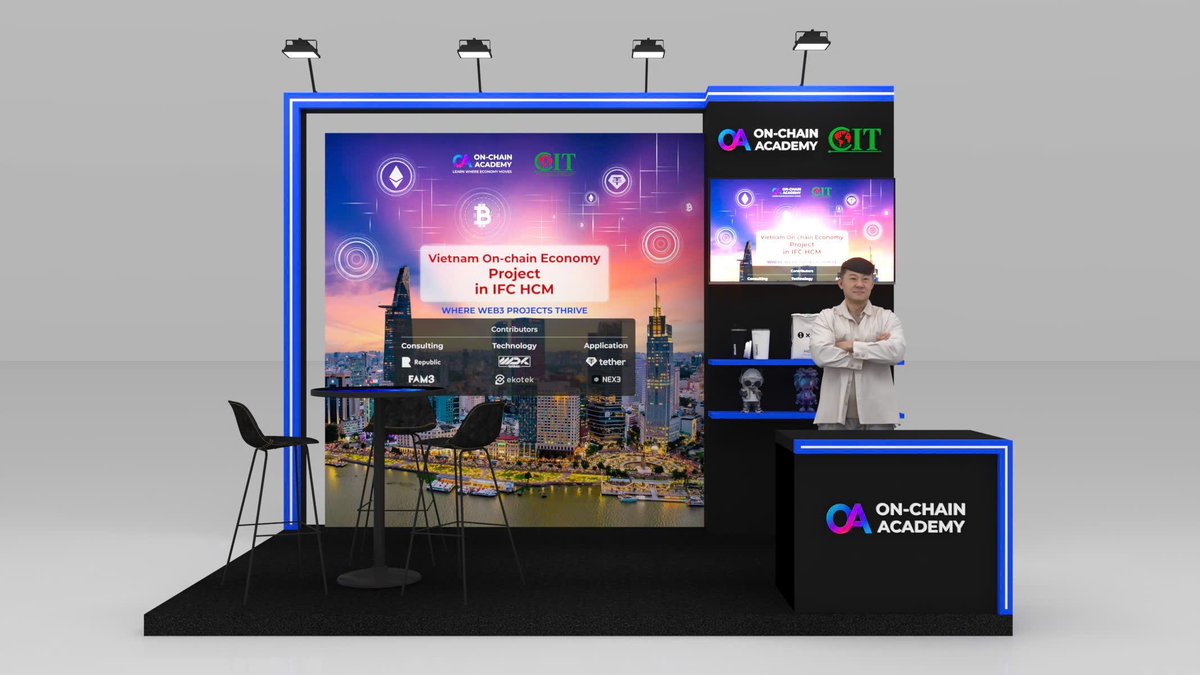
🔥 On-chain Academy is heading to #GMVietnam!
Meet us at our booth to explore the Vietnam On-chain Economy Master Plan (2025–2030) — a bold vision to drive tokenized assets, RWA adoption & IFC development 🇻🇳
Let’s co-build Vietnam’s On-chain future 💥
📍 Hanoi | 🗓 1 -2 Aug 2025