Most efficient (cost/output/speed) agent loop workflow right now:
- Use @cursor_ai Ultra Plan
- Workflow: Plan with Grok 4.5 high fast => Execute with Composer 2.5 fast => Review with Grok 4.5 high fast => Correct with Composer 2.5 fast => Rinse, repeat => Collect learnings on the way => Own this loop, optimize the next!
Made a Cursor plugin for this: https://t.co/QN4YOxZDT1
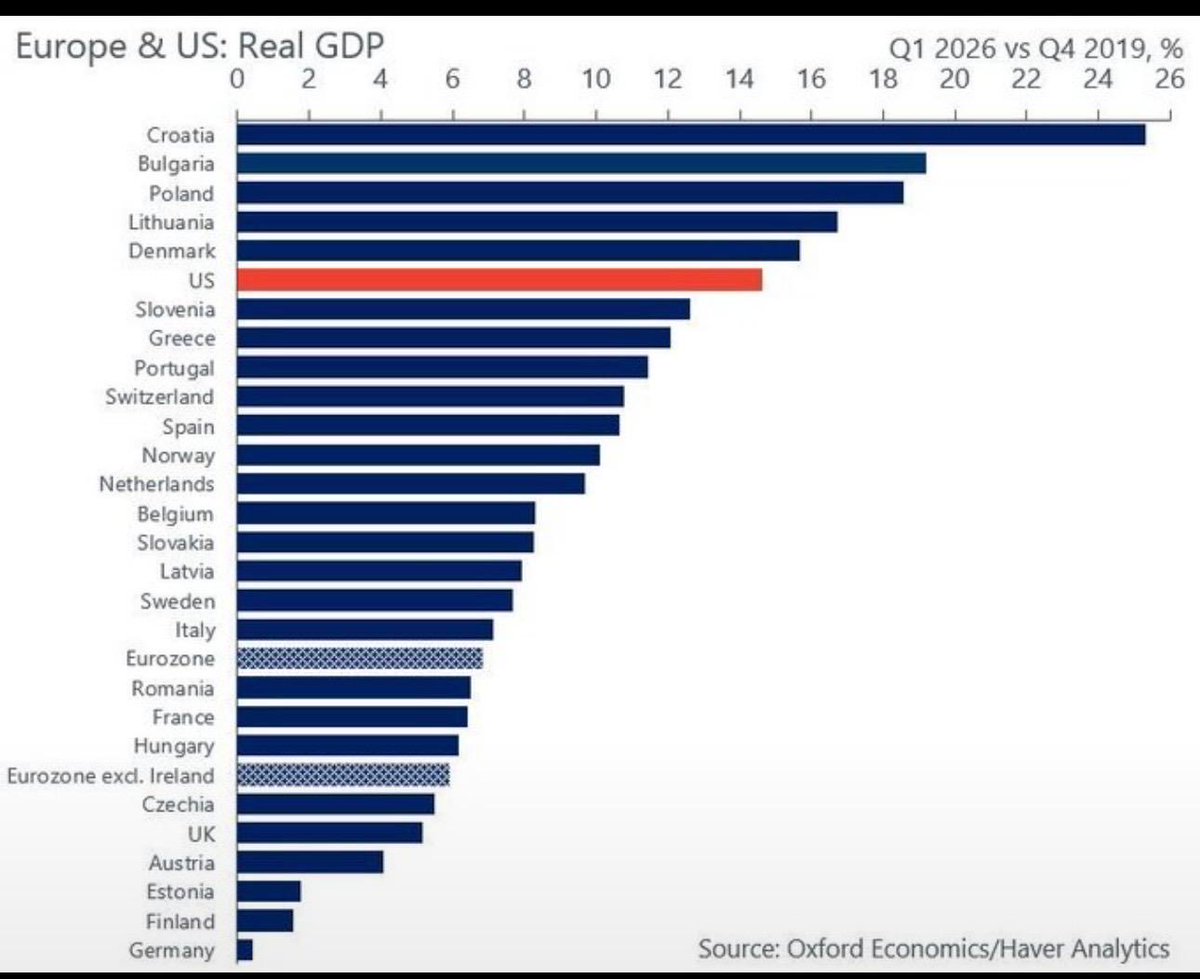
Deutschland in der Wachstumskrise
Was wir jetzt bräuchten:
✅ Die größte Einkommensteuerreform seit 1949
✅ Einen 40-Prozent-Deckel für Sozialabgaben
✅ Super-Abschreibungen von 150 Prozent, um attraktiv für Unternehmen zu werden
✅ Stromsteuer senken
✅ Bürokratie mindestens 20 Jahre zurückdrehen
✅ Einen politisch unabhängigen Staatsfonds
✅ Neue Schulden ausschließlich für Investitionen in Schienen, Stromnetze, Schulen, Digitalisierung und Forschung
✅ Massive Förderung von Unternehmertum und Aktionärskultur
Was wir bekommen:
❌ Schnitzelrabatt mit 7% Mehrwertsteuer auf Speisen in der Gastronomie
❌ Einen ewig dauernden Rentenstreit
❌ “Entlastungen”, die den Namen nicht verdienen (und selbst an dieser Stelle bremst Klingbeil nun nochmal)
❌ Immer neue Steuern und Belastungen (nun sollen Freibeträge für Vereine gekürzt werden)
“Our species is the only creative species, and it has only one creative instrument, the individual mind and spirit of a man. Nothing was ever created by two men. There are no good collaborations, whether in music, in art, in poetry, in mathematics, in philosophy.
Once the miracle of creation has taken place, the group can build and extend it, but the group never invents anything. The preciousness lies in the lonely mind of a man.”
—John Steinbeck, East of Eden
Build a plugin once and use it across compatible agent clients.
Introducing Agent Plugins, an open standard developed with @awsdevelopers, @cursor_ai, @github, @code, and @vercel that packages Agent Skills and supports MCP server configurations in a shared format.
When using agents, ensure that everything that can be deterministic, is done with a deterministic tool. Don't try to get the poor agents to follow a deterministic process.
Alright. I want you to read this.
Earlier today, I released a new component.
What you see is the finished result.
What you don’t see are the days of planning, research, testing, designing, simplifying, throwing ideas away, and trying again before I felt it was ready.
Within hours, it had been copied and ported to another framework by pointing an agent at my code.
Of course, it’s open source. They were allowed to do it.
And I’ve been around long enough, with multiple successful products, that I don’t care.
But what if this was someone’s first product?
What if they spent months building it, launched on Friday, and by Monday it had been cloned by agents, repackaged, and made free?
What happens when your second product is copied?
Your fifth?
Your tenth?
What happens when every new idea immediately becomes the next prompt?
What happens when your roadmap, your changelog, and your launch announcements become someone else input prompts?
What happens when models become good enough to copy bigger ideas?
What happens when “just execute better” stops being the answer?
What happens when “just build bigger” or “think wider” stops being enough?
What happens when both ideas and execution become cheap?
What happens when the creator pays the full cost of creativity but everyone else pays nothing to reproduce it?
What happens to creativity when AI makes copying effectively free?
What happens to the will to create when AI makes copying effectively free?
Look, copying is not new.
Copying at this speed, cost, and scale is.
People will tell you to think bigger.
But nobody starts "bigger".
Every one of us here started by making something small.
You keep going because, somewhere along the way, the work is rewarded.
Maybe people use it.
Maybe they pay for it.
Maybe they simply recognize the thought, effort, and care that went into it.
Copying once demanded effort.
You had to study the work and understand it to copy it.
That effort created appreciation for the person who made it.
Not anymore.
Creativity begins with small steps.
If we make those first steps feel pointless, we don’t just lose small products.
We lose the people who might have gone on to build the big ones.
We are uniquely positioned here.
We get to use and experience this life-changing technology before almost everyone else.
How we use it will set the default everywhere else.
That default will spread to writing, design, music, research, and every other field where someone still has to take the first creative risk.
We can use AI to build great things.
Or we can use it to strip every new idea for parts.
We decide.
Software quality now depends on the constraints you set around your agents.
When humans manually wrote most of the code we could look at the code itself for signs of quality. Is it clean? Is it thoughtful? Is it fast? Can another engineer understand it? Does it have tests?
Agents can now generate more code than people can read. When code generation scales beyond review, quality - checks for one or more of correctness, maintainability, security, performance etc - increasingly has to live somewhere else.
It moves into the harness, environment and operating system around the agent.
This can be the tests and deterministic checks that decide what the system is allowed to do (amongst others). Your constraints are what may eventually enable loops of agents to deliver production software reliably. They can include unit tests, property tests, acceptance tests, mutation testing and quality metrics.
This back-pressure lets the system resist bad work before it becomes somebody elses problem.
Set your constraints. They decide whether the code your agents generate is good enough to ship.
An internal version of our next major model produced 10 new results on long-standing open problems in mathematics and theoretical computer science, using roughly $2,000 worth of tokens at GPT-5.6 Sol API rates.
An internal version of Astra, @OpenAI’s next major model family, solved 10 major open problems in mathematics, quantum complexity, and theoretical computer science.
We believe it will be a major step for scientific reasoning. https://t.co/iP6cyheZ7i
you now have the ability to
- play with every possible solution to a problem
- refactor everything when you think of better patterns
so many people complaining about the code the LLMs produce, if you're not producing the best software of your life right now something is wrong
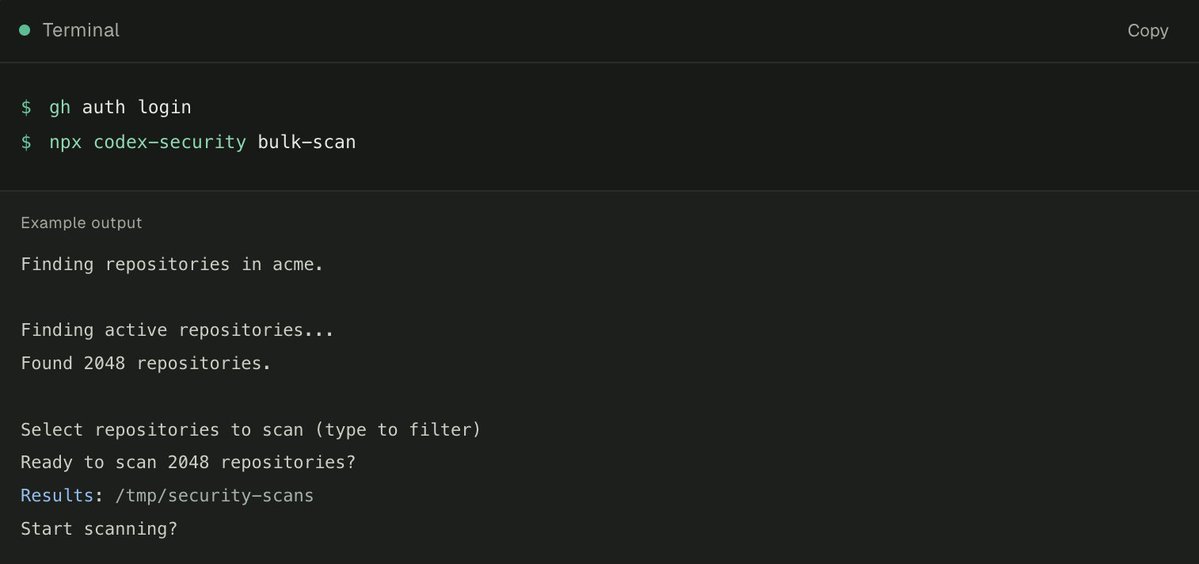
We quietly released the open-source Codex Security CLI, but Hacker News found it before we had a chance to share it here...
You can now use it to scan repositories, track findings across runs, verify fixes, and add security checks to CI/CD.
This is an early release, and we're listening to your feedback as we continue improving it.
@HedgieMarkets I’ve asked the SpaceXAI team to preserve any rare books in a library and scan them the hard way vs just cutting off the spine and scanning
AI security advances when the industry builds in the open, together.
We're introducing the Open Secure AI Alliance with industry leaders to develop new techniques and tools to safeguard software and agents.
By sharing models, tooling and research in the open, we can broaden the community of defenders.
Learn more about the founding members’ contributions: https://t.co/A16oqxs5Ty
For my first post, I’m sharing a letter @NVIDIA signed on why open models matter.
AI will transform every industry, power every company, and be built by every country.
Open models strengthen safety and cybersecurity, accelerate innovation and diffusion, and enable sovereignty.
The world needs both frontier closed models and frontier open models.
https://t.co/AUKzoQ5Ikb