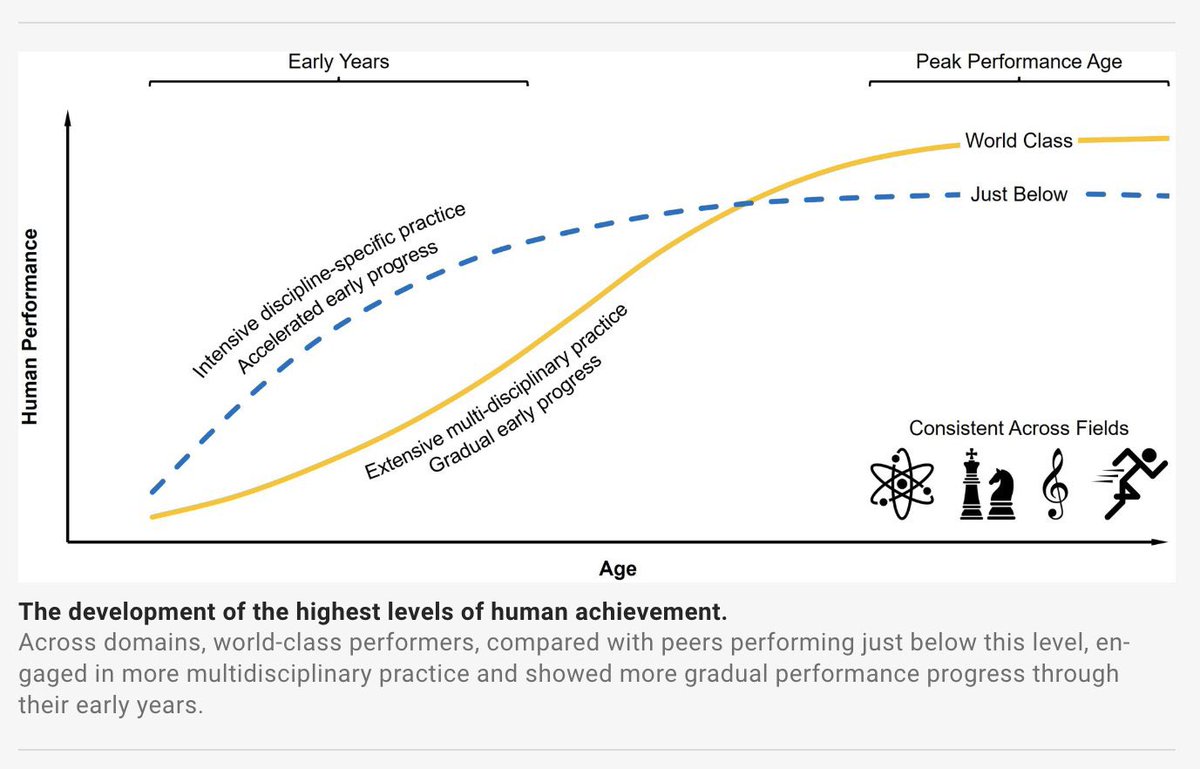
Fascinating paper just published in Science.
The authors analyze the career trajectories of top performers across multiple domains, including Nobel laureates, elite chess players, Olympic gold medalists, and more.
Their central finding challenges a common belief.
Intensive, single-discipline training at a young age does confer an early advantage, but this advantage fades over time.
By contrast, individuals exposed to multidisciplinary practice early in life tend to start more slowly. Yet, over the long run, they are more likely to reach world-class performance, eventually overtaking early specialists, who often plateau just below the very top.
An important reminder that breadth early on can be a powerful investment in long-term excellence.
Link to the paper in the first reply.
This paper from Harvard and MIT quietly answers the most important AI question nobody benchmarks properly:
Can LLMs actually discover science, or are they just good at talking about it?
The paper is called “Evaluating Large Language Models in Scientific Discovery”, and instead of asking models trivia questions, it tests something much harder:
Can models form hypotheses, design experiments, interpret results, and update beliefs like real scientists?
Here’s what the authors did differently 👇
• They evaluate LLMs across the full discovery loop hypothesis → experiment → observation → revision
• Tasks span biology, chemistry, and physics, not toy puzzles
• Models must work with incomplete data, noisy results, and false leads
• Success is measured by scientific progress, not fluency or confidence
What they found is sobering.
LLMs are decent at suggesting hypotheses, but brittle at everything that follows.
✓ They overfit to surface patterns
✓ They struggle to abandon bad hypotheses even when evidence contradicts them
✓ They confuse correlation for causation
✓ They hallucinate explanations when experiments fail
✓ They optimize for plausibility, not truth
Most striking result:
`High benchmark scores do not correlate with scientific discovery ability.`
Some top models that dominate standard reasoning tests completely fail when forced to run iterative experiments and update theories.
Why this matters:
Real science is not one-shot reasoning.
It’s feedback, failure, revision, and restraint.
LLMs today:
• Talk like scientists
• Write like scientists
• But don’t think like scientists yet
The paper’s core takeaway:
Scientific intelligence is not language intelligence.
It requires memory, hypothesis tracking, causal reasoning, and the ability to say “I was wrong.”
Until models can reliably do that, claims about “AI scientists” are mostly premature.
This paper doesn’t hype AI. It defines the gap we still need to close.
And that’s exactly why it’s important.
"Existe un culto a la ignorancia. La presión del anti-intelectualismo ha ido abriéndose paso a través de nuestra vida política y cultural, alimentando la falsa noción de que la democracia significa que mi ignorancia es tan válida como tu conocimiento."
Isaac Asimov.
Last quarter I rolled out Microsoft Copilot to 4,000 employees.
$30 per seat per month.
$1.4 million annually.
I called it "digital transformation."
The board loved that phrase.
They approved it in eleven minutes.
No one asked what it would actually do.
Including me.
I told everyone it would "10x productivity."
That's not a real number.
But it sounds like one.
HR asked how we'd measure the 10x.
I said we'd "leverage analytics dashboards."
They stopped asking.
Three months later I checked the usage reports.
47 people had opened it.
12 had used it more than once.
One of them was me.
I used it to summarize an email I could have read in 30 seconds.
It took 45 seconds.
Plus the time it took to fix the hallucinations.
But I called it a "pilot success."
Success means the pilot didn't visibly fail.
The CFO asked about ROI.
I showed him a graph.
The graph went up and to the right.
It measured "AI enablement."
I made that metric up.
He nodded approvingly.
We're "AI-enabled" now.
I don't know what that means.
But it's in our investor deck.
A senior developer asked why we didn't use Claude or ChatGPT.
I said we needed "enterprise-grade security."
He asked what that meant.
I said "compliance."
He asked which compliance.
I said "all of them."
He looked skeptical.
I scheduled him for a "career development conversation."
He stopped asking questions.
Microsoft sent a case study team.
They wanted to feature us as a success story.
I told them we "saved 40,000 hours."
I calculated that number by multiplying employees by a number I made up.
They didn't verify it.
They never do.
Now we're on Microsoft's website.
"Global enterprise achieves 40,000 hours of productivity gains with Copilot."
The CEO shared it on LinkedIn.
He got 3,000 likes.
He's never used Copilot.
None of the executives have.
We have an exemption.
"Strategic focus requires minimal digital distraction."
I wrote that policy.
The licenses renew next month.
I'm requesting an expansion.
5,000 more seats.
We haven't used the first 4,000.
But this time we'll "drive adoption."
Adoption means mandatory training.
Training means a 45-minute webinar no one watches.
But completion will be tracked.
Completion is a metric.
Metrics go in dashboards.
Dashboards go in board presentations.
Board presentations get me promoted.
I'll be SVP by Q3.
I still don't know what Copilot does.
But I know what it's for.
It's for showing we're "investing in AI."
Investment means spending.
Spending means commitment.
Commitment means we're serious about the future.
The future is whatever I say it is.
As long as the graph goes up and to the right.
empezo siendo "violencia" para pasar a ser "violencia de genero". ahora se sacan de la. manga la "violencia politica de genero"...
a este paso vamos a acabar como con las siglas LGTB+ que hubo que ponerle el + para dejar de añadirle adjetivos...
Podemos quiere que el Congreso apoye a la periodista Cristina Fallarás tras los ataques de Vox y propone que se reconozca la existencia de la "violencia política de género" como una forma de violencia machista https://t.co/spPvzuBHNq
“Por qué ya no colaboro con el grupo editorial Nature.
Mi respuesta a una reciente invitación para revisar un manuscrito para Nature Communications”
-Anna Krylov
“Aunque el tema está dentro de mi área de experiencia y normalmente acogería con agrado la oportunidad de contribuir a la revisión por pares, debo declinar. Además, he decidido no colaborar en ninguna capacidad profesional con las revistas del grupo Nature en el futuro, ya que el grupo ha adoptado políticas y prácticas incompatibles con la misión de un editor científico.
Los editores científicos desempeñan un papel clave en la producción de conocimiento: son un pilar de lo que Jonathan Rauch ha denominado la “Constitución del Conocimiento” (Rauch, 2025). El rol del editor es actuar como un embudo epistémico: acepta afirmaciones de verdad en un extremo, pero permite que solo aquellas que resisten un escrutinio organizado salgan por el otro, una función tradicionalmente desempeñada por un riguroso proceso de revisión por pares y edición. Este proceso debe guiarse por el rigor científico y un compromiso con encontrar la verdad objetiva.
Desafortunadamente, el grupo Nature ha abandonado su misión en favor de promover una agenda de justicia social. El grupo ha institucionalizado la censura, implementado políticas que han sacrificado el mérito en favor de criterios basados en la identidad e inyectado ingeniería social en sus directrices para autores y en su proceso de publicación. El resultado es que los artículos publicados en las revistas de Nature ya no pueden considerarse ciencia rigurosa.”
https://t.co/URdKMlXvXP
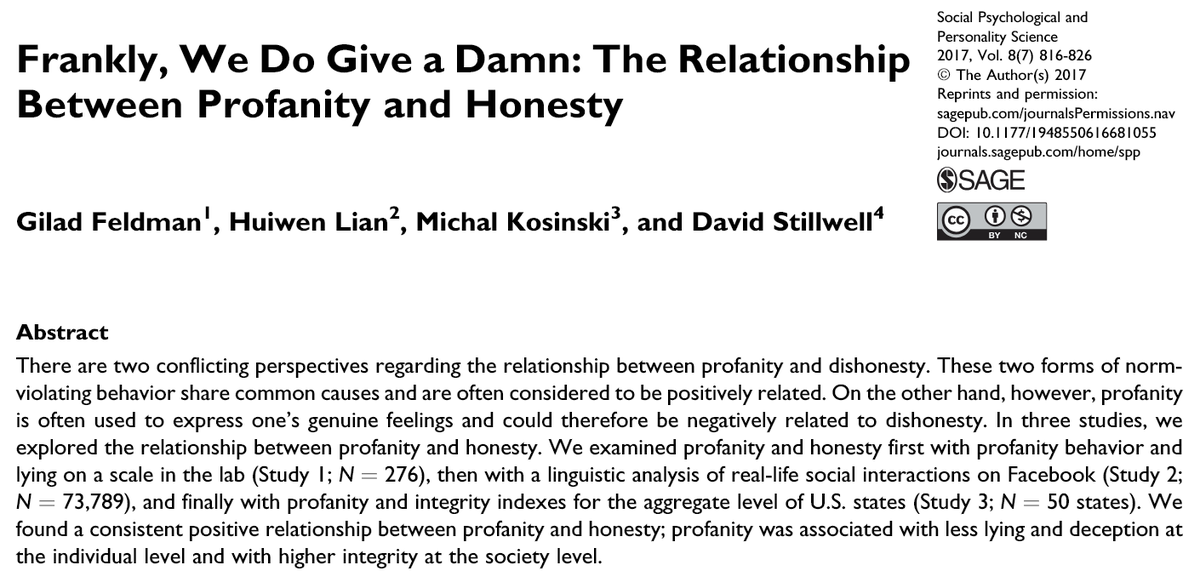
Cursing is rarely a symbol of low class. It's often a mark of high authenticity.
Evidence: Swearing predicts higher rates of honesty and integrity. It signals a willingness to prize candor over courtesy.
A little profanity shows that you're being real and you do give a damn.
@isaacrrr7 independientemente de que sea musulmana, cristiana o que adore el pastafarismo... un parque de atracciones no es un sitio para rezar, para eso ya estan los templos
@ramseyferrero79 de verdad? trolea a la pobre niña que solo quiere su zumo hasta el punto de hacerla llorar... y le da igual, lo importante son los likes...
todo mal, muy MAL