Excited Adobe’s @semrush acquisition now complete! Looking forward to working with @aramisguru
& team to help brands win in GEO and AI search — especially with @aleyda recent poll showing 47% skepticism https://t.co/y6uSIo4BVy
In 2023-24, big software and tech companies thought they could build their own AI products and features
In 2024-25, many realized they could not.
In 2025-26, this should lead to a whole wave of acquisitions of AI startups (which has already started).
Well, after 12 years of writing blogs complaining about various parts of the AEM ecosystem, I finally have my first article up on an @adobe domain! https://t.co/wkkuP98HWW
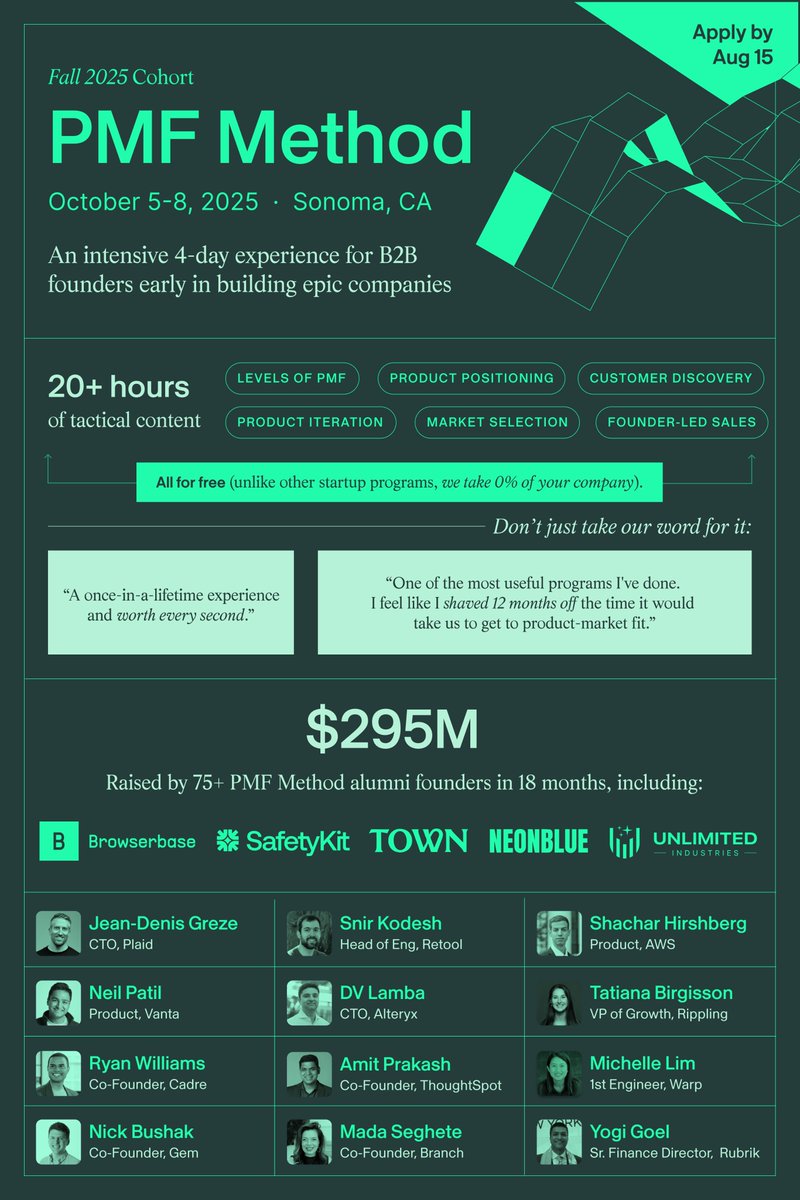
Opening up Fall 2025 applications today for @firstround’s PMF Method! If you’re exploring early B2B ideas, it’s the single best way to de-risk the jump. It’s completely free (we take 0% of your company) and only 4 days. And you’d be in good company.
Previous PMF Method founders are a seriously impressive bunch. They’ve collectively raised $295M+ (and most of the companies are <18 months old). Almost half are building their second company (many previously started unicorns). The rest are CTOs and senior leaders from companies like Stripe, Plaid, Rippling, Anthropic, Neuralink, Retool & Vanta.
Alongside builders like these, you’ll learn what it took legendary companies months (or years) to figure out on their own:
- How to run customer discovery that actually validates willingness to pay
- Whether your market can support a venture-scale business
- How to land your first enterprise contracts
- When it’s time to pivot
Here are a few key dates and details:
- The Fall 2025 PMF Method cohort runs 10/5 - 10/8.
- Application deadline is 11:59pm PDT 8/15.
- For early B2B SaaS founders, whether you’ve been working on an early idea for the past year, or you’re still at your day job, a few months away from leaving to start your company.
- You don’t have to be based in SF, just need to be able to get to Sonoma.
- If you’re in, you’ll know by 9/12 at the latest.
The app only takes 10 minutes, so don’t overthink it, just apply. (If previous cohorts are any indication, we’ll likely see thousands of founders apply for ~30 spots.)
More below 👇
Coinbase = infrastructure. We're excited to partner with @PNCBank via our Crypto as a Service platform, enabling PNC clients to trade crypto and use USDC.
We're powering >240 banks, brokers, fintechs, exchanges, and PSPs, and on a mission to help arm the FIs to build leading crypto products for their clients in every major geo around the world. 📈🌎
Spot trading. Regulated futures. Perps. Trade finance. Subcustody. Non custodial wallets. Embedded payments. USDC. Base. Tokenization. And more...
Founders: This is your micro memo for making your first $1M in revenue.
Real advice from leaders who’ve done it — from closing your first deal yourself to focusing on the right customers.
Get the full guide: https://t.co/DwM993Lze7
Generative AI’s (gen AI) transformative potential promises to revolutionize business and propel up to $4.4 trillion in economic impact annually according to McKinsey
https://t.co/p7MDqPLIoh
@JayaGup10 Intrigued to see follow up on how teams are making the point of intervention, or data capture, as seamless as possible. Methods for recording all of these touch points feels a little clunky right now from the limited tech I have had my hands on in the selling process.
I think the Deepseek moment is not really the Sputnik moment, but more like the Google moment.
If anyone was around in ~2004, you'll know what I mean, but more on that later.
I think everyone is over-rotated on this because Deepseek came out of China. Let me try to un-rotate you.
Deepseek could have come out of some lab in the US Midwest. Like say some CS lab couldn't afford the latest nVidia chips and had to use older hardware, but they had a great algo and systems department, and they found a bunch of optimizations and trained a model for a few million dollars and lo, the model is roughly on par with o1. Look everyone, we found a new training method and we optimized a bunch of algorithms!
Everyone is like OH WOW and starts trying the same thing. Great week for AI advancement! No need for US markets to lose a trillion in market cap.
The tech world (and apparently Wall Street) is massively over-rotated on this because it came out of CHINA.
I get it. After everyone has been sensitized over the H1BLM uproar, we are conditioned to think of OMG Immigrants China as some kind of Alien Other. As though the Alien-Other Chinese Researchers are doing something special that's out of reach and now China The Empire is somehow uniquely in possession of Super Efficient AI Power and the US companies can't compete. The subtext of "A New Fearsome Power Now Under The Command of the CCP" is what's driving the current sentiment, and it's not really valid.
Like, no. These are guys basically working on the same problems we are in the US, and not only that, they wrote a paper about it and open-sourced their model! It is not actually some sort of tectonic geopolitical shift, it is just Some Nerds Over There saying "Hey we figured out some cool shit, here's how we did it, maybe you would like to check it out?"
Sputnik showed that the Soviets could do something the US couldn't ("a new fearsome power"). They didn't subsequently publish all the technical details and half the blueprints. They only showed that it could be done.
With Deepseek, if I recall correctly, a lab in Berkeley read their paper and duplicated the claimed results on a small scale within a day.
That's why I say it's like the Google moment in 2004. Google filed its S-1 in 2004, and revealed to the world that they had built the largest supercomputer cluster by using distributed algorithms to network together commodity computers at the best performance-per-dollar point on the cost curve.
This was in contrast to every other tech company, who at that time just bought what were essentially larger and larger mainframes, always at the most expensive leading edge of the cost curve. (To the young people reading this, this will sound incredible to you)
I worked at PayPal at the time, and in order to keep pace with the rising transaction volume, the company was forced to buy bigger and bigger database servers from Oracle. We were totally Oracle's bitch. At one point when we ran into scalability issues, the Oracle reps told us we were their biggest installation so they had no other reference point on how to help us overcome our scalability issues. We literally resorted to flipping random config switches and rebooting it.
(This heavily influenced me when I was a young manager later at Facebook. I deliberately torpedoed an Oracle salesman's pitch to try and get us to switch from open source MySQL databases to an Oracle contract: of course we had scalability problems, but at least when we had them, we could open up the hood and figure out how to fix it ... assuming we had good enough engineers, and we did. When it's closed-source infra, you're at the mercy of the vendor's support engineers)
Back to Google - in their S-1, they described how they were able to leapfrog the scalability limits of mainframes and had been (for years!) running a far more massive networked supercomputer comprised of thousands of commodity machines at the optimal performance-per-dollar price point - i.e. not the more expensive leading edge - all knit together by fault-tolerant distributed algorithms written in-house.
Some time later, Google published their MapReduce and BigTable papers, describing the algorithms they'd used to manage and control this massively more cost-effective and powerful supercomputer.
Deepseek is MUCH more like the Google moment, because Google essentially described what it did and told everyone else how they could do it too. In Google's case, a fair bit of time elapsed between when they revealed to the world what they were doing and when they published a papers showing everyone how to do it. Deepseek, in contrast, published their paper alongside the model release.
Now, I've also written about how I think this is also a demonstration of Deepseek's trajectory, but that's also no different from Google in ~2004 revealing what it was capable of. Competitors will still need to gear up and DO the thing, but they've moved the field forward. But it's not like Sputnik where the Soviets have developed technology unreachable to the US, it's more like Google saying, "Hey, we did this cool thing, here's how we did it."
There is no reason to think nVidia and OAI and Meta and Microsoft and Google et al are dead. Sure, Deepseek is a new and formidable upstart, but doesn't that happen every week in the world of AI? I am sure that Sam and Zuck, backed by the power of Satya, can figure something out. Everyone is going to duplicate this feat in a few months and everything just got cheaper. The only real consequence is that AI utopia/doom is now closer than ever.
====
Bonus: This is also a little similar the Ethereum PoS moment, when AI finally has a counterpoint to the environmentalists who say AI uses so much electricity. We just brought down the cost of inference by 97%!
Why do I keep seeing online retailers let me order but not actually have the stock. Does a firm as large as @adidas really not have inventory up to date? "order cancelled"
apparently most of Twitter hates Ken Griffin but he just helped secure Pochettino for USMNT head coach🎊 Anyone know how much the donation was? https://t.co/Nadygx4kmL
In less than 1 week, we'll be tabling at #SBW2024! Join us at the ultimate conference for the #Boston and #NewEngland#startup ecosystem.
💼 100+ sessions
📅 5 days of learning
🤝 7,000+ connections
🎟️ Free tickets: https://t.co/L9xe9WWL4l
Join us 9/9, 12-1:30 pm @Suffolk_U