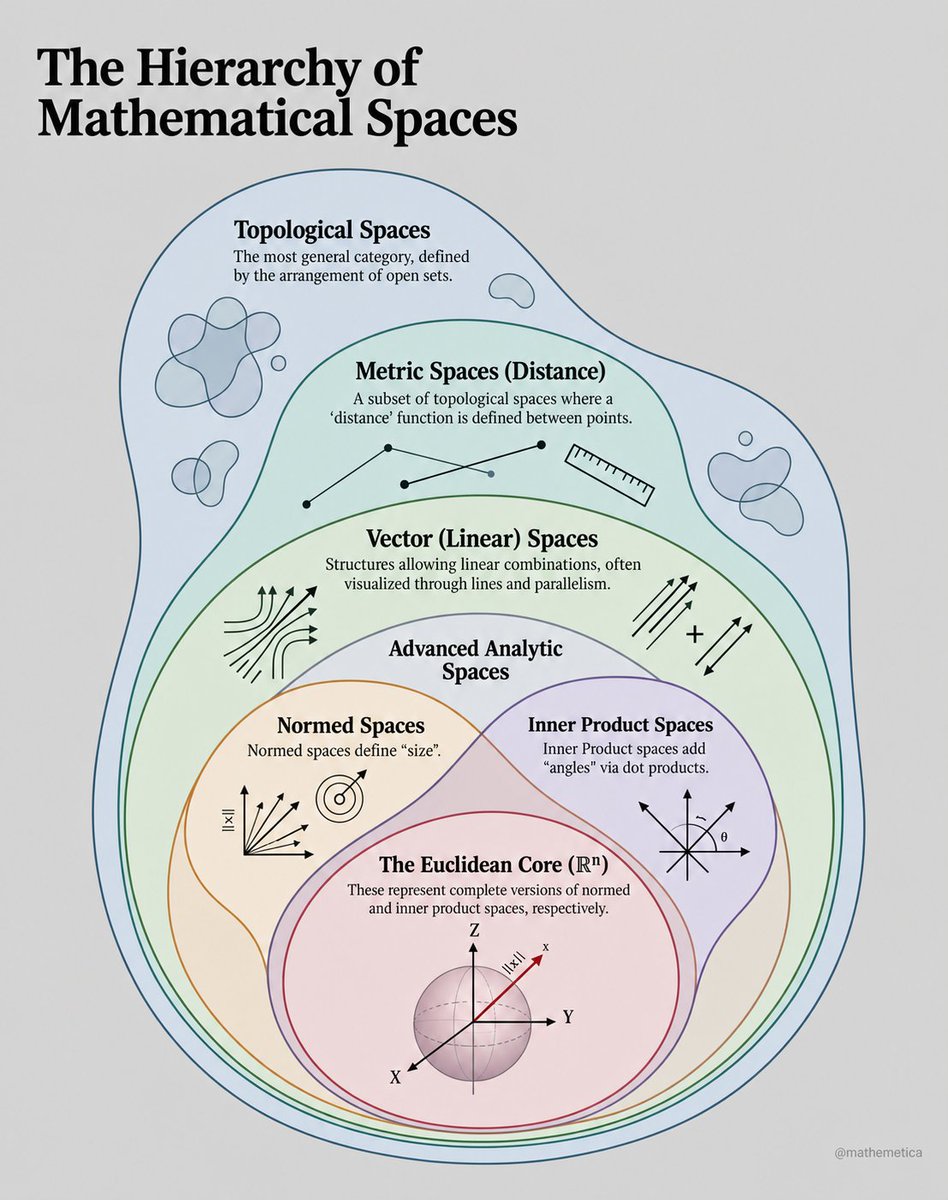
Ever get lost in all those mathematical “spaces”?
This beautiful diagram maps the full hierarchy from the wildest to the most familiar. Topological spaces are defined only by open sets. Metric spaces add distance. Vector spaces allow linear combinations. Normed spaces measure size while inner product spaces add angles.
At the core sits Euclidean R^n, the complete geometry of our everyday world.
me whenever i see what i believe to be a contradiction or a logical error in a proof. Either because the argument is too compact, or i just don’t get it. Lol
A valiant effort indeed, but it seems RH is overwhelmingly too difficult even for frontier models. It did create a commendable opening though. And who knows, maybe such openings could be used as lemma for future’s sake.
We asked an unreleased research version of Claude to take a stab at the Riemann hypothesis.
It didn’t solve it, but it did make strides on a related problem: it increased the lower bound for the fraction of zeros of the Riemann zeta function that satisfy the hypothesis from 41.6% to 67.2%.
https://t.co/aZDvqqhHRi
@ABSCBNNews@JervisManahan This is the exact problem of PhilHealth eh. It’s basically a health insurance corporation so why not appoint an actuary to be its CEO?
While the Fields Medal celebrates the under-40s, the mathematician Joan Birman has, at the age of 99, solved a major open problem in representations of the Braid groups, a topic she has worked on for more than 60 years.
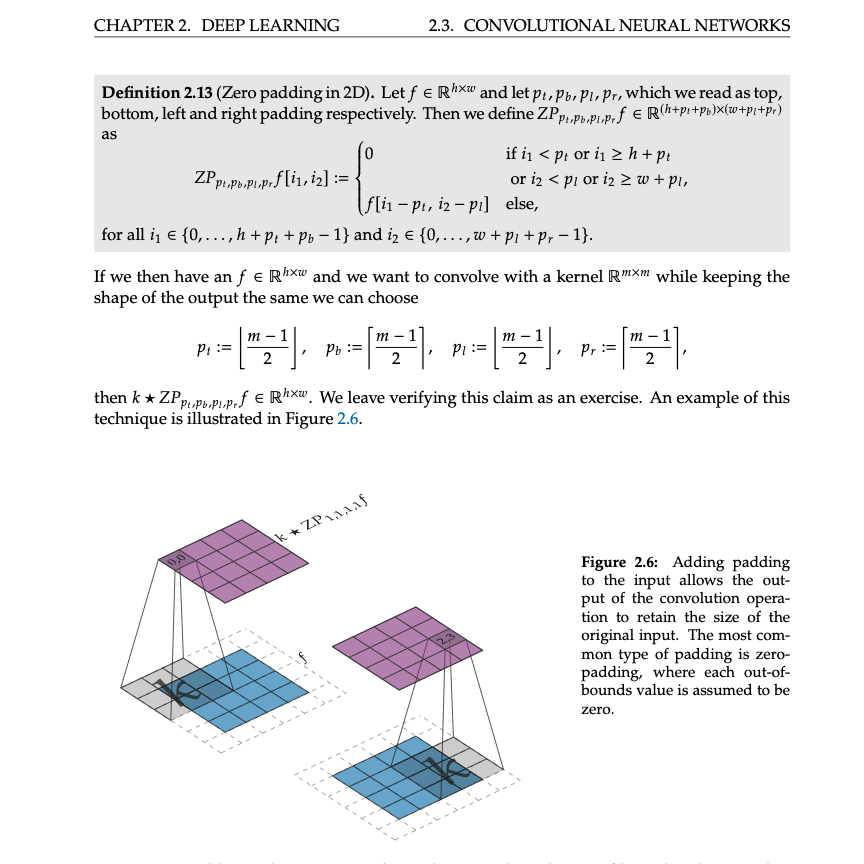
"Mathematics of Neural Networks" is a concise introductory text that presents deep learning from a mathematical perspective.
It progressively introduces the fundamental concepts behind modern neural networks, including supervised learning, artificial neurons and activation functions, feed-forward networks, stochastic gradient descent, deep neural networks, weight initialization, convolutional neural networks, automatic differentiation and backpropagation, optimization algorithms such as Adam, RMSProp, and Adagrad, as well as an introduction to equivariance, Lie groups, homogeneous spaces, and geometric deep learning.
It is a practical, accessible resource for students and anyone who wants to build a solid mathematical foundation in neural networks before moving on to more advanced texts. Although introductory, it maintains a rigorous approach and provides valuable insight into the mathematical principles underlying modern deep learning systems.
https://t.co/IpWzlJzfQW
@martinmrmar They are prolly using this convention (at least for Gallian tho).
ϕ(A) ⊆ ran(ϕ), instead of ran(ϕ) ⊆ codom(ϕ)
so that they won’t use the term “codomain”
AI is going to make massive progress in pure math, accomplishing decades of human work in the next 2-3 years, and nobody will care because progress in pure math is completely useless
@dahliarchives_ Maybe we should make it a mandatory requirement for each college degrees to at least have a full calculus sequence (calculus 1-3) regardless of major.
It would have been fun that way, I supposed.
@dahliarchives_ The error here is merely an arithmetic error. It should have been positive 2/3. But those people saying na mali dahil no such thing as a negative na area, well, sorry but negative areas do actually exists in calculus. They’re called signed areas because they fall below +x axis.
What if you have three or more variables, say 5? I doubt if this technique would work. It would be more easier if we just multiply by its multiplicative inverse.
Say if you are solving for current liabilities just multiply both sides by current liabilities times 1/current ratio
alam niyo super helpful ng magic triangle sa akin since junior high. sa math teacher ko talaga natutunan yan, inapply ko lang sa finman nung college tapos gumagana naman siya HAHAHAHA di ko need sauluhin lahat ng formula basta may space ako para magdrawing ng triangle sa papel 😆