@nietras1@EgorBo Yeah I have kinda the same opinion, unless there happens to be some roslyn fixer which automatically applies the lowest valid combination of unsafe, I kinda doubt I will use that much.
@lucasmeijer@xoofx Yup, I went straight to roslyn analyzers for a lot of weird code GPT 5.4/5.5 produces. static mutables, lock() in quite a few places, abstract base classes with all the Code instead of one concrete type etc.
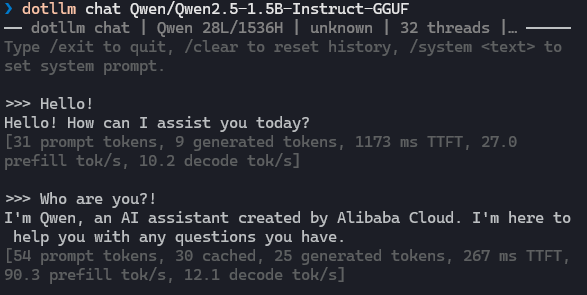
I've built a full LLM inference engine in C#/.NET 10. From scratch. Not a wrapper - native GGUF loading, BPE tokenizer, attention, KV-cache, SIMD-vectorized CPU kernels, CUDA GPU backend, OpenAI-compatible API. Solo dev, ~2 months, AI-assisted (not vibe-coded!). First preview is out.
Check it out for mode details at https://t.co/Bl5wAYalYY and https://t.co/rQWhKN0iVA
AI is unlikely to cure cancer. I think we might make significant scientific and medical progress in the near future, but it is important to understand the state we are in.
We are in a decade-long scientific stagnation. Outside of computing, progress is historically slow. We struggle to find who should receive a Nobel prize in Chemistry or Physics.
Some will tell you that we have simply exploited all the low-hanging fruits. Somehow, just as the 1970s arrived, we reached the apogee of scientific progress.
I have another much more credible explanation.
Let us examine stagnations in general.
During the 2010s, we lamented the stagnation in microprocessors. Our CPUs ran hot, and they were no longer much faster. "We reached the end, processors won't get much better from now now". It turns out that the dominant player (Intel) was the one stagnating.
This was unthinkable. Intel had the best engineers, the best technology in the world. Surely, if you could do much better, someone would have done it by now?
Turns out that Apple, AMD and others eventually did. It just took time.
What about Alzheimer's? One researcher, Sylvain Lesné, published a paper entitled "A specific amyloid-β protein assembly in the brain impairs memory". The paper had made up images although it took some time before everyone learned about the fraud. Meanwhile, somehow, everyone in the world accepted that Alzheimer's was cased by amyloid-β proteins. Every other avenue was closed. It is only after we invested billions to dollars to create drugs capable of eliminating these proteins, and more money yet to engage in clinical trials, that doubts emerged: it does not work. Why doesn't it work?
See the pattern? There is one unified culture with everyone thinking along the same lines.
Thomas Kuhn described science as having “normal science,” which is largely incremental and sterile, and “revolutionary science,” where new ideas emerge and paradigms are challenged. He wrote about this in The Structure of Scientific Revolutions (1962).
If you want to cure cancer or Alzheimer's, you need revolutionary science, not the other kind.
So how do you get revolutionary science? You cannot buy it. We multiplied the number of researchers in the last century, and we have little to show for it.
So why did we start getting less and less revolution science in everything but computing starting in the 1970s?
The decline in revolutionary science outside computing since the 1970s stems from increased government bureaucracy and government funding models, resembling Soviet-style five-year plans. It is when "peer review" became the norm. It is when credentialism and technocracy took charge. While not all science is sterile, much is constrained by this cultural shift. Changing it is tough but possible—revolutionary breakthroughs often come from a few determined scientists and engineers, not masses.
To get out of this stagnation, we need to spread a better culture. It would be useful to kill the 'linear model of innovation' (that all progress originates from university professors thinking hard in their offices). We need to greatly diminish the role of peer review. We need to greatly diminish the role of PhD programs: stop the focus on credentialism. It is should flat out embarassing to ask a scientist to write a 5-year plan.
@dodyg Closed everything. I like the enum stuff, not sure about closed as another modifier, but not having to do the ArgumentOutOfRange Exception dance would be nice
@EgorBo@ben_a_adams@neuecc It appears to be that the typeof(T) == typeof(byte), https://t.co/IQqcc4UEX7 code and similar code by now generates the same asm.
https://t.co/By3jyMK0bp