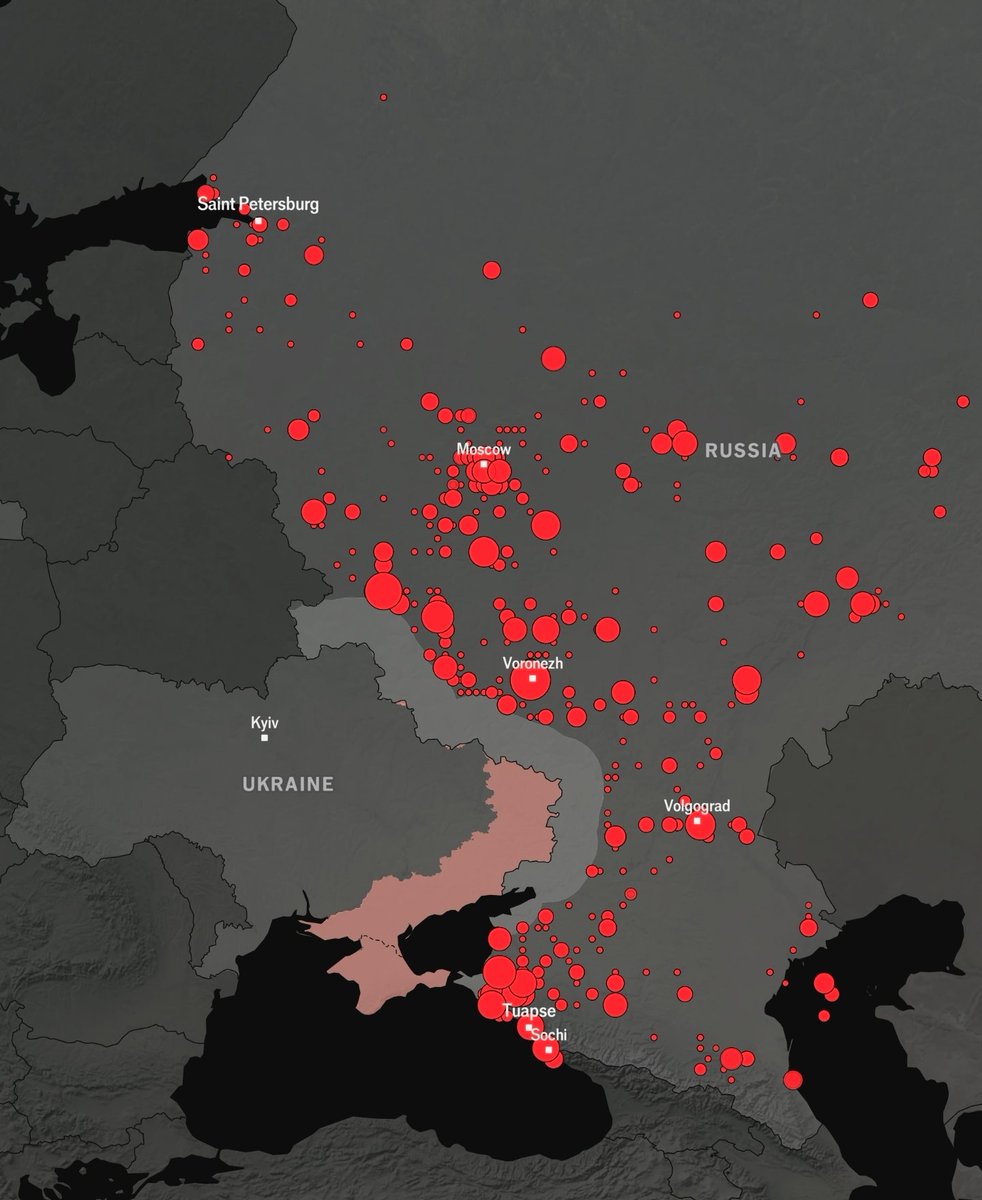
“Ukraina har et nytt militært overtak over Russland, for andre gang siden fullskala invasjonen. Men Kyiv advarer om at dette mulighetsvinduet er kortvarig.”
https://t.co/SItRhYIX6B
TV Pirveli reports it has obtained exclusive footage allegedly showing police officers systematically beating and torturing detainees in order to extract desired testimonies.
According to the broadcaster, the videos were recorded by the officers themselves and shared in an internal group chat. The individual who allegedly downloaded the footage was later arrested. More information will be released on Saturday night.
Let me illustrate how bad things are this time when it comes to the fuel shortage. In the capital of Tatarstan, Kazan, the gas station chain of the Tatarstan region owned Tatneft oil company, which has its own refinery, doesn't have not just gasoline but also diesel.
Updated map of the regions of Russia where there are shortages of gasoline or diesel. As always it's worse in the occupied territories. Added 9 regions making it 14 for the week, a record. Kemerovo, Khabarovsk, Volgograd, Ulyanovsk, Amur, Astrakhan, Ivanovo, Kaluga and Kursk.
Russernes forsyningslinjer over okkupert ukrainsk territorium er hyppige mål for ukrainske droner med forbedrede motorer og batterier, effektiv bruk av kommunikasjonssystemet Starlink og nye KI-funksjoner. https://t.co/0tc13KR0FI
The Economist has published an excellent article titled “Ukrainian strikes are inflicting pain deep inside Russia,” which describes the impact of strikes deep within Russian territory. The publication conducted its own analysis of the data — and the findings for Ukraine are simply outstanding. I’ll break down the key points.
“We looked at data on 1,289 Ukrainian strikes from the Armed Conflict Location and Event Data project (ACLED), a monitoring group, on targets that were at least 100km from its borders. From 2022 to the end of 2024, 335 strikes fit this definition. In 2025 Ukraine completed 658 such strikes—almost twice as many in a single year as the previous three combined. This year, at the current pace, Ukraine is on track to execute over 800 deep strikes.”
These figures mean one simple thing: our deep-strike program is not growing gradually, but exponentially. What used to take years is now being accomplished in months. And the reason is clear — we have our own defense industry, which has reached mass production scale and no longer depends on foreign permits or supplies.
In addition to the number of strikes, their geographic scope is also growing steadily:
“The coverage of Ukraine’s campaign is expanding, too. We compiled an inventory of 6,351 Russian strategic sites located at least 100km from the border, drawing on open-source intelligence and reports from energy monitors. We found that 2,377 of these sites were within 5km of a deep Ukrainian strike reported by ACLED last year. That compares with just 32 in 2022.”
At the same time, the publication honestly acknowledges that even these figures provided by ACLED are underestimated and builds its own model based on satellite data:
“Over the course of 2025 our model flagged roughly three times as many strikes as ACLED recorded.”
The actual scale of our operations is so vast that even professional monitoring groups can no longer keep up with it. And separately, The Economist highlights our tactics of repeated strikes on the same targets — this is exactly how we operated in Tuapse, at the St. Petersburg terminals, and at “VNIIR-Progress” in Cheboksary.
“First, it makes quick repairs harder... Repairs are costly, diverting funds that would otherwise flow to the military and civilian economy. Russian central-bank data shows that, since the first quarter of 2024, bank lending to oil companies for refinery operations has grown by $22bn.”
$22 billion — just to patch the holes left by our drones and missiles. Every repeat strike wipes out the previous repairs and forces them to start over. This is money that the Kremlin is taking out of the war against us and burying in its own ruins.
“This spring Russian oil refinery production was 15% lower than the year before, despite high prices. The government has put limits on exports of gasoline and jet fuel to avoid shortages... Russia may have to cut oil production later this year because it will not be able to process or sell all the crude it produces.”
Pay attention to the last point. We are no longer talking about temporary gasoline shortages — we are talking about the prospect of a reduction in extraction itself. It is important to understand that, given the current situation, Russia will not be able to simply reopen closed wells, and this represents a massive loss.
“Between June and December 2025, the country’s fossil-fuel export revenues were $18bn, or 12% lower than would normally be expected. In the first four months of 2026, they were 34% lower.”
A 34% drop in oil and gas revenues in just four months of this year. This is money that will not be spent on “Shaheds,” “Iskanders,” or salaries for the occupiers.
It was also noted that Ukraine is rapidly advancing technologically:
“Its new Flamingo cruise missile has a reported range of 3,000km, and its ballistic missiles may soon enter serial production.”
It is very important that all these narratives are a cold analysis by one of the world’s most authoritative business publications, based on satellite data, banking statistics, and independent models. And this analysis confirms: the strategy of deep strikes is working, and it is working systematically.
All of this has been achieved using our own weapons, which are not subject to any foreign “red lines.” While our partners spent years debating where to strike and where not to, often due to information leaks during prolonged preparations, Russia was prepared for the attacks. Now we have built a weapon that can reach the enemy 3,000 kilometers away and has already drained tens of billions of dollars from the Russian budget.
Hot Take: Ukraine is setting conditions to force Russia to restart fuel shipments to occupied Crimea using the railroad section of the Crimean Bridge. Because hitting a fuel train and causing another concrete-destroying, steel-melting, BLEVE is much easier than destroying the bridge itself.
All evidence suggests that Ukraine has advanced further than any map currently depicts north of Lyman. Russians say Ukraine has captured towns and other areas that were once firmly held are now contested. I try to keep my map to only verified facts so I am far more conservative.
1/3 Russia constructed a pontoon bridge on June 7 after a Ukrainian strike damaged the main bridge at Chongar, which connects Crimea and Kherson Oblast. This can be seen by comparing @planet satellite images taken on June 6 and 7.
Minst det tredje angrepet mot fabrikken så langt i år, hvis jeg ikke tar helt feil. Også angrepet med Flamingo i starten av mai, og et angrep i februar.
Viktig fabrikk for den russiske krigsmaskinen, så får vi se om den nå er satt ut av spill eller om de klarer å gjenoppta produksjonen relativt raskt.
🇳🇴 I was invited to speak at the Oslo Freedom Forum (@OsloFF) about the Orbán regime and what these past sixteen years were like for a journalist—especially the staggeringly turbulent election campaign. I sat down with outstanding colleagues from Georgia, Iran, and Ukraine to discuss our work inside the authoritarian regimes whose abuses we documented, and which made us targets of state power ourselves.
🇬🇪 @irmadimitradze, journalist at the independent Georgian outlet @Batumelebi_ge, spoke about the repression carried out by the pro-Kremlin Georgian Dream regime. Ahead of the 2024 Georgian parliamentary elections, she led an investigation that exposed how Georgian Dream harvested the sensitive personal data of tens of thousands of citizens from various state databases for its political campaign. The regime has since imprisoned the outlet's founder and director, @MziaAmaglobeli—Georgia's first female political prisoner since the country's 1991 independence, and one of last year's recipients of the Sakharov Prize, among other honors.
🇮🇷 @roxanasaberi, an Iranian-American independent journalist, was unlawfully imprisoned by the Iranian regime for one hundred days in 2009 at Tehran's Evin Prison and then forced into exile. Together with her colleagues, she has continued documenting the terror of Iran's theocratic regime ever since—including this year's bloody crackdown on mass protests. She described, for instance, how they obtained X-rays and other medical records from Iranian doctors that provided black-and-white proof of killings and abuses by Iranian security forces.
🇺🇦 Oksana Romaniuk (@Sanatja), director of Ukraine's Institute of Mass Information (IMI), laid out how her team has been documenting Russia's deliberate targeting of journalists and reporters as a war crime ever since the invasion began. As she put it during our panel: PRESS vests no longer offer journalists any protection in the conflict zone—on the contrary, they now mark them as targets for the Kremlin. Beyond documenting these cases, IMI has built a support network of fifteen regional media hubs for journalists working under wartime conditions.
🇭🇺 Sitting alongside them, I have to admit I felt distinctly out of place. The Orbán government has fallen in the meantime, the espionage charges the government filed against me have been dropped, and—as far as I can tell—the intelligence surveillance that targeted me over the past decade has finally ended.
I recalled what it had been like to investigate Russian influence operations and intelligence activities in Hungary and across the region for @VSquare_Project—and how Hungary's EU and NATO membership meant that even if the previous government's leaders may have considered it, they weren't yet in a position to crack down on journalists the way the regimes in the other panelists' countries do.
Listening to them, I felt extraordinarily lucky—both personally and as a Hungarian—that with the fall of the Orbán regime, Hungary has hopefully escaped the Russian sphere of influence, where official and physical attacks on journalists would likely have been only a matter of time.
Statsminister Nikol Pasjinjan og hans proeuropeiske parti Borgerkontrakt vant en klar seier i parlamentsvalget i 🇦🇲Armenia. – Et stort tilbakeslag for Putin og russisk innflytelse, sier Lene Wetteland i Den norske Helsingforskomité til Nettavisen. https://t.co/iPJk76cOEe
OSCE says Armenia's election was largely free and fair. "Armenia’s voters were given – and took – the opportunity to make a genuine choice in a professionally managed election process and a vibrant and pluralistic, if often highly polarized campaign." https://t.co/FGcZeH9HaY
Warmest congratulations to @NikolPashinyan! Today, Armenia firmly chose a free, independent & European future. This historic vote reinforces democracy and solidifies our region’s place in the family of European nations. 🇬🇪🤝🇦🇲
Mannen bak det «globale krigspartiet» gratulerer Pashinyan med seieren mens under fem prosent av stemmene er telt opp 🙃
Skal sies at Orban gjorde omtrent det samme for Georgisk Drøm i 2024, og det fungerte jo
Heartfelt congratulations to PM @NikolPashinyan on his party's success in the elections. Looking forward to continuing our close cooperation to strengthen the strategic partnership and friendly relations between Georgia and Armenia for the prosperity of our nations 🇬🇪🇦🇲